Every Confirmed SA Fibre Price Increase in 2026, Network by Network
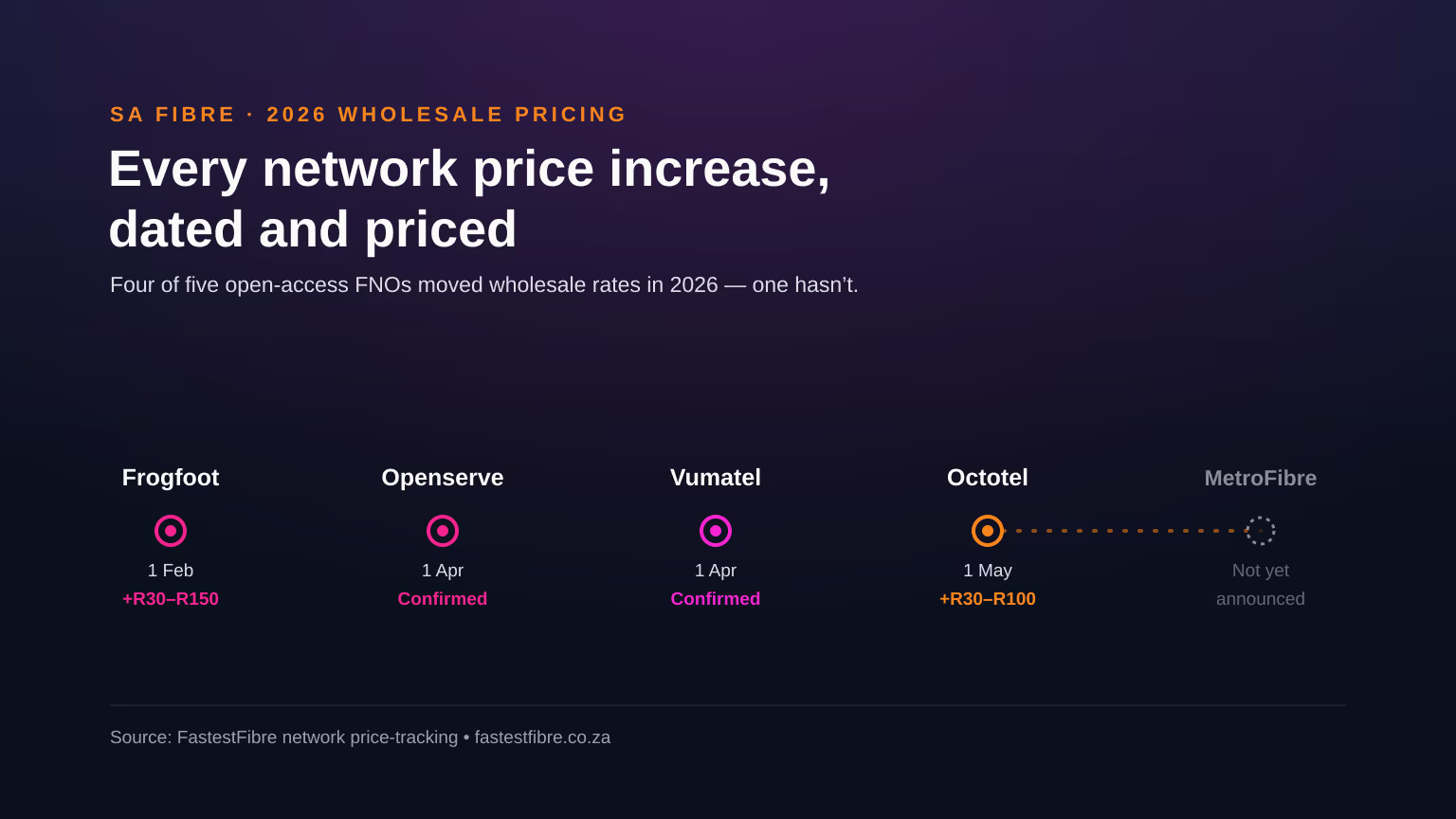
Frogfoot in February, Openserve and Vumatel in April, Octotel in May - and MetroFibre still to come. Here's every confirmed 2026 wholesale fibre price change in South Africa, with full price tables, dates and what to check on your own invoice.
In this article(11)
- 01A year of wholesale price changes, one network at a time
- 02The full 2026 timeline at a glance
- 03Frogfoot: the first mover, effective 1 February 2026
- 04Openserve and Vumatel: the same date, two very different approaches
- 05Octotel: a price change and a lineup reshuffle, effective 1 May 2026
- 06MetroFibre: confirmed, in two separate moves
- 07Why all five networks moved in the same year
- 08How to check what actually changed on your own invoice
- 09Switch ISP, switch network, or just downgrade?
- 10What's left to watch in 2026
- 11Frequently asked questions
A year of wholesale price changes, one network at a time
If your fibre bill has crept up at some point in 2026, you're not imagining it - and you're probably not alone, whichever network your line actually runs on. Between February and June 2026, all five of South Africa's major open-access fibre network operators (FNOs) - Frogfoot, Openserve, Vumatel, Octotel and MetroFibre - confirmed and implemented their own wholesale price change. We've covered Openserve's April increase, Vumatel's April increase and MetroFibre's June increase in detail elsewhere on FastestFibre - the MetroFibre piece also corrects an earlier version of this article, which listed MetroFibre as the one network that hadn't moved yet. This piece does something different: it pulls every confirmed 2026 network price change into one place, in date order, so you can see the full picture regardless of which network your ISP resells.
A quick note on how fibre pricing actually works, since it explains why this happens on a rolling basis rather than all at once. Frogfoot, Openserve, Vumatel, Octotel and MetroFibre are all open-access FNOs - they build and own the physical fibre in the ground but don't sell directly to households. Instead they sell wholesale access to dozens of ISPs (Afrihost, Webafrica, MWeb, Cool Ideas, Vox, RSAWeb, Atomic and many more), who each add their own margin and resell the line to you. Each FNO reviews its own wholesale rate card on its own schedule - typically once a year - which is why these changes land in a staggered sequence rather than a single industry-wide event.
The full 2026 timeline at a glance
Here's every confirmed 2026 wholesale price change, in the order it took effect:
| Network | Effective date | Typical increase | Status |
|---|---|---|---|
| Frogfoot | 1 February 2026 | R30-R150/month | Confirmed & live |
| Openserve | 1 April 2026 | R20-R60/month | Confirmed & live |
| Vumatel | 1 April 2026 | Varies by tier, unpublished | Confirmed & live |
| Octotel | 1 May 2026 | R40-R50/month (most tiers) | Confirmed & live |
| MetroFibre | 1 June 2026 (wholesale); 1 May 2026 (MetroConnect prepaid) | Avg +5.29% wholesale; +18-25% MetroConnect | Confirmed & live |
Below, each network gets its own section with the actual numbers where they've been published, plus what to do about it if your bill went up.
Frogfoot: the first mover, effective 1 February 2026
Frogfoot was first out of the gate in 2026, confirming a wholesale FTTH and interconnect price increase effective 1 February 2026 - its first change in about a year. The increase applied across its full home fibre range, with the rand increase scaling up at the faster, asymmetrical mid-tiers rather than following a flat percentage:
| Speed tier | Old price | New price | Increase |
|---|---|---|---|
| 60/30 Mbps | R799 | R839 | +R40 |
| 60/60 Mbps | R889 | R929 | +R40 |
| 120/60 Mbps | R999 | R1,069 | +R70 |
| 120/120 Mbps | R1,019 | R1,069 | +R50 |
| 240/120 Mbps | R1,149 | R1,299 | +R150 |
| 240/240 Mbps | R1,249 | R1,299 | +R50 |
| 400/200 Mbps | R1,399 | R1,499 | +R100 |
| 400/400 Mbps | R1,459 | R1,499 | +R40 |
| 1000/500 Mbps | R1,729 | R1,799 | +R70 |
| 1000/1000 Mbps | R1,769 | R1,799 | +R30 |
Frogfoot's ISP partners were notified with a deadline of 22 January 2026 at 14:00 for customers who wanted to upgrade, downgrade or cancel before the new rates locked in, with new pricing invoiced from 24 January and taking effect on customer accounts from 1 February. Frogfoot framed the increase around rising line and interconnect costs, and said proceeds would go toward network expansion and enabling more package options above 1Gbps.
The 240/120 Mbps tier stands out as the biggest single jump in the table - R150/month, more than double the increase on the tier either side of it - which is worth specifically checking if that's your package. If you're on Frogfoot and want to see what other ISPs charge for the same tier on the same line, compare live pricing on our Frogfoot fibre deals page.
Openserve and Vumatel: the same date, two very different approaches
South Africa's two largest fibre networks both moved on 1 April 2026 - each implementing their first wholesale price change in twelve months, but publishing the change very differently.
Openserve published a clear, tier-by-tier rate card change ranging from R20/month at its 50/25 Mbps entry uncapped tier up to R60/month at its fastest 500/250 Mbps line - a jump of roughly 2.5% to 4% depending on tier. Its cheaper Web Connect and 20/10-30/30 Mbps entry lines weren't touched by this specific change. We've broken the full table down, along with a checklist for your own invoice, in our dedicated Openserve price change explainer.
Vumatel, by contrast, didn't publish an exact rate card - the increase varied by tier and wasn't uniform, with entry-level Reach products (aimed at the underserved-area and township segment) seeing a smaller adjustment than mid-tier Core packages. What's consistent with Openserve's approach is that the size of the actual increase on your invoice depends heavily on which ISP resells your line - some, like Atomic, publicly said they'd absorbed part of the increase rather than pass it on in full, while others passed the wholesale change straight through. The full breakdown, including what to check on your own bill, is in our Vumatel April 2026 price change piece.
The practical takeaway from both networks moving on the same date: don't assume two households on the same network, same tier, saw the same increase. The ISP layer, not just the network, decides the final number.
Octotel: a price change and a lineup reshuffle, effective 1 May 2026
Octotel's turn came on 1 May 2026, twelve months after its previous home fibre price update. Unlike the other three networks, Octotel used the moment to change its product lineup as well as its prices:
| Speed tier | Old price | New price | Note |
|---|---|---|---|
| 25/25 Mbps (promo) | R649 | R699 | New customers only |
| 55/25 Mbps | R759 | R799 | Standard |
| 55/55 Mbps | - | R849 | New tier |
| 100/100 Mbps | R959 | R989 | Standard |
| 150/150 Mbps | R1,089 | R1,139 | Being phased out |
| 300/200 Mbps | R1,259 | R1,299 | Standard |
| 500/200 Mbps | R1,429 | R1,479 | Standard |
| 1000/200 Mbps | R1,729 | R1,789 | Standard |
| 2500/2500 Mbps | R2,349 | R2,349 | No change |
Two changes are worth calling out beyond the price increases themselves. First, Octotel introduced a new 55/55 Mbps symmetrical tier at R849/month, sitting between its 55/25 Mbps and 100/100 Mbps packages - a genuinely new option for households that want symmetrical upload for video calls or cloud backups without paying for a 100 Mbps line. Second, its 150/150 Mbps tier is being phased out for new orders; existing customers on it keep the package but move to the new price shown above.
Octotel's top 2500/2500 Mbps line was the one tier left untouched at R2,349/month, and its ISP partners had until 24 April 2026 at 14:00 to process upgrade or downgrade requests before the new pricing took effect. If Octotel is live at your address, see current retail pricing across ISPs on our Octotel fibre deals page.
MetroFibre: confirmed, in two separate moves
MetroFibre has now confirmed a 2026 wholesale price increase, correcting an earlier version of this article that listed it as the one network still holding the line. MetroFibre's wholesale increase averaged 5.29% across all products (maximum 7.76%, entry-level packages just 1.96%-2.90%), effective 1 June 2026 for most existing customers - new month-to-month sign-ups on its Nova and Nexus networks were already on the new pricing from 1 April. MetroFibre cited inflation, exchange-rate pressure, intensified loadshedding and other power outages, and cable theft and vandalism as the drivers, the same cluster of costs every other network on this page has pointed to this year.
Separately, MetroFibre's prepaid MetroConnect 30 Mbps product on its Nexus network rose 18%-25%, effective 1 May 2026 - a bigger jump than the wholesale change, on a different product and a different date. The 1-day voucher was discontinued outright as part of the same change. No rand-value rate card has been published for either the wholesale or the MetroConnect increase - only the percentages above - so treat any specific rand figure you see elsewhere for this change as unverified. We break both changes down in full, including a checklist for your own invoice, in our dedicated MetroFibre price change explainer.
Why all five networks moved in the same year
It's tempting to read five wholesale increases landing in the same year as coordinated, but the more mundane explanation fits better: most FNOs review pricing once a year, typically anchored to their own financial cycle, and 2026 is simply the year several of those annual cycles lined up within a few months of each other. Every network cited a similar set of underlying pressures - civils and equipment costs, power (a real line item for infrastructure running through South Africa's electricity constraints), and the ongoing capital cost of extending coverage into new areas.
It's also happening against a backdrop of real structural change in the market. Vumatel's parent company Maziv passed the one-million-subscriber mark in February 2026 and has been expanding aggressively into townships and smaller towns through its Reach product and its Herotel acquisition - see our explainer on what the Maziv-Herotel deal means for SA fibre. Openserve, meanwhile, has spent 2026 pushing 1 Gbps home lines further into its footprint. Growth and investment on that scale isn't free, and price increases - even in a competitive market - are one of the ways FNOs fund it. None of that makes any individual increase more or less fair on its own merits, but it's useful context for why "the network is growing" and "the network raised prices" have both been true at the same time in 2026.
How to check what actually changed on your own invoice
Whichever network your line runs on, the process for working out your real increase is the same:
- Find your network first. Not sure if you're on Openserve, Vumatel, Frogfoot, Octotel or MetroFibre? Your ISP's invoice or app usually states it, or you can check with our fibre coverage map.
- Compare the invoice from the month before the network's effective date to the month after. That's your real increase - not the difference from whatever promotional rate you originally signed up at, which may already reflect earlier changes.
- Match your tier against the tables above. If your invoice jumped by significantly more than the network-level number for your tier, the extra amount is coming from your ISP's own margin decision, not the network.
- Check whether your package was quietly restructured. Some ISPs use a wholesale price change as a moment to retire, rename or resize tiers - for example nudging you onto a slightly different speed at the same time as the price change. If your speed changed too, that's a repackaging, not a pure like-for-like increase.
- Compare live pricing on your own network. Use our best fibre deals comparison to see what other ISPs charge for the same tier on the same network right now.
Switch ISP, switch network, or just downgrade?
Once you know your real increase, there are three practical responses:
- Switch ISP on the same line. Because every network here is open-access, moving to a cheaper ISP on the exact same physical line is usually a backend migration - no new installation, often completed within days. We cover the mechanics in how to switch fibre providers without losing connection. If you're paying R100+/month above the cheapest comparable package on your network, this is almost always worth doing.
- Downgrade your tier. If you're paying for more speed than your household actually uses, dropping a tier can offset most or all of a given year's increase. Our guide on how much internet speed you actually need is a useful gut check before you commit.
- Switch network entirely. Only worth it if a genuinely cheaper or better-value network is actually live at your address, since it typically means a new installation. Check what's really available at your address before assuming another network is automatically better.
What's left to watch in 2026
With MetroFibre's confirmation, every major network on this page has now moved in 2026 - there's no open item left to watch for. If the pattern set by Openserve, Vumatel and MetroFibre repeats, the next wave of changes across all five networks is likely to land on a roughly annual cadence again in 2027, clustered around the same months these 2026 changes did. We'll keep this page - and the dedicated per-network breakdowns linked throughout - updated as new numbers are confirmed.
For now, the same practical advice applies regardless of network: read the actual number on your own invoice, compare it against what your network and your ISP have actually published, and check the live market before assuming your current price is still competitive.
Frequently asked questions
Help someone else pick the right fibre
Now go and compare the deals
Prices below come from our own deal tracking, checked on 6 October 2026.
Ranked by price across every ISP and network we track.
See the dealsWhat each package actually costs per megabit, not just per month.
See the dealsEvery package at 1 Gbps and above, with the cheapest route to that speed.
See the dealsRelated insights

The April 2026 Openserve Price Increase Explained
Read article
The April 2026 Vumatel Price Change Explained
Read article
MetroFibre Did Raise Prices in 2026: The Confirmed June and May Increases
Read article
How to Switch Fibre Providers Without Losing Connection
Read article
Why Municipalities Are Fibre's Biggest Bottleneck
Read article
The State of Fibre Internet in South Africa 2026
Read article
Icasa Just Told Starlink Exactly How to Get a Licence
Read article
Why Vodacom Just Cut Its Dividend to Fund Its Fibre Push
Read article