Vodacom Just Cut Its Own Dividend to Pay for Its Fibre Push
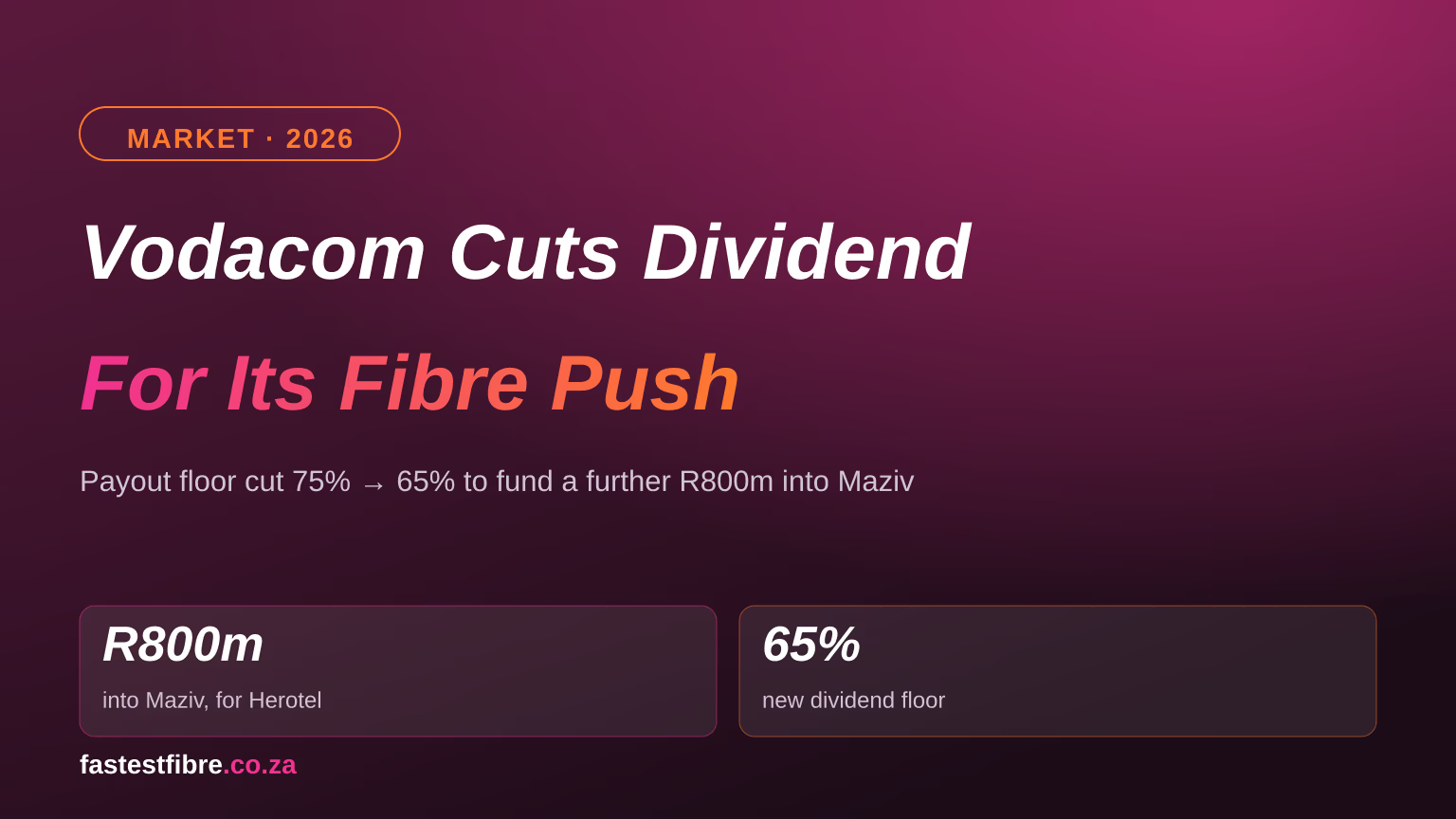
Vodacom's board has lowered its dividend payout floor from 75% to 65% of headline earnings - and a big part of the freed-up cash is going straight into Maziv, the group behind Vumatel, to finish paying for the Herotel takeover. Here's what the trade-off means for SA fibre's consolidation and for your bill.
In this article(9)
- 01A dividend cut to pay for a fibre network
- 02A note on where these numbers come from
- 03The quarter in numbers
- 04What actually changed in the dividend policy
- 05Why fibre gets a slice of the freed-up capital
- 06Does this actually affect you?
- 07The bigger pattern: SA's biggest mobile operator is becoming a fibre owner
- 08The practical takeaway
- 09Frequently asked questions
A dividend cut to pay for a fibre network
Vodacom Group's trading update for the quarter ended 30 June 2026, released on 27 July 2026, contained a line that will matter more to South African fibre customers than to the shareholders it was actually written for: "In fixed, we advanced our strategy in South Africa by investing a further R0.8 billion into Maziv to support the completion of the Herotel transaction."
That single sentence confirms two things at once. First, the long-running takeover of Herotel by Vumatel - the fibre network operator Vodacom part-owns through Maziv - has now actually closed, after clearing its last regulatory hurdle at Icasa in May 2026. Second, and less obviously, Vodacom paid for its share of that completion partly by cutting its own dividend: the board lowered its payout floor from at least 75% of headline earnings to at least 65%, redirecting real cash toward fibre and its enlarged Safaricom stake instead of shareholders' pockets.
We've already covered what the Herotel deal itself does to coverage, competition and pricing in detail in our deep-dive on Vodacom's R800m top-up. This piece looks at the other half of the story: why a mobile operator with 167.7 billion rand in annual revenue felt the need to cut its own dividend to fund a fibre network it only owns 30% of - and what that says about where South African connectivity is headed.
A note on where these numbers come from
Every figure in this article is checked against Vodacom Group's own trading update for the quarter ended 30 June 2026, published 27 July 2026. Vodacom's release states the new 65% dividend floor directly but does not itself quote the previous 75% figure; that number is corroborated by TechCentral's 27 July 2026 report, which cites the same trading update and states the old-to-new change explicitly. Regulatory dates for the Herotel takeover (Icasa's conditional approval, the Competition Tribunal's decisions, and the final May 2026 licence-transfer approval) are drawn from Icasa, Competition Tribunal and contemporaneous trade-press reporting, cross-checked against the fuller timeline in our companion piece on the Herotel deal itself. Where a figure could not be confirmed against a first-party source, it has been left out rather than estimated.
The quarter in numbers
Vodacom's Q1 FY2027 trading update covers the three months to 30 June 2026. Group revenue rose 5.9% to R42.4 billion and group service revenue rose 6.3% to R34.3 billion - solid growth at group level, driven mainly by international operations and the newly consolidated Safaricom stake rather than the South African core.
| Metric | Value | Detail |
|---|---|---|
| Maziv top-up | R800m | Paid to complete the Herotel takeover |
| New dividend floor | 65% | Of headline earnings, down from 75% |
| Vodacom's Maziv stake | 30% | R12.642bn, implemented 1 Dec 2025 |
| Group revenue | R42.4bn | Q1 FY2027, up 5.9% year on year |
The number that explains the dividend decision is the quieter one: South Africa segment service revenue grew just 2.0% in the quarter, with prepaid mobile "returning to growth" doing most of the work. That's a soft result for Vodacom's home market, and it's the backdrop against which the board chose to redirect cash toward fibre and Safaricom rather than protect the old payout ratio.
What actually changed in the dividend policy
Vodacom has historically been a classic "income stock" on the JSE - the kind of counter South African retirement funds and pensioners hold specifically for a large, reliable dividend rather than share-price growth. Lowering the payout floor is therefore not a routine capital-allocation tweak; it's a visible break from that identity, at least temporarily.
| Metric | Previous policy | New policy (from Q1 FY2027) |
|---|---|---|
| Payout floor | At least 75% of headline earnings | At least 65% of headline earnings |
| Stated rationale | Consistent, high cash return to shareholders | Redirect capital to growth - fixed/fibre (Maziv) and the enlarged Safaricom stake |
| CEO commentary | n/a | “At this revised payout level, we expect to grow the dividend per share for FY2027, based on our current growth trajectory.” — Shameel Joosub |
| Who it affects most | n/a | Income-focused shareholders, including SA retirement funds holding Vodacom for yield |
Note what the board did not do: it didn't cut the dividend per share outright, and Joosub explicitly said he still expects it to grow this financial year. What changed is the minimum proportion of earnings paid out - as earnings grow, a lower floor still leaves more cash inside the business for capex, acquisitions and stakes like Maziv, even if the per-share cheque keeps rising more slowly than it otherwise would have.
Why fibre gets a slice of the freed-up capital
Vodacom's fixed-line ambitions run through Maziv, the holding company for Community Investment Ventures Holdings' fibre assets - Vumatel, Dark Fibre Africa and, since the Herotel takeover closed, Herotel itself. Vodacom holds a 30% stake in Maziv (with an option to lift that to 34.95%), a position that took roughly four years and multiple regulatory rounds to secure. The R800 million confirmed in this quarter's update is what keeps that 30% stake intact as Maziv issues new shares to fund the Herotel deal - if Vodacom hadn't topped up, its proportional ownership would have been diluted.
Set against the other big capital call this quarter - completing the increase in Vodacom's Safaricom stake from 35% to 55% - the R800 million into Maziv is a comparatively small number. But size isn't really the point. It's a company that makes almost all of its South African revenue from mobile choosing to keep paying, repeatedly, to protect a minority stake in a fixed-line fibre group, rather than letting that stake dilute. That's a directional bet on fibre and fixed-wireless mattering more to Vodacom's future than a rounding error in its accounts would suggest.
| Destination | This quarter's move | What it protects or builds |
|---|---|---|
| Maziv (Vumatel/Herotel) | Further R800m invested | Keeps Vodacom's Maziv stake at 30% as Maziv funds the Herotel takeover |
| Safaricom | Stake increased 35% → 55%, effective 30 June 2026 | Vision 2030 group revenue ambition raised from R200bn to “more than R300bn” |
| Shareholders | Payout floor cut 75% → 65% of headline earnings | Board still targets dividend-per-share growth in FY2027 despite the lower floor |
Does this actually affect you?
Who this news actually changes something for
Most of this story is about capital markets, not your monthly fibre bill. Here's who should actually pay attention.
- Q1
Are you a Vumatel or Herotel fibre customer?
- Yes → No change to your pricing, contract or service today - this is a shareholder-level funding story, not a product change.
- No → Skip to the next question.
- Q2
Do you hold Vodacom shares, directly or via a retirement fund, for dividend income?
- Yes → Worth noting: the guaranteed-minimum payout ratio just dropped 10 percentage points, even though Vodacom expects the per-share amount to keep rising this year.
- No → This is background context on why SA's fibre market keeps consolidating - not something that changes your household budget.
- Q3
Are you weighing fibre availability in a smaller town or rural area Herotel serves?
- Yes → Relevant: the Herotel deal came with Competition Tribunal conditions requiring low-income area rollout - see our full deal breakdown for the detail.
- No → This deal's rollout obligations are unlikely to change your own coverage timeline.
The bigger pattern: SA's biggest mobile operator is becoming a fibre owner
Zoom out, and this is the latest instalment of a consolidation story that has defined South African fibre for the past two years. Maziv itself was formed to combine Vumatel and Dark Fibre Africa. Vodacom's 30% stake, first conditionally approved by Icasa back in November 2022, took until 1 December 2025 to actually close - surviving a Competition Tribunal prohibition in 2024 along the way. The Herotel takeover added a third layer, clearing the Competition Tribunal in December 2025 and Icasa in May 2026. Each step made South Africa's largest single fibre group larger, and each one required Vodacom's continued capital.
Historically, Vodacom's exposure to fibre was mostly as a reseller - buying wholesale access on other operators' networks to sell its own fibre packages, the same model Webafrica, Afrihost and MWEB use. A 30%-and-rising equity stake in the country's biggest FNO, funded partly by cutting its own dividend, is a materially different level of commitment. It suggests Vodacom's leadership sees more value in owning a slice of the infrastructure than in staying a pure reseller as fibre keeps taking share from mobile data in South African homes.
The practical takeaway
If you're shopping for fibre today, nothing in this trading update changes your options, pricing or coverage timeline - Vumatel and Herotel continue trading under their existing brands, contracts and pricing, exactly as confirmed when the deal itself closed. What this update actually confirms is that the Herotel takeover is now fully paid for and done, not still pending - so if you've been holding off on a decision waiting to see whether the deal would actually complete, that question is now settled.
The more useful long-term signal is about market structure: South Africa's fibre market keeps consolidating around a small number of increasingly well-capitalised groups, and Vodacom has just shown - via an actual dividend cut, not just a press statement - how seriously it takes securing its position in that consolidation. For the deeper breakdown of what the Herotel deal itself means for coverage, competition and your specific area, see our full analysis of the R800m top-up.
Frequently asked questions
Help someone else pick the right fibre
Now go and compare the deals
Prices below come from our own deal tracking, checked on 19 October 2026.
Ranked by price across every ISP and network we track.
See the dealsThe full catalogue in one sortable table - filter by speed, price or network.
See the dealsHow the major ISPs rank on price, support and real measured performance.
See the dealsRelated insights
Capitec's Annual Report Just Revealed a Home Connectivity Ambition
Read article
EAAIF Just Committed $50 Million to the Fibre Backbone Behind South Africa's International Speed
Read article
Vodacom's R800m Top-Up: What the Herotel Deal Means for Maziv, Vumatel and SA Fibre
Read article
The Maziv Merger Explained: How Vumatel, Vodacom Fibre, DFA and Herotel Came Together
Read article
Amazon Just Solved the Problem That Kept Starlink Out of South Africa
Read article
Vumatel Hits One Million Subscribers: What This Milestone Actually Means for South African Fibre
Read articleHerotel Fibre & Wireless: Coverage, Packages, Pricing and Deals in 2026
Read article
WIOCC's $300 Million Raise: What a Bigger Backbone Wholesaler Means for SA Fibre
Read article
Six Telecoms Giants Want a Competition Exemption for Rural Fibre
Read article