Vodacom's R800m top-up: what the Herotel deal really means for Maziv, Vumatel and South African fibre
Vodacom expects to push another R800 million into Maziv on the back of Vumatel's takeover of Herotel - pushing combined homes passed from 2.3 million to 2.9 million. Here is what the deal does to coverage, competition, pricing and your fibre choices in 2026.

In this article(10)
- 01What just happened
- 02The money: how R12.6 billion becomes R13.4 billion
- 03The regulatory road: four years from first approval to completion
- 04The network: 2.3 million to 2.9 million homes passed
- 05Vumatel vs Herotel: how the networks compare
- 06The Tribunal conditions that actually bite
- 07What changes for Herotel customers (short answer: nothing yet)
- 08What it means if you're buying fibre in 2026
- 09The bigger picture: consolidation is the story of 2026
- 10Frequently asked questions
What just happened
On Monday, 11 May 2026, Vodacom Group released its results for the year ended 31 March 2026 - a set of numbers that delivered headline earnings up 22.9% and revenue up 10.1% to R167.7 billion. Tucked into the South African commentary was a smaller, more interesting line item: Vodacom expected to inject at least another R800 million into Maziv once Vumatel completed its takeover of Hero Telecoms (Herotel).
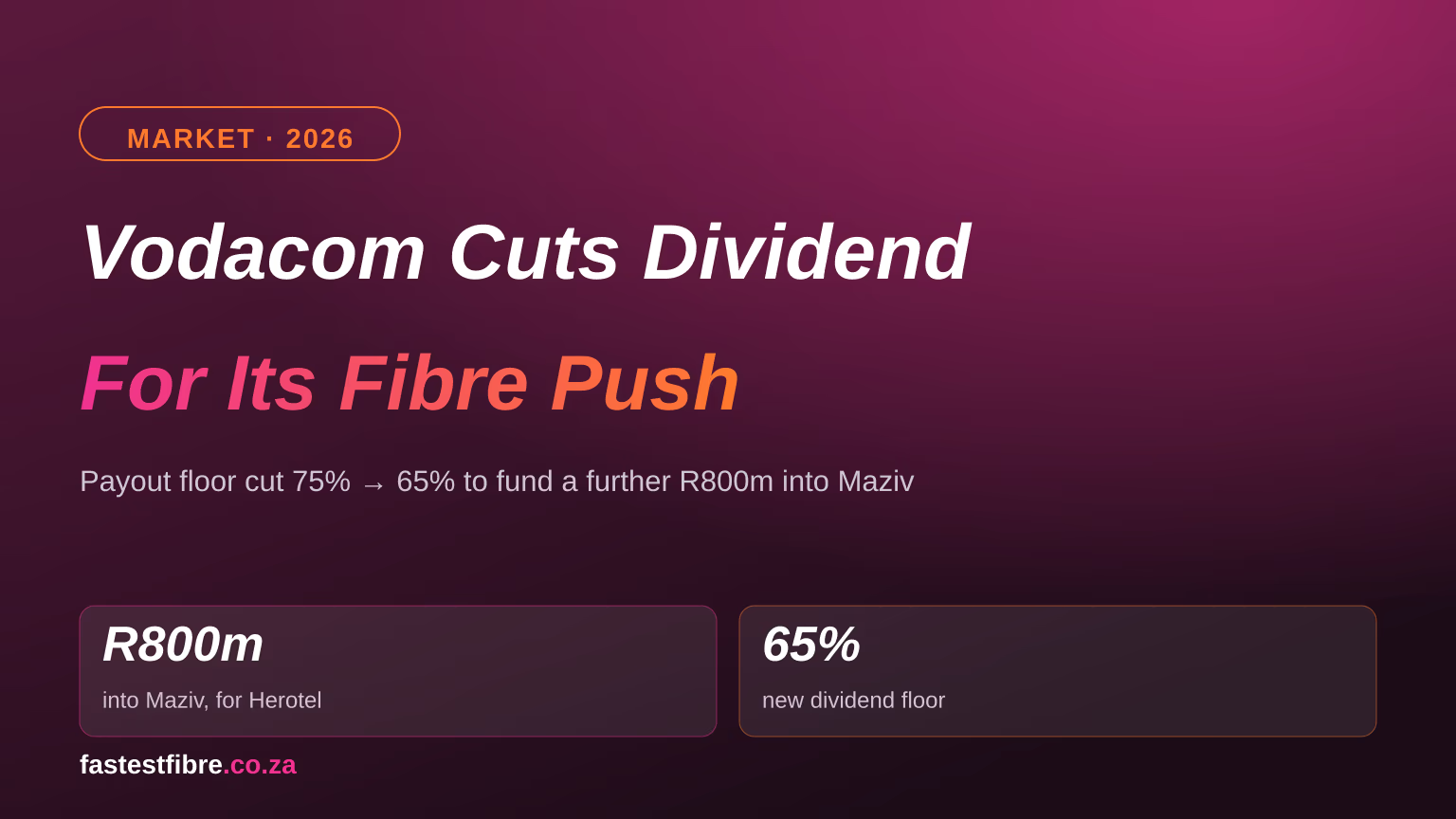
That "once" has now happened. Icasa cleared the last regulatory hurdle - the Herotel licence transfer - on 15 May 2026, and Vodacom's trading update for the quarter ended 30 June 2026 (released 27 July 2026) confirms the R800 million has been paid into Maziv "to support the completion of the Herotel transaction." Vodacom funded part of that outlay, and its wider fibre and Safaricom push, by cutting its own dividend payout floor from at least 75% to at least 65% of headline earnings - a real trade-off for a stock retirement funds have long held for its income. It is the clearest signal yet of how serious the consolidation of South African fibre has become.
To understand what this number actually means, you need to follow three threads at once: the money, the network, and the regulation.
| Metric | Value | Detail |
|---|---|---|
| Vodacom top-up | R800m | Paid into Maziv to complete the Herotel deal |
| Combined homes passed | 2.9m | Vumatel + Herotel, per Vodacom's FY2026 results |
| Low-income homes, 3 yrs | 540k | Tribunal-mandated rollout obligation |
| New dividend floor | 65% | Cut from 75%, to help fund fibre and Safaricom |
The money: how R12.6 billion becomes R13.4 billion
Start with the bedrock figure. Vodacom's initial 30% stake in Maziv, finalised on 1 December 2025, came in at R12.642 billion. That figure combines cash and fibre assets Vodacom contributed to the joint venture - the deal had been originally announced four years earlier and survived an initial Competition Tribunal prohibition before being restructured with the Competition Commission's blessing in July 2025.
From the 1 December 2025 acquisition date to Vodacom's 31 March 2026 year-end, Vodacom's share of Maziv's after-tax profit came in at R53 million - a roughly four-month contribution that gives the first real glimpse of what 30% of Maziv earns.
Maziv's own forecast for its full 2026 financial year, as disclosed in Vodacom's results presentation, is R7.6 billion in revenue and R5.2 billion in EBITDA. That is a ~68% EBITDA margin - characteristic of mature wholesale infrastructure businesses, where capex is heavy but operating leverage on incremental connections is enormous.
The additional R800 million is structured as a top-up subscription for new Maziv shares, sized to keep Vodacom's stake at 30% as Maziv issues fresh equity to fund the Herotel acquisition. The minimum subscription value of R0.8 billion was locked in during the July 2025 restructuring with the Competition Commission. The actual figure will be set by an independent fair-market-value exercise on completion.
One detail worth flagging: Vodacom retains an option to lift its stake further to 34.95%. That ceiling - down from the original 40% proposal - was part of the price of getting the deal past the regulator.
"The two milestone transactions, Safaricom and Maziv, are expected to materially enhance the Group's beyond-mobile positioning."Shameel Joosub, Vodacom Group CEO, 11 May 2026
The regulatory road: four years from first approval to completion
Neither the Vodacom-Maziv deal nor the Herotel takeover happened quickly. Both went through multiple rounds of regulatory scrutiny before reaching the point where an R800 million top-up could actually be paid. Laid end to end, the timeline explains why "Vodacom owns 30% of Maziv" and "Maziv now owns Herotel" are both true today despite each fact taking years to become final.
- 1 November 2022Icasa gives conditional approval
Icasa conditionally approves Vodacom's proposed 30% acquisition of Maziv, four years before the deal is finally implemented.
- 1 October 2024Competition Tribunal blocks the merger
The Tribunal prohibits Vodacom's Maziv acquisition on competition grounds, sending the deal back for restructuring.
- 1 July 2025Restructured deal clears the Commission
A revised structure - Vodacom's stake capped at 34.95% instead of the original 40% proposal - wins the Competition Commission's backing.
- 1 December 2025Vodacom's 30% Maziv stake is implemented
Vodacom's R12.642 billion, 30% acquisition of Maziv formally closes.
- 22 December 2025Tribunal approves the Herotel takeover
The Competition Tribunal conditionally clears Vumatel's acquisition of Herotel, with open-access and low-income rollout obligations attached.
- 15 May 2026Icasa approves the Herotel licence transfer
Icasa signs off on transferring Herotel's network licence to Vumatel, the last regulatory hurdle to completing the takeover.
- 27 July 2026Vodacom confirms the R800m top-up and cuts its dividend
Vodacom's Q1 FY2027 trading update confirms it has paid a further R800m into Maziv to complete the Herotel deal, funded partly by lowering its dividend payout floor from 75% to 65% of headline earnings.
| Date | Milestone | What happened |
|---|---|---|
| 1 November 2022 | Icasa gives conditional approval | Icasa conditionally approves Vodacom's proposed 30% acquisition of Maziv, four years before the deal is finally implemented. |
| 1 October 2024 | Competition Tribunal blocks the merger | The Tribunal prohibits Vodacom's Maziv acquisition on competition grounds, sending the deal back for restructuring. |
| 1 July 2025 | Restructured deal clears the Commission | A revised structure - Vodacom's stake capped at 34.95% instead of the original 40% proposal - wins the Competition Commission's backing. |
| 1 December 2025 | Vodacom's 30% Maziv stake is implemented | Vodacom's R12.642 billion, 30% acquisition of Maziv formally closes. |
| 22 December 2025 | Tribunal approves the Herotel takeover | The Competition Tribunal conditionally clears Vumatel's acquisition of Herotel, with open-access and low-income rollout obligations attached. |
| 15 May 2026 | Icasa approves the Herotel licence transfer | Icasa signs off on transferring Herotel's network licence to Vumatel, the last regulatory hurdle to completing the takeover. |
| 27 July 2026 | Vodacom confirms the R800m top-up and cuts its dividend | Vodacom's Q1 FY2027 trading update confirms it has paid a further R800m into Maziv to complete the Herotel deal, funded partly by lowering its dividend payout floor from 75% to 65% of headline earnings. |
The network: 2.3 million to 2.9 million homes passed
The numerical impact on coverage is straightforward. Vodacom CEO Shameel Joosub told investors on Monday that Herotel's footprint takes Vumatel's combined homes-passed figure from 2.3 million to roughly 2.9 million. The connection rate, he added, is "very good" - Herotel's closed-access model means every home passed represents a more direct path to revenue than an open-access network where ISPs handle conversion.
The shape of that 600,000-home addition is what makes it strategically valuable. Herotel was founded in 2013 out of the consolidation of more than 30 owner-operated regional ISPs and a wireless network built largely outside the major metros. Its FTTH footprint had reached 606,388 homes passed by December 2025, with 273,829 connected - making it South Africa's third-largest FNO by both measures. Only Vumatel and Openserve sit above it.
Geographically, Herotel fills in exactly the gap Vumatel has been trying to address with Vuma Reach and Vuma Key - secondary cities, smaller towns, agricultural communities. Coverage runs across the Free State, Limpopo, Mpumalanga, North West, Northern Cape and Western Cape, with more than 2,000 wireless towers picking up where the fibre stops. Where the major FNOs have historically chased density in Sandton and the Atlantic Seaboard, Herotel built in places like Modimolle, Robertson and Queenstown.
The bigger story is the operating model collision. Most major FNOs in South Africa - Vumatel, Openserve, Frogfoot, MetroFibre, Octotel - operate on an open-access basis: they build infrastructure and resell wholesale to ISPs like Webafrica, Afrihost, MWEB and dozens of others. Herotel, uniquely among the top-five FNOs, runs closed-access - it builds the infrastructure and sells direct as the only ISP on its network.
Herotel's pitch for that model has always been service quality and cost. "By bypassing unnecessary and costly intermediaries, we maintain control over service quality and swiftly address customer needs," the company has said. Whether that operating philosophy survives the Vumatel acquisition is one of the live questions hanging over the deal. The Tribunal's conditions point toward partial open-access conversion, but Vumatel has separately signalled a hands-off approach.
Vumatel vs Herotel: how the networks compare
The two FNOs were built for different geographies and different price points. Comparing them side by side shows why combining them is a strategic fit rather than a pure consolidation play.
| Feature | Vumatel | Herotel |
|---|---|---|
| Founded | 2014 (Parkhurst, JHB) | 2013 (Stellenbosch) |
| Homes passed | ~2.3 million | 606,388 (Dec 2025) |
| Connected | ~1 million | 273,829 |
| Operating model | Open-access wholesale | Closed-access, sole ISP |
| Geographic focus | Major metros, suburbs | Secondary cities, towns, rural |
| Products | Vuma Core, Vuma Reach, Vuma Key | HeroFibre, HeroWireless, HeroPrepaid, HeroVoice |
| Entry pricing | From R249/month (Reach) | From R399/month (HeroFibre); R199 (HeroPrepaid 14-day) |
| ISPs on network | 75+ open-access ISPs | Single ISP (itself) |
| Wireless network | None | 2,000+ towers, 60,000+ customers |
| Position in market | #1 FNO by homes passed | #3 FNO by homes passed |
The Tribunal conditions that actually bite
The Competition Tribunal's December 2025 approval came with one of the most extensive sets of binding conditions South African fibre has seen. The reason is structural: combining a dominant open-access wholesaler (Vumatel) with a vertically integrated closed-access operator (Herotel) raised both horizontal (market power) and vertical (foreclosure of third-party ISPs) concerns. The conditions aim to neutralise both.
The headline obligations:
| Condition | Requirement | Why it matters |
|---|---|---|
| Open access maintained | Vumatel must remain an open-access FNO, serving third-party ISPs on non-discriminatory, transparent terms | Keeps Webafrica, Afrihost and other resellers able to sell on Vumatel infrastructure |
| Backhaul protection | Vumatel may not use Herotel's metro backhaul, FTTH or FTTB infrastructure for wholesale unless it too converts to open access | Stops the deal quietly foreclosing competitors from Herotel's network |
| Cap-ex floor | Vumatel must hold its pre-merger capital expenditure plans for at least five years | Prevents the merger being used to justify slower network investment |
| Low-income rollout | 540,000 additional homes passed in lower-income areas within three years, part of a wider one-million-premises commitment | Turns a commercial merger into a binding coverage-expansion obligation |
| School connectivity | Approximately 1,000 schools connected as part of the rollout | Ties the deal to a measurable public-interest outcome |
| Vuma Reach protected | Vumatel may not scale back its lower-income Vuma Reach rollout in favour of Herotel deployments | Stops capital being redirected to better-margin Herotel-aligned builds |
That last bullet is the most interesting. The Tribunal explicitly anticipated the risk that combining the two networks could lead to capital being redirected from Vuma Reach toward more lucrative Herotel-aligned builds in better-margin small-town markets. The conditions force the trade-off to go the other way: Reach gets protected; Herotel can grow, but not at Reach's expense.
For consumers, this matters in a direct way. If you live in a lower-income area waiting for fibre, the Tribunal has just written your address into a contractual obligation.
What changes for Herotel customers (short answer: nothing yet)
The immediate consumer-facing impact is deliberately minimal. Vumatel told MyBroadband earlier in 2026 that it would be "business as usual" at Herotel: "Existing services, pricing, and contracts remain unchanged."
Concretely:
- Herotel keeps its own brand and its own Electronic Communications Network Services Individual Licence.
- HeroFibre packages (uncapped FTTH from R399/month with free-to-use router) continue as advertised.
- HeroPrepaid voucher fibre (R199 starter pack, 14 days) remains in market.
- HeroWireless serves areas outside the fibre footprint as before.
- HeroVoice VoIP continues operating.
What changes over the medium term is harder to predict. The Tribunal's open-access conditions mean Herotel's metropolitan backhaul and FTTH infrastructure may eventually be opened up to third-party ISPs - a fundamental shift in operating model that would let resellers like Webafrica and Afrihost compete on Herotel infrastructure for the first time. Whether that happens at scale, and how quickly, depends on commercial agreements that have not yet been disclosed.
Pricing is the other open question. Vumatel's April 2026 wholesale price change rippled through every ISP that resells its lines. Herotel customers, sitting outside that wholesale layer, were insulated. As the two networks converge operationally, that insulation will erode. Whether Herotel's pricing drifts toward Vumatel's wholesale rates, or vice versa, is a story that will play out over 18 to 24 months.
What it means if you're buying fibre in 2026
The practical takeaway depends on where you live.
If you're in a Vumatel-covered metro suburb: nothing changes immediately. Your Webafrica or Afrihost line on Vuma Core remains exactly what it was. The deal does not directly affect your monthly bill, your speed, or your contract.
If you're in a smaller town served by Herotel: watch this space. The Tribunal conditions create a slow-moving but inevitable pull toward open access on Herotel infrastructure. Over the next 12 to 24 months you may start seeing third-party ISPs offering packages on Herotel lines - which historically has been a fast track to better pricing through competition.
If you're in a lower-income area still waiting for fibre: the 540,000-homes-in-three-years commitment is now a binding obligation. Vuma Reach rollout is protected by Tribunal order, which means it cannot be deferred to fund Herotel-area expansion. That doesn't tell you the exact month fibre arrives at your address, but it does make the trajectory considerably more certain than it was 12 months ago.
If you're choosing between Vuma Core, Vuma Reach and Herotel: the choice today is the same as it was last week. Each product is built for a different audience. We've broken the full decision tree down in Vuma Core vs Vuma Reach and on our Herotel network page.
The bigger picture: consolidation is the story of 2026
Stand back and the Herotel deal is one chapter of a broader consolidation story that has dominated South African fibre for two years. The Maziv structure itself - formed in 2022 to house CIVH's fibre assets (Vumatel and Dark Fibre Africa) - was the first major move. Vodacom's 30% acquisition, finalised in December 2025 after four years and a substantial restructuring, was the second. The Herotel takeover is the third. And there are smaller deals in the wings: regional operators like Evotel and Zoom Fibre remain potential targets in a market where the gap between top three and the rest keeps widening.
The math is unforgiving. Building fibre is capital-intensive. Maintaining and upgrading it less so, but still material. Operating it well requires scale in customer service, billing, ISP relationships and field engineering that smaller operators can't match. The economics push toward consolidation, and the regulator has accepted that - with conditions - because the alternative is either a market with too many under-funded players or one dominated by a single FNO without the public-interest obligations the Tribunal has now baked in.
For Vodacom specifically, Maziv plus Safaricom turns the group from a mobile operator with some fixed-line exposure into a genuine fibre player. The group expects its fibre footprint to extend to 3.6 million homes passed once Safaricom completes. R800 million sounds like a rounding error against R167.7 billion in annual revenue - and at the group level, it is. But it is the price of admission to a structural shift in how South African connectivity is owned and operated.
Frequently asked questions
Help someone else pick the right fibre
Now go and compare the deals
Prices below come from our own deal tracking, checked on 19 October 2026.
What each package actually costs per megabit, not just per month.
See the dealsThe full catalogue in one sortable table - filter by speed, price or network.
See the dealsRanked by price across every ISP and network we track.
See the dealsRelated insights
Why Vodacom Just Cut Its Dividend to Fund Its Fibre Push
Read article
Vuma Core vs Vuma Reach: Which Vumatel Fibre Product Is Right for Your Home?
Read article
The Maziv Merger Explained: How Vumatel, Vodacom Fibre, DFA and Herotel Came Together
Read article
The April 2026 Vumatel Price Change: What Actually Happened and What It Means for Your Bill
Read article
Vumatel Hits One Million Subscribers: What This Milestone Actually Means for South African Fibre
Read article