WIOCC's $300 Million Raise: What a Bigger Backbone Wholesaler Means for SA Fibre
WIOCC Group has signed a $300 million Shareholder Subscription Agreement with Africa Finance Corporation and Saudi Arabia's Vision Invest - its largest capital raise yet, per first-party announcements from both WIOCC and AFC on 1-3 September 2026. WIOCC already runs six data-centre sites and stakes in four subsea cables inside South Africa today. Here's what the new money is actually earmarked for, how WIOCC stacks up against Liquid Intelligent Technologies - the other backbone wholesaler behind SA fibre - and what does and doesn't change for your bill.
In this article(11)
- 01What actually happened
- 02Who is WIOCC, and why should a South African fibre customer care
- 03What WIOCC already operates in South Africa today
- 04Where the new $300 million is actually earmarked
- 05WIOCC vs Liquid: South Africa's two backbone wholesalers, compared
- 06Why this matters if you've never heard of WIOCC before today
- 07What we verified today, and how
- 08Does this actually affect your fibre bill?
- 09What to watch next
- 10Bottom line
- 11Frequently asked questions
What actually happened
On 1 September 2026, at the LEAP technology exhibition in Riyadh, WIOCC Group signed a Shareholder Subscription Agreement (SSA) with two investors: the Africa Finance Corporation (AFC) - a multilateral development finance institution with 48 member countries that has deployed over $19 billion across 36 African countries since 2007 - and Vision International Investment Company (Vision Invest), a Saudi Arabian infrastructure investor with a portfolio spanning five continents. Together they're putting a combined $300 million into WIOCC. Both organisations' own newsrooms confirm the figure, the date and the venue independently, which clears this site's bar for a first-party-verified announcement rather than one sourced only to trade press.
WIOCC's CEO, Chris Wood, called it a chance to "do more of what WIOCC Group already does best: building the business-critical digital infrastructure that other companies rely on every day." AFC's president and CEO, Samaila Zubairu, framed the rationale in broader terms: "The Africa we build must be connected, competitive and equipped to create value from the digital economy, not only consume it." Neither statement, nor the structured deal details from either newsroom, discloses the resulting equity stake or a valuation for WIOCC - both announcements are explicit that those terms aren't being made public.
| Metric | Value | Detail |
|---|---|---|
| New capital raised | $300 million | Combined AFC + Vision Invest via a Shareholder Subscription Agreement |
| Vs 2025's full-year total | ~$400m across all 2025 rounds | Per TechCentral's reporting only - not restated in WIOCC's or AFC's own announcement |
| Vs 2022's largest round | $200 million | Per TechCentral's reporting only - see sourcing note below |
| Equity stake disclosed | Not disclosed | Neither WIOCC's nor AFC's announcement states the stake or valuation |
Who is WIOCC, and why should a South African fibre customer care
If you've never heard of WIOCC, that's by design - it doesn't sell you a fibre package. WIOCC Group (the company was originally the West Indian Ocean Cable Company, though it now operates a broader portfolio than its original name suggests) is a Nairobi-headquartered, open-access wholesale digital infrastructure operator active in more than 30 African countries. Its existing shareholder base includes Uganda Telecom, Dalkom Somalia, Djibouti Telecom, Mozambique's TMCEL and the International Finance Corporation - a mix of national telecoms operators and development-finance investors, which is typical of open-access wholesale infrastructure rather than a retail consumer brand.
"Open-access wholesale" is the operative phrase. WIOCC doesn't compete with Openserve, Vumatel, Frogfoot, Octotel or MetroFibre for a homeowner's fibre contract. Instead it operates two of the layers those retail networks and their upstream ISPs quietly depend on: colocation and data-centre space (through its Open Access Data Centres, OADC, division) and long-haul connectivity - terrestrial backbone fibre plus subsea cable capacity that carries traffic into and out of the country. It's the same category of business as Liquid Intelligent Technologies, which this site covered in detail after the Emerging Africa & Asia Infrastructure Fund (EAAIF) put fresh debt into Liquid's balance sheet in August - see the full comparison further down this article.
What WIOCC already operates in South Africa today
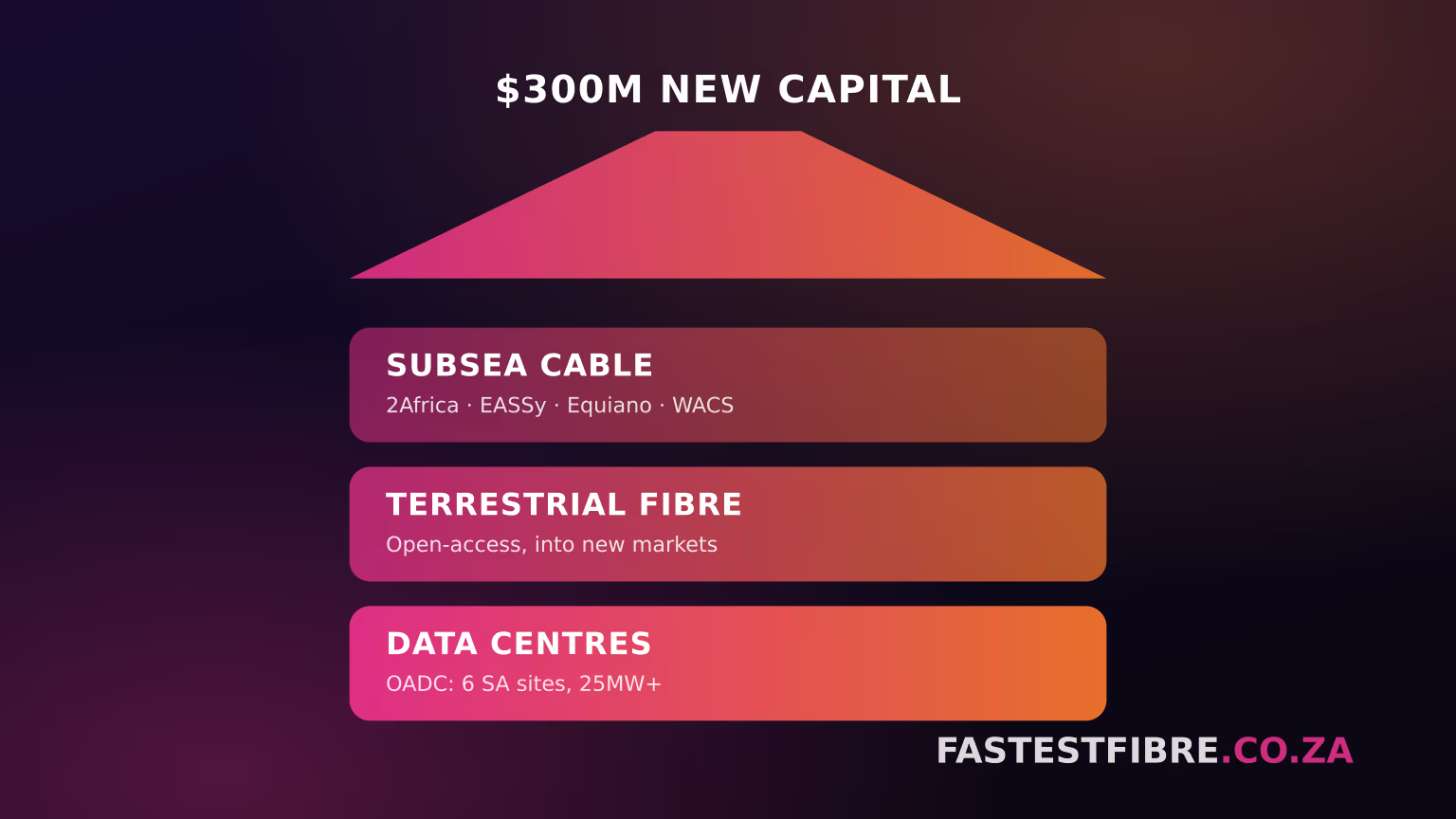
Here's the part that makes this story more concrete for South African readers than a pure balance-sheet item: WIOCC isn't proposing to enter South Africa with this new money - it's already here, with named, dated infrastructure. Its Open Access Data Centres division completed the acquisition of seven NTT Data facilities effective 31 December 2025, adding more than 25 megawatts of data-centre capacity across six South African cities. On the connectivity side, WIOCC's own Southern Africa product pages describe metro fibre rings in Johannesburg, Cape Town and Durban feeding a national long-distance backbone with more than 100 live points of presence, plus fibre-pair ownership or strategic stakes across four subsea cable systems that land on the South African coast.
| Asset | Where | Detail |
|---|---|---|
| Data centres (OADC) | Bloemfontein, Cape Town, East London, Gqeberha, Durban, Johannesburg | 25MW+ across 7 facilities acquired from NTT Data, effective 31 December 2025 |
| Metro fibre networks | Johannesburg, Cape Town, Durban | Dense in-city fibre rings feeding the national backbone |
| National long-distance backbone | Nationwide | More than 100 live points of presence, per WIOCC's own Southern Africa product page |
| Subsea cable holdings touching SA | 2Africa, EASSy, Equiano, WACS | Full fibre-pair ownership on 2Africa and Equiano; largest investor in EASSy; strategic investor in WACS and EIG |
One clarification worth making precisely, because it's easy to conflate: Openserve is the landing partner for the Equiano subsea cable in South Africa, holding one of twelve fibre pairs (roughly 12Tbps of the cable's 144Tbps total design capacity). WIOCC's fibre-pair ownership on Equiano is a separate holding on the same physical cable system - both companies connect to it, as different capacity owners, not as the same entity under two names.
Where the new $300 million is actually earmarked
Both WIOCC's and AFC's announcements name the same three priorities for the new capital, in this order: accelerating the deployment and consolidation of data-centre capacity; extending WIOCC's open-access terrestrial fibre footprint into new markets; and adding "strategically selected" new subsea cable assets to strengthen international connectivity. WIOCC's Group Chief Strategy and M&A Officer, Joshua Smythwood, put it plainly: "This agreement strengthens our position and gives us the capacity to deliver on that strategy."
What neither announcement does - and we checked both in full rather than relying on a summary - is commit a specific dollar figure to South Africa, or name a specific new subsea cable, data-centre site or fibre route the $300 million will build. That's a materially different disclosure gap to, say, a retail ISP publishing a price increase effective a named date: this is growth capital for a multi-country expansion strategy, and the company hasn't yet said where within that strategy the money lands first. We'll treat any future country-specific announcement from WIOCC as the next dated milestone to watch for, rather than assuming South Africa gets a proportional share simply because it's already WIOCC's most built-out national footprint.
WIOCC vs Liquid: South Africa's two backbone wholesalers, compared
South African fibre customers have, without necessarily knowing it, two major open-access wholesale infrastructure operators sitting upstream of their internet connection: WIOCC and Liquid Intelligent Technologies (through its Africa Data Centres subsidiary and its own subsea and terrestrial holdings). Both raised significant new capital in 2026. Here's how they actually compare, dimension by dimension, using only figures each company or its named investors have themselves disclosed.
| Dimension | WIOCC | Liquid Intelligent Technologies |
|---|---|---|
| Latest funding round | $300m Shareholder Subscription Agreement, 1 Sep 2026 | $50m EAAIF tranche (Aug 2026) inside a $450m package, itself following an April 2026 $660m debt-plus-equity refinancing |
| Lead investors this round | Africa Finance Corporation + Saudi Arabia's Vision Invest | Emerging Africa & Asia Infrastructure Fund (EAAIF, managed by Ninety One) |
| South African data centre cities | 6 (Bloemfontein, Cape Town, East London, Gqeberha, Durban, Johannesburg) via OADC | 2 (Johannesburg, Cape Town) via Africa Data Centres |
| Data centre capacity disclosed | 25MW+ in South Africa specifically (OADC's ex-NTT sites) | 78MW combined across Johannesburg, Cape Town, Nairobi, Harare and Kigali - no SA-only figure published |
| Subsea cables held | Full fibre pairs on 2Africa and Equiano; largest EASSy investor; strategic investor in WACS and EIG | Capacity on SAT-3/SAFE, WACS, TEAMS, EASSy and a large SEACOM holding |
| Countries of operation | 30+ | 25 |
| Headquarters | Nairobi, Kenya | Johannesburg, South Africa |
The practical read: neither company is bigger on every dimension. WIOCC's newest raise is larger as a single deal and its South African data-centre footprint spans more cities, but Liquid's combined pan-African data-centre capacity is larger in aggregate and it's headquartered in Johannesburg rather than Nairobi. For a South African reader, the useful takeaway isn't "WIOCC wins" or "Liquid wins" - it's that the country now has two well-capitalised, competing wholesale infrastructure operators rather than one, which is a healthier market structure for exactly the reasons open-access wholesale fibre proved to be for retail ISPs: competition among carriers at the wholesale layer is part of what's kept downward pressure on prices further down the stack.
Why this matters if you've never heard of WIOCC before today
International and backbone capacity is the part of a fibre connection nobody notices until it breaks. Every overseas video call, every stream from a server outside South Africa, and a meaningful share of your ISP's own upstream bandwidth rides across exactly this layer - cross-border terrestrial fibre and subsea cable capacity sold wholesale to the ISPs and mobile operators that actually bill you. Our reporting on Africa's submarine cable repair crisis found the continent shares just 13% of the world's active cable-repair ships, with a single 43-year-old vessel permanently stationed in Cape Town for the entire coastline - part of why a single subsea cable fault thousands of kilometres away can slow an otherwise fast, uncapped South African fibre line for weeks.
Route diversity and financial strength at the wholesale layer are two of the few real levers against that fragility. WIOCC holding stakes across four separate subsea systems (2Africa, EASSy, Equiano and WACS), rather than depending on any single cable, is the kind of redundancy that determines how badly one fault actually bites. A fresh $300 million of capital - on top of, not instead of, that existing footprint - makes WIOCC a financially stronger link in that mesh, in the same way this site noted EAAIF's $50 million into Liquid did for a different operator in August. Separately, Google's new Eastern Cape cable-landing site, which we covered in our report on the Digital Exchange Port, is another data point in the same trend: more international capacity, held by more distinct operators, landing on South African soil, rather than the country depending on a small number of cables or carriers.
None of this is a guarantee against future outages, and it isn't a reason to expect a near-term retail price cut either - wholesale capacity investment operates on a multi-year cycle, and neither WIOCC nor AFC's announcement makes any pricing claim at all. It's simply a genuinely different, more resilient starting position than an under-capitalised wholesale layer would be.
What we verified today, and how
Unlike our August report on EAAIF's financing of Liquid - where neither EAAIF's nor Liquid's own newsroom had published the story at the time of writing - both parties to this deal have their own live announcements. We fetched WIOCC Group's own newsroom post and AFC's own newsroom post directly today. Both are first-party, both are dated within the announcement's news cycle, and both independently state the same $300 million figure, the same 1 September 2026 signing date at LEAP in Riyadh, and the same three-priority use of funds - clearing this site's bar for a verified figure without needing to lean on trade-press intermediaries at all. One figure in this article doesn't clear that bar on its own: the framing of this as WIOCC's largest raise, "ahead of" a roughly $400 million 2025 total and a $200 million 2022 round, comes from TechCentral's reporting alone - neither WIOCC's nor AFC's own announcement restates those historical figures, and we could not find a second independent source for them today. We're presenting that comparison as TechCentral's characterisation, not as independently confirmed, per our usual two-source bar for non-first-party figures.
WIOCC's existing South African footprint (the data-centre and subsea/backbone detail in the table above) comes from WIOCC's own Southern Africa product page and the publicly reported completion date of the NTT Data acquisition. We could not independently verify a precise current power-draw figure beyond the "25MW+" WIOCC itself states, and neither WIOCC nor Liquid publishes a single combined "South Africa-only" data-centre capacity number in the same units - which is why the comparison table above cites Liquid's pan-African 78MW figure rather than inventing an SA-only split nobody has disclosed. We did not find, and are not claiming, any confirmed named South African ISP customer of either WIOCC's or Liquid's wholesale capacity products - both companies describe their customer base only in general terms (carriers, ISPs, mobile operators, enterprises).
Does this actually affect your fibre bill?
Does WIOCC's $300 million raise change anything for you?
For essentially every South African fibre customer, the honest answer is: not directly, and not this month. Work through it below.
- Q1
Do you buy internet access, colocation or wholesale capacity directly from WIOCC or its OADC data centres?
- No - my provider is Openserve, Vumatel, Frogfoot, Octotel, MetroFibre, or a reseller ISP → True of essentially every South African home fibre customer. WIOCC operates several layers upstream from your actual contract, not the company billing you.
- Q2
Does this raise change your monthly fibre price, contract terms, or coverage?
- No → Correct. Neither WIOCC's nor AFC's announcement makes any pricing claim, and there's no South Africa-specific capex commitment disclosed. Nothing here should show up on your next invoice.
What to watch next
Three concrete things would move this story forward for South African readers specifically: any country-by-country breakdown of how the $300 million is actually deployed, which neither newsroom has published yet; any new subsea cable system WIOCC names as one of the "strategically selected" assets the raise is meant to fund; and whether OADC announces further South African data-centre expansion beyond the six ex-NTT sites it already operates. We'll update this article, or publish a follow-up, if any of that surfaces.
Bottom line
WIOCC Group signed a $300 million Shareholder Subscription Agreement with the Africa Finance Corporation and Saudi Arabia's Vision Invest on 1 September 2026 - its largest capital raise on record, confirmed by both investors' own first-party newsrooms rather than trade press alone. The money is earmarked for data-centre expansion, terrestrial fibre growth and new subsea cable assets, though neither party discloses a country-specific split. What makes this more concrete for South African readers than a pure balance-sheet story is that WIOCC already operates real, dated infrastructure here today - six data-centre sites and stakes across four subsea cables - independent of what this new money eventually funds.
What it isn't: a change to any South African fibre customer's bill, contract or coverage. If you take one thing from this article, make it the plain version - this is good news for the financial depth and competitive structure of the wholesale layer behind your connection, not something that changes what you pay this month.
Frequently asked questions
Help someone else pick the right fibre
Now go and compare the deals
Prices below come from our own deal tracking, checked on 12 October 2026.
What each package actually costs per megabit, not just per month.
See the dealsThe full catalogue in one sortable table - filter by speed, price or network.
See the dealsRanked by price across every ISP and network we track.
See the dealsRelated insights
EAAIF Just Committed $50 Million to the Fibre Backbone Behind South Africa's International Speed
Read article
One 43-Year-Old Ship in Cape Town Guards All of Africa's Internet
Read article
Google Is Building South Africa's Newest Gateway to the World's Internet
Read article
Icasa Withdrew Its Telecoms Affordability Inquiry Before It Began
Read articleSA Fibre Benchmarks: Price, Speed and Network Data
Read articleFibre Coverage Map: Check What's Available at Your Address
Read article
Six Telecoms Giants Want a Competition Exemption for Rural Fibre
Read article