Icasa Withdrew Its Affordability Inquiry Before It Began
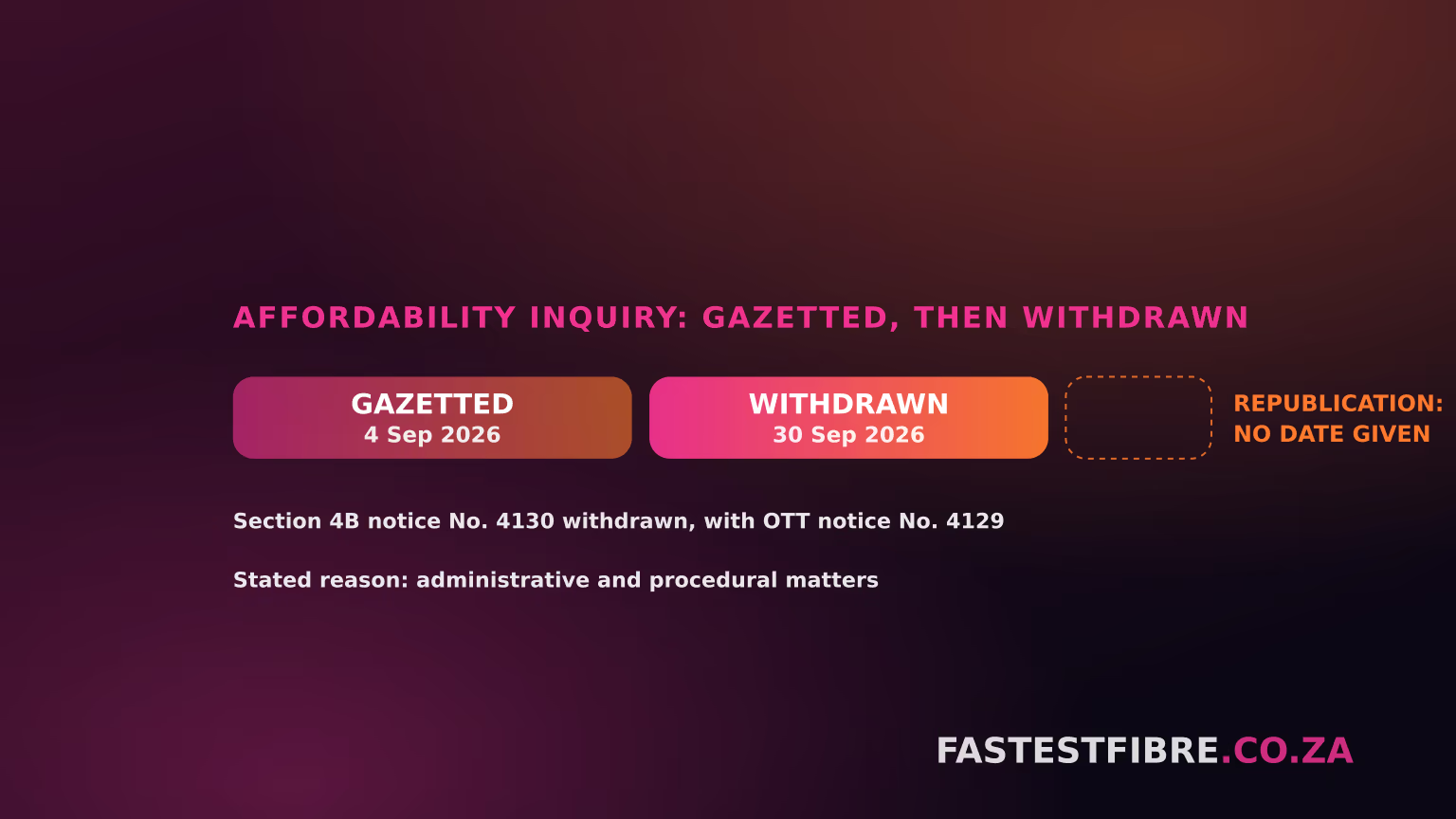
Icasa gazetted a section 4B market inquiry into telecommunications affordability in early September 2026 - then withdrew the notice, along with its parallel over-the-top services inquiry, via withdrawal notices dated 30 September and a media statement on 1 October. The stated reason is administrative and procedural. Icasa says the affordability notice will be republished with its draft questionnaire, but has announced no date. Here's what was withdrawn, what the withdrawal does and doesn't mean, and what to do about your fibre bill now that no process is running.
In this article(9)
- 01The inquiry was gazetted, then withdrawn before it began
- 02What Icasa actually said when it withdrew
- 03What happened, and when
- 04What a section 4B market inquiry is, and why withdrawal matters
- 05What the withdrawal does not mean
- 06The affordability numbers, which the withdrawal does not touch
- 07Icasa's track record, and why fibre is the gap in it
- 08What to do about your fibre bill, now that nobody is coming
- 09Frequently asked questions
The inquiry was gazetted, then withdrawn before it began
In early September 2026, South Africa's communications regulator formally opened an inquiry into whether the country's telecommunications prices are actually affordable. The Independent Communications Authority of South Africa (Icasa) published a notice in the Government Gazette under section 4B of the Icasa Act - notice No. 4130, signed by chairperson Mothibi Ramusi - giving notice of its intention to conduct a market inquiry into the affordability of telecommunications services. TechCentral reported it on 5 September 2026. This article originally covered that notice as a live process.
It is not one. Icasa withdrew the notice. A withdrawal notice dated 30 September 2026 pulled both the affordability inquiry (No. 4130) and the parallel inquiry into over-the-top services (No. 4129), and Icasa confirmed it in a media statement on 1 October 2026. The regulator's own affordability-inquiry document page now lists four documents dated 30 September 2026, among them the notice of withdrawal of the notice of intention and a pricing questionnaire. The inquiry was withdrawn before it gathered a single questionnaire response.
That leaves three questions worth answering honestly: why it was withdrawn, what the withdrawal does and does not tell you about South African broadband pricing, and what a reader paying a fibre bill should do about it. The short version of the last one: nothing about this process was ever going to move your bill this year, and the withdrawal makes that more true, not less.
What Icasa actually said when it withdrew
The stated reason is procedural. Icasa says the notices are withdrawn to allow it to address administrative and procedural matters and ensure better regulatory alignment. That is the whole of the justification given - no finding, no change of position on pricing, no indication that the regulator has concluded anything about affordability one way or the other.
On what comes next, Icasa commits to one thing and declines to date it: the affordability notice will be republished, together with the draft questionnaire, for public comment, and the OTT notice will be republished at a later date with additional context and clearer guidance on how stakeholders can take part. Anyone who already submitted comments against the original notice will be able to submit again once a revised notice is published. No date is attached to any of that, which is why you will not find one below - an estimate dressed up as a schedule is exactly the kind of thing this article got wrong the first time.
Republishing a notice with the draft questionnaire is itself a tell about what went wrong. The original notice set deadlines that ran off a questionnaire stakeholders had not yet seen: 10 working days to raise questions about it, 10 more for Icasa to answer, then 45 to complete it. Bundling the questionnaire with the notice removes that awkwardness, which fits the "administrative and procedural" framing rather better than it fits any theory about the regulator losing its appetite for the subject.
What happened, and when
Every step below has already happened. There are deliberately no forward-dated milestones here: the ones this article used to carry were working-day projections off the original notice, and the withdrawal made all four of them impossible.
- 4 September 2026Notice of intention gazetted under section 4B of the Icasa Act
Icasa chairperson Mothibi Ramusi signs a notice of intention to conduct a market inquiry into telecommunications affordability (Government Gazette notice No. 4130), published alongside a parallel notice for an inquiry into over-the-top services (No. 4129). TechCentral reports it on 5 September 2026.
- 30 September 2026Icasa signs withdrawal notices for both inquiries
Withdrawal notices dated 30 September 2026 pull both the affordability notice (No. 4130) and the OTT notice (No. 4129). Icasa's own affordability-inquiry document page carries four documents of this date, including the notice of withdrawal and a pricing questionnaire.
- 1 October 2026Icasa explains the withdrawal in a media statement
The stated reason is to address administrative and procedural matters for better regulatory alignment. Icasa says the affordability notice will be republished together with the draft questionnaire for public comment, and that stakeholders who already submitted will be able to do so again against the revised notice.
- 6 October 2026Status today: withdrawn, with no republication date announced
Nothing further has been gazetted. Icasa has committed to republishing the affordability notice but has not said when, and this article does not guess - the inquiry is currently not running at all.
| Date | Milestone | What happened |
|---|---|---|
| 4 September 2026 | Notice of intention gazetted under section 4B of the Icasa Act | Icasa chairperson Mothibi Ramusi signs a notice of intention to conduct a market inquiry into telecommunications affordability (Government Gazette notice No. 4130), published alongside a parallel notice for an inquiry into over-the-top services (No. 4129). TechCentral reports it on 5 September 2026. |
| 30 September 2026 | Icasa signs withdrawal notices for both inquiries | Withdrawal notices dated 30 September 2026 pull both the affordability notice (No. 4130) and the OTT notice (No. 4129). Icasa's own affordability-inquiry document page carries four documents of this date, including the notice of withdrawal and a pricing questionnaire. |
| 1 October 2026 | Icasa explains the withdrawal in a media statement | The stated reason is to address administrative and procedural matters for better regulatory alignment. Icasa says the affordability notice will be republished together with the draft questionnaire for public comment, and that stakeholders who already submitted will be able to do so again against the revised notice. |
| 6 October 2026 | Status today: withdrawn, with no republication date announced | Nothing further has been gazetted. Icasa has committed to republishing the affordability notice but has not said when, and this article does not guess - the inquiry is currently not running at all. |
What a section 4B market inquiry is, and why withdrawal matters
A section 4B market inquiry is Icasa's formal investigative mechanism - the same type of process behind the regulator's Mobile Broadband Services inquiry. It is structured and deadline-driven: a gazetted notice of intention, a window for stakeholders to question the proposed questionnaire, Icasa's published responses, a questionnaire completed by operators, then a discussion document opened for public comment before any findings. Unlike a report or a statement, it can end in binding regulatory findings and interventions.
That structure is the reason a withdrawal is more than paperwork. Each stage is a precondition for the next, and the clock on all of them runs from publication of the notice. Pull the notice and the whole sequence resets to zero - a republished notice starts a fresh question window, a fresh response window and a fresh questionnaire period. Whatever time the September notice had banked is gone.
It is also worth being realistic about the pace of these processes even when they do run. Icasa's page for that earlier mobile broadband inquiry, now listed among its closed processes, states the Authority aimed to finalise it "in the 2019/2020 financial year". Market inquiries at this regulator routinely run well past their original targets, and that was true of this one before it was withdrawn.
What the withdrawal does not mean
It is not a finding that prices are fine. A withdrawal on administrative and procedural grounds says something about the paperwork, not about the market. No evidence was gathered, so no evidence was discarded, and nothing in the withdrawal notice revisits a single affordability figure.
It is not a cancellation either. Icasa has said in writing that the affordability notice will be republished with its draft questionnaire. Treating this as the regulator abandoning the subject would be as wrong as the original framing - and the parallel OTT withdrawal, with its promise of "additional context and clearer guidance on how stakeholders can participate", reads much more like a process being tidied up than one being dropped.
And it is not nothing. An inquiry that has to be withdrawn and restarted is an inquiry that has lost its place in the queue. The honest reading is that the affordability question is still open at Icasa, is now further from an answer than it looked in September, and has no published schedule attached to it at all.
The affordability numbers, which the withdrawal does not touch
These four figures come from a different Icasa document entirely - its State of the ICT Sector Report, published 31 March 2026. That report stands. It is the reason the affordability question was asked, and withdrawing a notice of intention does not revise a single one of its numbers.
| Metric | Value | Detail |
|---|---|---|
| Entry fixed broadband | R309/mo | 66% above Icasa's affordability benchmark |
| Global broadband rank | 115th of 152 | Down 13 places year-on-year |
| Homes passed by fibre | ~28% | of SA households; only ~17.4% actually connected |
| BRICS affordability rank | Least affordable | for fixed broadband specifically, of the bloc |
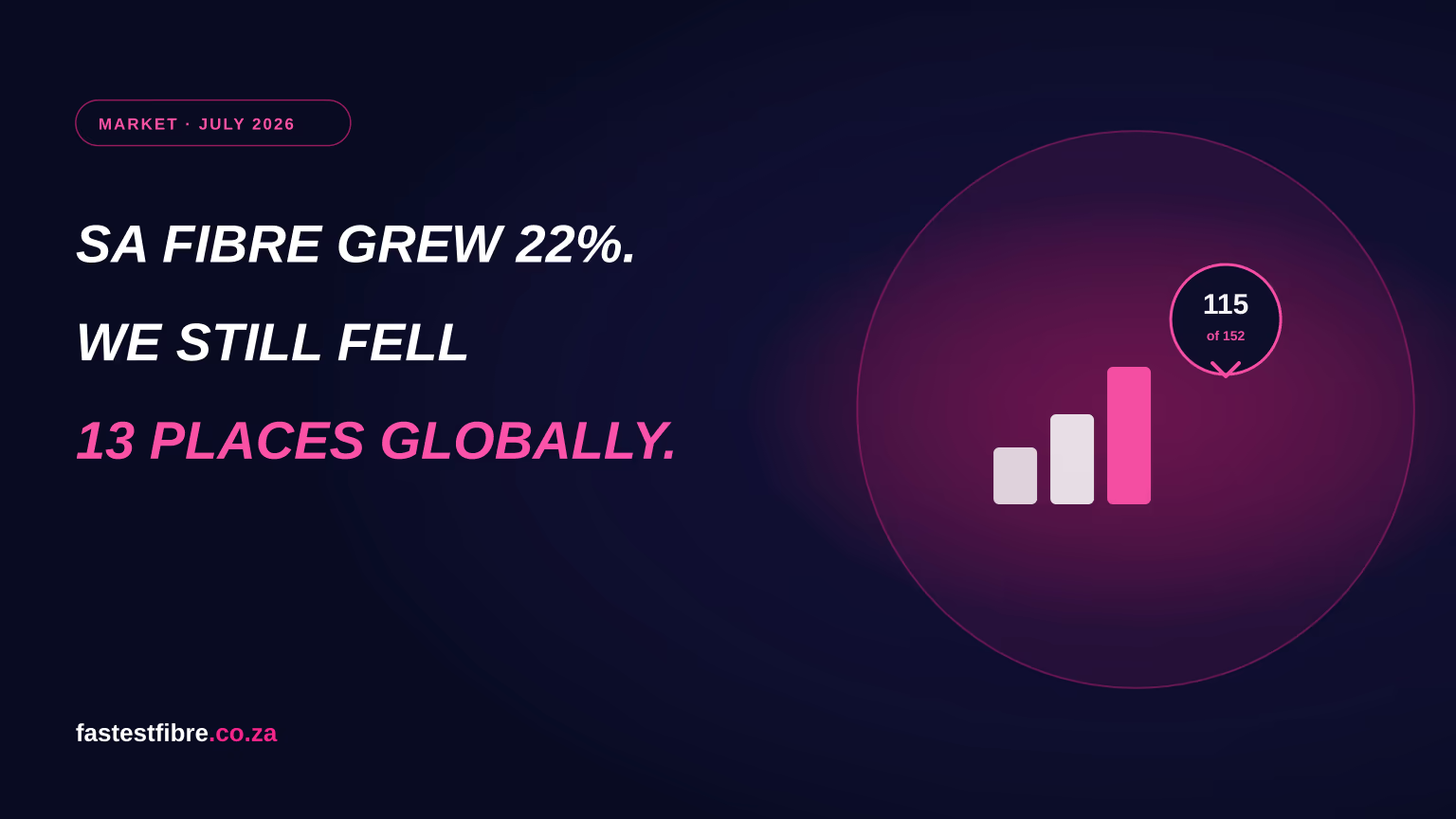
We covered that report in detail when it landed: fibre subscriptions grew 22% for the year while South Africa's overall fixed-broadband ranking fell 13 places globally, and entry-level fixed broadband came out the least affordable in the BRICS bloc. Also from that report, via TechCentral: of 21,878 government facilities obligated for connection under the 2022 spectrum auction licence conditions, 4,377 were connected by October 2025 - roughly 20%, three years on from an auction that raised R14.4 billion against a projected R8 billion. That gap between conditions attached and connections delivered is the kind of structural evidence an affordability inquiry exists to formalise, and it has not gone anywhere.
Icasa's track record, and why fibre is the gap in it
A market inquiry that runs its full course can genuinely move prices here, which is why the delay is worth noticing rather than shrugging at. Icasa's original call termination market inquiry led to cost-based wholesale regulations under the Electronic Communications Act from 2010, and the regulator's own figures show the average prepaid mobile voice price fell 24% - from R1.37 to R1.04 per minute - between June 2010 and June 2012 as that regulation took hold.
The same pattern is still running on mobile. Icasa's December 2024 call termination rate review set a glide path of further cuts: the wholesale rate large operators charge each other to terminate calls fell from 9c/minute to 7c in July 2025 and to 5c in July 2026, with further scheduled reductions still to come under the same published path, and small operators' rates falling on a parallel, steeper curve. A separate Icasa rule mandating data rollover is being challenged in court by Vodacom and MTN. Per Business Day's 31 August 2026 reporting, the financial effect is already visible: Cell C recorded an 11% (R174 million) drop in "other revenues" it attributed largely to termination-rate cuts, and Telkom's mobile interconnection fees fell 29% - from R157 million to R107 million - year-on-year to June 2026.
Read against that record, the withdrawal is a genuine setback rather than a formality. Icasa's affordability interventions have real teeth - operators litigate against them, which is the clearest evidence they bite - but that record is almost entirely on the mobile side. Fixed broadband, fibre included, has never had an equivalent binding intervention. The withdrawn inquiry was the first process pointed squarely at that gap, and the gap is now open for longer.
What to do about your fibre bill, now that nobody is coming
The practical conclusion is sharper than it was in September. Back then, the honest advice was that any regulatory relief sat at least a year out, so you should not wait for it. Now there is no process running at all and no date for one to restart - so "do not wait for the regulator" stops being a caution and becomes the whole answer. Nothing about your pricing, packages or current contract changed on 30 September, in either direction.
What does move your bill is the spread between ISPs reselling the identical line into your home - a gap this site measures continuously, and one that is routinely larger than anything a completed inquiry would be likely to deliver in its first year. Three things are worth doing this week:
- Find out what is genuinely available at your address. Our fibre coverage map shows which networks actually reach you, which decides everything that follows.
- Price the same line across every ISP that sells it. Compare fibre deals puts the full tracked catalogue in one table, and cheapest fibre deals ranks it by price per month - same network, same speed, different bill.
- Check the first-year total, not the sticker price. Best fibre deals and our ISP rankings account for promo periods reverting and once-off fees, which is where headline prices most often mislead.
We will update this article when a republished notice appears in the Government Gazette. There is no date to watch for, so the thing to watch is the Gazette itself and Icasa's own affordability-inquiry page - and a republished notice should arrive with the draft questionnaire attached, which is the signal that the process has genuinely restarted rather than merely been promised.
Frequently asked questions
Help someone else pick the right fibre
Now go and compare the deals
Prices below come from our own deal tracking, checked on 12 October 2026.
Ranked by price across every ISP and network we track.
See the dealsThe full catalogue in one sortable table - filter by speed, price or network.
See the dealsHow the major ISPs rank on price, support and real measured performance.
See the dealsRelated insights
Icasa 2026: Fibre Grew 22%, SA Fell 13 Broadband Places
Read article
Fibre Downgrade Fees, By Network: Every Operator's Number, Now Confirmed
Read article
Icasa's Rapid Deployment Rules vs the Wayleave Gap
Read article
The State of Fibre Internet in South Africa 2026
Read articleCheapest Fibre Deals in SA 2026
Read article