The State of Fibre Internet in South Africa 2026
FTTH crosses 3 million subscribers, Vodacom-Maziv reshapes the market, and prepaid township fibre from R5/day rewrites the affordability map. A consumer-market analysis with provider comparisons, pricing tables and strategic outlook.

In this article(13)
- 01Executive summary
- 021. Market overview & size
- 032. Major FNO players
- 043. Major ISPs
- 054. Pricing analysis
- 065. Township and lower-income market
- 076. Business fibre (FTTB)
- 087. Speed tiers and technology trends
- 098. Regulatory and policy environment
- 109. Challenges
- 1110. Consumer trends
- 1211. Future outlook
- 1312. A note on the UK comparison
Executive summary
South Africa's fibre market has moved decisively from a "land-grab" phase into a monetisation, consolidation and price-stratification phase in 2026. FTTH subscriptions have crossed roughly 3 million (up from 1.49 million in 2023), homes passed sit at around 6.1 million, and Vumatel alone hit 1 million live subscribers in February 2026.
The defining structural events of the past 12 months - the Competition Appeal Court's conditional approval of the Vodacom-Maziv deal in August 2025 (effective 1 December 2025), Octotel's launch of XGS-PON symmetrical 10 Gbps services, and the explosion of pay-as-you-go township fibre via Vuma Key (R99/month) and Fibertime (R5/day) - together mean the market now ranges from R99 prepaid lines in Alexandra to R2,400+ symmetrical gigabit offerings on the Atlantic Seaboard.
Wholesale fibre pricing has flattened or fallen for the third year running, with several FNOs (Evotel, Net Nine Nine) confirming no 2026 wholesale price hikes, and headline retail prices for 100 Mbps lines having fallen roughly 80-86% from their 2017 highs.
For an affiliate-site operator familiar with the UK's Openreach/altnet dynamic, SA's market should feel structurally similar but a phase behind: South Africa is now where the UK was around 2021-22, with full-fibre footprint expansion plateauing, ISPs differentiating on service rather than price, and gigabit becoming a mainstream rather than premium tier. The big difference: SA's market is genuinely open-access at the wholesale layer for almost all suburbs, and prices at the entry level are now materially cheaper than the UK on a price-per-line basis once you reach the township/Reach tiers.
1. Market overview & size
Subscriber numbers and growth
| Metric | 2023 | 2024 | 2025 | Notes |
|---|---|---|---|---|
| FTTH subscriptions | 1.49 m | 2.47 m | ~3.01 m | Icasa: FTTH/B +22% YoY in 2025 |
| Total fixed broadband subs | ~2.4 m | ~2.7 m | 3.26 m | +19.3% YoY (Icasa, 2025) |
| Homes passed (major FNOs) | ~4.7 m | ~5.4 m | 5.5-6.1 m | Ispa & Telegeography aggregates |
| Active FWA / 5G fixed subs | 0.6 m | 0.9 m | 1.26 m | +39% YoY |
| Internet users | 45 m | 48 m | 50.8 m | 79.6% of population (Jan 2025) |
FTTH growth ran at 65% YoY in 2024 - its fastest-ever year - slowing toward the high-20s in 2025 as build-out plateaus and operators pivot to connection rate (converting homes passed into paying customers). Vumatel reported a 19% jump in active connections in Q1 2025 alone; Openserve's connectivity rate hit a market-leading 52.4% by December 2025.
Penetration
Stats SA records that only 17.4% of South African households actually subscribe to fixed home internet - meaning the majority of "internet users" still rely primarily on mobile data. Roughly 28% of households have access to (rather than active) fibre. Urban FTTH penetration is now over 20% in major metros; in some affluent Joburg/Cape Town suburbs Vumatel reports attachment rates of 80%+. Mobile remains dominant: 69% of internet users still go online primarily via smartphones.
Geographic distribution
The Western Cape and Gauteng remain the most aggressively built-out and competitively priced provinces, with KwaZulu-Natal a strong third (driven by Zoom Fibre's coastal expansion). Limpopo, North-West and parts of the Northern Cape remain materially underserved by fibre and depend on fixed-LTE/5G FWA from Rain, MTN, Vodacom and Herotel.
- Cape Town suburbs: Octotel (largest), Frogfoot, Openserve; Vumatel growing on the Atlantic Seaboard.
- Joburg / Sandton / Bryanston: Vumatel and Openserve dominate; MetroFibre in pockets.
- Pretoria / East: Openserve + MetroFibre + Frogfoot.
- Durban / North Coast: Vumatel, Openserve, Zoom Fibre, MetroFibre.
- Estates & new developments: often Frogfoot or Vumatel; some closed-network operators (Lightstruck, Balwin, Purple Forest).
- Townships: Vuma Reach + Vuma Key dominant; Openserve in some areas; Fibertime expanding rapidly in Western Cape and Eastern Cape.
Comparison to other technologies
Fibre has comprehensively overtaken ADSL - Telkom's ADSL base fell below 36,000 by end-2024 from a 2015 peak above 1 million, and Openserve has been retiring copper since October 2021. The growth competition is now between fibre and 5G/LTE FWA, where Icasa's 2025 data showed FWA subs up 39% YoY to 1.26 million. Vodacom's 5G covers ~52% of the population, MTN ~44%, and Rain remains the price-leader on uncapped data-only 5G (from R649/month for 30 Mbps, R1,095 uncapped). Starlink is still illegal as of mid-2026 pending Icasa's regulatory amendments.
2. Major FNO players
The nine players below now control over 95% of South Africa's residential fibre footprint. The Vodacom-Maziv deal (effective 1 December 2025) and Vumatel's December 2025 takeover of Herotel mean Maziv (Vumatel + DFA + Herotel + Vodacom Fibre) now sits as a single dominant infrastructure group with a combined 2.96m+ homes passed - Vumatel's 2,339,932 at 31 March 2026 plus Herotel's stated 620,000+ floor at the 1 June 2026 merger, both from Remgro's FY2026 annual results presentation. The two as-of dates are three months apart, so treat the total as a floor rather than a same-date count; Remgro's own outlook slide rounds it to ">3 million".
| FNO | Owner | Homes passed | Connected | Conn. rate | Focus |
|---|---|---|---|---|---|
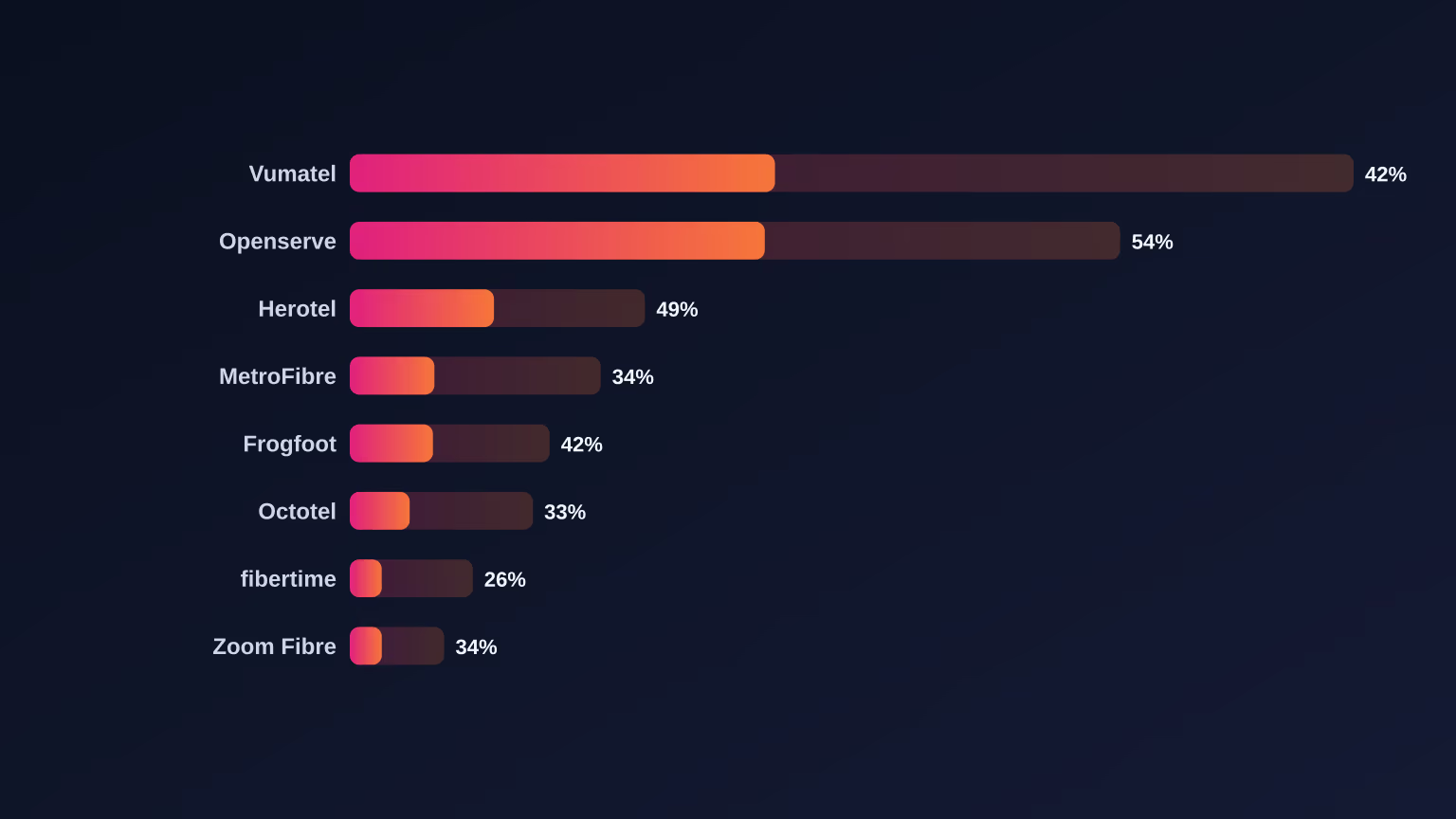
| Vumatel | Maziv (Remgro/CIVH; Vodacom 30%) | 2,339,932 (Mar '26) | 1,032,226 | 44% | National; Joburg + townships |
| Openserve | Telkom 100% | 1,501,406 (Dec '25) | 786,490 | 52.4% | Widest geographic reach |
| Herotel | Maziv 100% (merger completed 1 Jun 2026) | 620,000+ (Jun '26) | 350,000+ | 56% | Rural, peri-urban, secondary towns |
| MetroFibre Networx | AIIM / SAHIF / STOA | ~510,000 (Jun '25) | ~172,000 | 34% | Gauteng-focused; 5 provinces |
| Frogfoot | Vox / CIVH (Vivica) | 406,000 (2025) | 169k res + 13k biz | 42% | National; CT + Pretoria + estates |
| Octotel | AIIM / STOA / Thebe | 372,000 (Jun '25) | 121,800 | 33% | Western Cape only (licensed) |
| Fibertime | Isizwe Group (private) | ~250,000 (2026) | ~200,000 | 80%+ | Townships (Kayamandi, Mfuleni, Soweto) |
| Zoom Fibre | Founder-led | 191,636 (Jun '25) | 65,100 | 34% | KZN, Gauteng, Mpumalanga, NW, WC |
| Vodacom Fibre | Vodacom (now via Maziv) | 165,879 (Jun '25) | ~55,000 | 33% | JHB, PTA, CT, Durban |
| MTN Supersonic | MTN (closed) | ~150,000 (est) | n/a | n/a | Major metros |
ISP-rated FNO performance (Ispa February 2025 survey of how ISPs rate the FNOs they buy from): Octotel 7.4/10, Openserve 6.7, MetroFibre 6.7, Liquid 6.1, Link Africa 6.1, Frogfoot 5.6, DFA 4.9, Vumatel 4.6. Octotel has consistently topped this list - a useful signal for ISPs choosing which network to lean on.
The Vodacom-Maziv merger - what changed in 2025-26
After a four-year regulatory marathon, the deal was:
- Originally prohibited by the Competition Tribunal in October 2024 (350-page ruling).
- Conditionally approved by the Competition Appeal Court on 15 August 2025, after the Competition Commission reversed its position.
- Granted Icasa's unconditional approval in November 2025.
- Effective from 1 December 2025.
The R13.2bn transaction gives Vodacom a 30% co-controlling stake in Maziv (parent of Vumatel + Dark Fibre Africa). The conditions are extensive and consumer-relevant:
- A binding undertaking to extend fibre into "Reach" areas (avg household income < R254,495) and "Key" areas (< R60,000), with mandatory minimum connection rates.
- R60 billion Vodacom capex commitment for 90% 5G population coverage within five years.
- Free, uncapped wholesale FTTH for every public and private school, plus connectivity for 1,573 healthcare facilities, 210 libraries and 100 police stations.
- Strict open-access requirements: Maziv must keep its network available to smaller ISPs on a non-discriminatory basis.
- An employee benefit scheme for broad-based worker ownership in Maziv.
For the consumer market, the merger removes Vodacom's incentive to build duplicate fibre and accelerates Vumatel's expansion into low-income communities. Expect Vodacom-bundled fibre+mobile offers to ramp through 2026.
3. Major ISPs
Roughly 75 ISPs sit on top of Vumatel alone, and 79+ are active under SA Connect. The big-15 commercial ISPs:
- Afrihost - MyBroadband ISP of the Year 2023, 2024, 2025 and 2026 (four consecutive). Owned by MTN. Strongest mainstream brand for value + service.
- Cool Ideas - highest customer satisfaction (86% in 2025). Premium/quality-focused; was first to deploy Vumatel 10 Gbps trial.
- Webafrica - strong multi-FNO play, aggressive R19 first-month promos, free install + free router.
- RSAWEB - best in class for SLAs and business; consistently highest-rated for support.
- Axxess - flexible month-to-month, no credit checks, strong in fixed-LTE/5G.
- MWEB - established, good multi-network coverage.
- Vox - closely tied to Frogfoot; strong in SME/business fibre.
- Telkom (consumer ISP) - sells direct on Openserve; converged mobile bundles.
- Vodacom Fibre - now layered on Maziv post-merger; bundled with mobile.
- MTN Supersonic - MTN-owned ISP (closed FNO + retail).
- Cybersmart - Cape Town-headquartered Tier-1 IECS+IECNS licensed; owns its own fibre and data centres in CPT/JHB/DBN.
- Atomic Access - Western Cape independent; first SA ISP to launch XGS-PON over Octotel.
- Home Connect - Afrihost subsidiary (acquired from CipherWave).
- Cell C - value/mobile-focused; 56% satisfaction; recent push back into fibre and 5G.
MyBroadband customer satisfaction snapshot (2025 Q2)
| ISP | Satisfaction score |
|---|---|
| Cool Ideas | 86.0% |
| Afrihost | 76.3% |
| Axxess | 74.1% |
| Webafrica | 69.0% |
| RSAWEB | 67.1% |
| Vox | 66.9% |
| Cell C | 57.0% |
| Telkom | 56.0% |
4. Pricing analysis
Average residential FTTH pricing by speed tier (April 2026)
Cheapest publicly listed uncapped, month-to-month deals from Webafrica, Afrihost, RSAWEB, MWEB, Cool Ideas and Axxess. Includes router, install and activation unless noted. All prices in ZAR per month.
| Speed tier | Cheapest entry | Mid-market avg | Premium ISP | Typical FNOs |
|---|---|---|---|---|
| 10/1 Mbps | R297 (Frogfoot via Afrihost) | R329-R399 | R449 | Openserve, Frogfoot |
| 20/10 (Reach/entry) | R339 (Openserve via RSAWEB) | R399 (Vuma Reach) | R449 | Openserve, Vuma Reach |
| 25/25 symmetrical | R449 (Vuma) | R499-R545 | R599 | Vuma, Openserve |
| 50/25 - 50/50 | R679 (Vuma) | R725-R819 | R899 | All |
| 100/50 - 100/100 | R817 (MTN/Frogfoot via Afrihost) | R869-R899 | R999 | All |
| 200/200 | R1,045 (Vuma via RSAWEB) | R1,099-R1,199 | R1,299 | Vuma, Openserve, Frogfoot |
| 500/250 | R1,345 (Openserve via RSAWEB) | R1,397 (Afrihost) | R1,499 | Openserve, MetroFibre |
| 1 Gbps asymmetrical | R1,049 (Mitsol) | R1,149 (Zoom) | R1,277-R1,499 | Mitsol, Zoom, Vuma |
| 1 Gbps symmetrical | R1,149 (Comtel via Cool Ideas) | R1,199-R1,499 | R1,899-R2,429 (Vuma) | Comtel, Frogfoot, Mitsol |
| 10 Gbps (XGS-PON) | ~R3,500-R4,500 | n/a | n/a | Vumatel, Octotel |
Pricing trend - has fibre got cheaper?
Yes, materially. South African 100 Mbps fibre is approximately 86% cheaper than at its 2017 launch, and the price-per-Mbps at the 500/250 tier has fallen below R2.79 (Afrihost on Openserve) - better than many UK Openreach 1 Gbps re-sellers on a £/Mbps basis.
For 2026 specifically, several FNOs have frozen wholesale prices:
- Evotel and Net Nine Nine confirmed no 2026 wholesale increases.
- Vumatel and Openserve both update pricing on 1 April annually; Vumatel's 1 April 2026 changes are described as "modest, mostly speed upgrades."
- Herotel confirmed it does not anticipate "broad, above-inflation" 2026 increases.
Promotional offers (April 2026)
- Free installation (worth R1,500-R2,800) on virtually every Openserve and Vumatel package via Webafrica, Afrihost and RSAWEB.
- Free Wi-Fi router (mostly insured TP-Link or Tenda) included with most packages above R599/month.
- R19 first-month deals are standard at Webafrica.
- R0 first month promos on Cybersmart 1 Gbps via Afrihost.
- R999 SLA credits if line not installed within 7-21 days (Webafrica, Afrihost).
- Up to 6 months free on certain Vodacom and MTN bundled fibre + mobile packages post-merger.
FTTB (business fibre) pricing for SMEs
Business fibre carries a 30-80% premium over equivalent residential lines because it includes lower contention ratios (typically 1:5 to 1:10), enforceable SLAs (99.5-99.9% uptime), priority repair, dedicated/static IP, and business-grade routers.
| FTTB tier | Speed | Typical price/month | Best-fit |
|---|---|---|---|
| FTTB Lite (RSAWEB/Vox) | 10/10 - 25/25 | R599-R1,199 | Freelancers, micro-SMEs |
| Standard FTTB | 50/50 - 100/100 | R1,299-R2,499 | Small offices (5-20 staff) |
| Premium FTTB | 200/200 - 500/500 | R2,999-R6,500 | E-commerce, call centres |
| Dedicated fibre (1:1) | 100 Mbps - 1 Gbps | R7,500-R25,000 | Enterprise, finance, ISPs |
| Cybersmart Lightspeed (own-net) | 100-1,000 Mbps symmetrical | R1,499-R7,000 | Western Cape SMEs |
South Africa vs other emerging markets
| Country | Typical 100 Mbps FTTH (USD) | 1 Gbps FTTH (USD) |
|---|---|---|
| South Africa (2026) | $43-$49 | $55-$80 |
| Kenya (Safaricom Home, 2025) | $40 | $115 |
| Nigeria (MTN, ipNX, 2025) | $65-$85 | $200+ |
| Morocco (Maroc Telecom, 2024) | $35 | $90 |
| Brazil (Vivo, Claro, 2025) | $25 | $40 |
| Egypt (Telecom Egypt, 2024) | $20 | n/a |
| UK reference | £22 ($28) | £29 ($37) |
South Africa is mid-pack for emerging markets at the consumer level - significantly cheaper than Nigeria, marginally cheaper than Kenya at gigabit, but still 50-80% more expensive than UK gigabit.
5. Township and lower-income market
This is the most important growth segment in 2026, and the area where SA is leading global emerging-market fibre rollouts.
Vuma Reach (post-paid, R399 entry)
- Open-access aerial fibre targeted at households earning R5,000-R30,000/month.
- Coverage: Soweto, Alexandra, Khayelitsha, Mitchells Plain, Mamelodi, Soshanguve, Vosloorus, Retreat, Grassy Park, Blue Downs, Tshwane, Kuils River.
- Expanded 12% in 2025 with subscriber growth of 39% YoY.
- Pricing: 20/10 Mbps for R399, 40/10 for R529, 100/50 for R799 - all uncapped.
- Free installation (R999), router included in the ONT, no contracts.
Vuma Key (prepaid, R99/month)
- Targets households earning under R5,000/month - the country's poorest 10 million homes.
- R99 for 30 days of uncapped 10/5 Mbps, supports 4 simultaneous devices.
- 34% cheaper than its closest prepaid competitor.
- Pay via EasyPay vouchers at Boxer, Pick n Pay, PEP, Ackermans, Kazang/spaza shops.
- Live in Alexandra (wards 75, 76, 107, 108, 116) and all wards of Kayamandi.
- 30,000+ homes connected by October 2025; targeting the full 10 million addressable market.
- Includes free fibre to qualifying schools along the deployment route.
Fibertime (pay-as-you-go, R5/day)
- The fastest-growing entrant of 2025-26. Stellenbosch-based (Isizwe Group); 100% township-focused.
- R5 per 24 hours of uncapped 100 Mbps - equivalent to R150/month if used daily, or zero on days the household doesn't use the internet.
- Connected 6,500 homes in Kayamandi by end of 2024; 200,000 homes by October 2025.
- Targets 1.8 million homes by April 2028, with R60bn investment commitment.
- Active in: Kayamandi, Mfuleni, Kraaifontein, KwaNobuhle (Kariega), Rustenburg, Makhanda, plus Cape Town, Johannesburg, Gqeberha, Mangaung.
- Free router and Gizzu battery backup with installation; partnership with Nokia.
- Reaching connection rates of 100-1,200 households per day.
Other affordable township products
- Wire-Wire, Ilitha Telecoms, Zing Fibre - smaller township-focused FNOs operating similar prepaid/low-cost models.
- Vumatel Fibre to Schools - free 1 Gbps lines to qualifying primary and secondary schools along Vuma Key routes.
- SA Connect Phase 2 - government target of free 50 GB/month for all households via subsidised public Wi-Fi; aims to connect 5.5 million households by end of 2026.
Since 2011, the share of South African households with no internet access has dropped from 64.8% to 21.1% (2022 census). For the first time in SA history, fibre - not mobile data - is the cheapest way to get online for low-income households. Cable.co.uk data put SA mobile data at $1.18 per GB in 2023; Vuma Key effectively delivers unlimited data at less than R0.01 per GB for an average user.
6. Business fibre (FTTB)
Architecture choices
- Shared / contended FTTB: 1:5 to 1:10 contention; uncapped; 10-500 Mbps; R1,299-R6,500/month.
- Dedicated fibre: 1:1 contention; full-rate guaranteed; 100 Mbps - 10 Gbps; R7,500-R50,000+/month.
- Hybrid (fibre + LTE/5G failover): Vox's "Fibre Plus" and similar packages from RSAWEB, Cybersmart, Telkom Business - auto-failover prevents downtime.
SLAs and uptime
Network operators typically don't guarantee specific repair times; ISPs add their own commitments on top:
- RSAWEB Premium: 99.9% uptime, 4-hour MTTR.
- Cool Ideas Business: 99.5%, dedicated IP, business support.
- Vox Premier: 99.9% with managed failover.
- Cybersmart Lightspeed: Own-network IECS+IECNS - "single throat to choke" advantage.
- Telkom/Vodacom/MTN Business: 99.95% on dedicated tiers.
Top business fibre providers (2026)
| Provider | Best for | Network access | Differentiator |
|---|---|---|---|
| RSAWEB | SMEs needing tiered SLAs | Multi-FNO | Two-tier (Lite + Premium) approach |
| Vox | Mid-market with managed services | Frogfoot + multi-FNO | Wi-Fi-as-a-Service, MTN failover |
| Cybersmart | Western Cape SMEs | Own + open-access | Dual licensing + own DC |
| Cool Ideas Business | Premium technical | Multi-FNO | Low contention, transparent |
| Telkom Business | Nationwide | Openserve | Widest geographic reach |
| Vodacom Business | Mobile + fibre converged | Now Maziv post-merger | Bundle with 5G |
| MTN Business | Enterprise | MTN Supersonic + multi | Pan-Africa enterprise services |
| Liquid Intelligent Tech. | Enterprise / ISP wholesale | Own pan-African net | 110,000+ km, Africa's largest indep. |
| United Telecoms | Voice + data bundles | Multi-FNO | Cloud PBX integrated |
7. Speed tiers and technology trends
Symmetrical takeover
Until 2024 the SA market was overwhelmingly asymmetric (most popular: 100/50 Mbps). 2025 saw a structural reset:
- Openserve rolled out symmetrical FTTH tiers across its core packages in 2025 (20/20, 50/50, 100/100, 200/200, 500/500), delivered via existing GPON.
- Frogfoot, MetroFibre and Octotel followed within months.
- Vumatel retained asymmetric pricing on its premium tiers (1 Gbps/500 Mbps remains a flagship), but added symmetrical options on Vuma Reach.
Symmetrical packages now command roughly 20-40% price premium over equivalent asymmetric tiers, but the gap is closing fast.
Gigabit going mainstream
1 Gbps fibre was a luxury R2,000+/month product in 2021. In 2026 it's available from R1,049/month (Mitsol via Webafrica), with symmetrical 1 Gbps from R1,149. Vumatel reports 4-5% of its base now on 1 Gbps packages. See our honest gigabit buyer's guide.
XGS-PON and 10 Gbps
- Octotel launched commercial XGS-PON symmetrical 10 Gbps in selected Cape Town suburbs in late 2025 (sold via Atomic and others).
- Vumatel has run 10 Gbps trials with Cool Ideas since 2021 and offers commercial 10 Gbps in selected Joburg and Cape Town suburbs.
- Openserve is upgrading its core to support 10 Gbps tiers but has not yet announced 10 Gbps retail packages. (Update, July 2026: since this article was first published, Openserve has entered retail directly - launching Openserve ISP, a direct-to-consumer service selling uncapped fibre from R345 to R1,449/month through its own web store.)
Pricing for 10 Gbps tiers is currently R3,500-R4,500/month with most cost going to suitable customer hardware (10 GbE NIC, capable ONT, Wi-Fi 6/7 router).
Wi-Fi 6 / Wi-Fi 7 routers
- Wi-Fi 6 is now the default included router on R699+/month packages from Webafrica, Afrihost, RSAWEB and MWEB (typically TP-Link Deco X50 mesh systems on premium tiers).
- Wi-Fi 7 routers appearing on premium 1 Gbps+ tiers from Cool Ideas, Cybersmart and Atomic; usually a R999-R1,999 once-off upgrade.
- Fibre-to-the-Room (FTTR) - Openserve launched a commercial FTTR product in 2024-25, delivering whole-home symmetrical Wi-Fi via secondary mini-ONTs.
8. Regulatory and policy environment
Icasa's expanding workload
- Approved (with conditions) the Vodacom-Maziv deal (November 2025).
- Published its State of the ICT Sector report (Q4 2025) showing fixed broadband subs up 19.3%, FTTH/B subs up 22%, FWA up 39%.
- Working through the contentious Equity Equivalent Investment Programme (EEIP) policy directive issued by Minister Solly Malatsi on 12 December 2025.
- Drafting a new satellite licensing framework for 2026/27.
SA Connect Phase 2
- R710 million allocated over the medium term.
- Targets: 5.5 million households connected, 32,000 Wi-Fi hotspots, 18,000 schools, 5,700 clinics, 8,200 tribal authority centres by end-2026.
- Underpinned by Broadband Infraco's Modernised National Broadband Backbone, launched 2 October 2025.
- The plan also targets free 50 GB/month per household via subsidised networks.
Starlink and the EEIP saga
The most politically charged story in SA telecoms. Status as of mid-2026:
- Starlink remains technically illegal in South Africa; SpaceX has not held the I-ECNS and I-ECS licences required by the Electronic Communications Act.
- The blocker is the requirement that 30% of equity be held by historically disadvantaged groups under B-BBEE rules.
- Minister Malatsi's 12 December 2025 policy directive instructed Icasa to recognise EEIPs (Equity Equivalent Investment Programmes) as an alternative compliance route.
- The directive has since stalled: Icasa has formally flagged that it cannot give full effect to the policy direction without an amendment to the Electronic Communications Act itself - a far slower, Parliament-bound process than a regulatory tweak.
- 90% of public submissions supported the directive; political opposition (EFF, MK Party, Portfolio Committee chair Khusela Diko) is fierce.
- Starlink has pledged R2 billion in EEIP commitments (R500m to connect 5,000 schools).
- Telecoms expert Dominic Cull warns the full Icasa amendment process could take 12-18 months, putting realistic legal Starlink launch at late 2026 to 2027.
Amazon Project Kuiper and Eutelsat OneWeb are also waiting on the same regulatory door to open.
Open access and wholesale pricing
Icasa has not aggressively regulated wholesale fibre pricing - competition between FNOs at the suburb level largely keeps it in check, although Ispa has flagged that exclusive municipal rollout permits sometimes give a single FNO a de facto monopoly on a street. The Vodacom-Maziv conditions reinforce open access at the wholesale level: Maziv must continue to support smaller ISPs on non-discriminatory terms and cannot bundle anti-competitively.
9. Challenges
Power and infrastructure
- Eskom officially declared an end to load shedding in 2024-25, but municipal-level outages remain pervasive.
- Telecoms equipment theft jumped 189% to R201.5 million in 2025, according to Icasa's State of the ICT Sector report - the dominant new cost driver.
- Operators spent R3.5 billion on backup power in 2023, falling to R385m in 2024 as load shedding eased.
- Telecoms lobby group ACT continues lobbying for diesel rebates; the request was again ignored in the 2025-26 budget.
- Cable theft (especially of FNO backhaul cables and tower batteries) continues to affect fibre uptime in Joburg and the East Rand.
Affordability and inclusion
Despite Vuma Key (R99) and Fibertime (R5/day), SA's fibre affordability ceiling is still real - only about 17.4% of households subscribe to fixed home internet, far below the 28% with access. The R99-R150/month tier is genuinely transformative but will need 2-3 more years of expansion to penetrate the addressable 10m low-income homes meaningfully.
Last-mile and backhaul
- 5G boom is bypassing rural areas (per Icasa), as 5G upgrades follow device penetration.
- International backhaul has become more resilient with 2Africa, Equiano, SEA-ME-WE-6 and Medusa all live or under construction, dramatically lowering wholesale bandwidth costs.
- Subsea cable cuts (notably March 2024's WACS/SAT-3 incident) showed the importance of route diversity; Openserve is enabling a fifth international point of presence via a planned SA-Angola-Brazil cable.
10. Consumer trends
What South Africans use fibre for
- Streaming dominates: Netflix, Showmax (now sunsetting in favour of Canal+ in 2026), YouTube, DStv Stream, Amazon Prime Video. SA average household data consumption has crossed 200 GB/month on fibre lines.
- Work-from-home sustained at high levels post-COVID; video conferencing is the second-biggest driver of upload demand and the catalyst for the symmetrical-pricing revolution.
- Online gaming has grown sharply with PS5/Xbox Series X penetration; latency-conscious users gravitate to Cool Ideas, RSAWEB and Atomic.
- Smart-home / IoT and 4K + 8K streaming justify the gigabit upgrades that 4-5% of Vuma's customer base have made.
Customer satisfaction trends
- Cool Ideas has held the top satisfaction spot for four consecutive years (86% in 2025).
- Afrihost has won MyBroadband ISP of the Year 2023, 2024, 2025 and 2026.
- Vumatel scored just 4.6/10 from ISPs in Ispa's February 2025 FNO survey - the lowest of major FNOs.
Switching behaviour
- ISP migration on the same FNO typically takes 1-2 business days and costs R0-R200.
- FNO switching (e.g. Openserve to Vumatel) requires a fresh install and is rare.
- Webafrica and Afrihost dominate the switcher market on Openserve; MWEB has been losing share.
Bundled services
- Telkom's converged bundles (mobile + fibre + voice) reignited in 2024 and continue to gain share.
- Vodacom is preparing aggressive fibre+5G+mobile bundles for mid-2026 post-Maziv merger.
- Showmax integration with MTN ended in 2025 with the Canal+ takeover; new content bundles expected through Q2/Q3 2026.
11. Future outlook
Subscriber growth 2026-28
Africa Analysis projects FTTH subscriptions to reach 4.5-5.0 million by 2028, implying ~20% CAGR from 2025's 3.0m base. The top-line driver is no longer middle-class subdivision rollouts (Vumatel views these as saturated) but the lower-income segment served by Vuma Reach, Vuma Key, Fibertime and rivals.
5G FWA: complement or competitor?
5G FWA is firmly a complement in fibred suburbs but a direct competitor elsewhere. Rain, MTN and Vodacom are pricing aggressively (5G home routers from ~R699/month). Vodacom's MTN/Vodacom 5G coverage now reaches roughly 50% of the population, with R60bn earmarked for 90% coverage within five years. Expect ISPs to increasingly bundle hybrid fibre-and-5G failover for resilience.
Starlink and LEO satellite
Even on optimistic timelines Starlink is unlikely to launch legally before late 2026, and could slip to 2027. Once live, its impact on metro-fibre will be limited (it is materially more expensive at $50-$100/month and capacity-constrained), but in rural, peri-urban and small-town SA it could leapfrog Herotel and fixed-LTE within 12-18 months. Amazon Kuiper and OneWeb will follow.
M&A activity
- Vumatel/Herotel consolidation rubberstamped December 2025 - expect operational consolidation through 2026.
- Maziv + Vodacom Fibre integration is expected to combine three networks into one operationally over 12-18 months.
- Octotel changed hands in 2024 (Actis to AIIM consortium); further private-equity activity expected, particularly around MetroFibre and Frogfoot.
- Smaller FNOs (Mitsol, Lightstruck, Zoom, Link Africa, Net Nine Nine, DNATel) are likely M&A targets.
Investment landscape
The combined SA wholesale telecoms market is forecast to reach R52 billion by 2027 (CAGR 9.1%), and the ICT sector overall to hit $58 billion by 2030 (CAGR 7.9%). South Africa's dark fibre segment specifically is projected to grow from $16.15m in 2023 to $41.36m by 2032 - a 10.86% CAGR.
12. A note on the UK comparison
For UK readers used to the Openreach/altnet dynamic, the SA fibre landscape sits at an interesting parallel point in its life cycle:
- Openreach ↔ Openserve are direct functional analogues (incumbent telco-owned wholesale unit).
- Vumatel ↔ CityFibre in concept, but Vumatel has dramatically more market share than CityFibre does in the UK (~36% vs ~4%).
- Octotel ↔ Hyperoptic / Community Fibre - high-quality regional altnets bought up by infrastructure PE.
- Vuma Reach / Vuma Key / Fibertime have no direct UK equivalent - these are emerging-market price tiers (R99/month uncapped, R5/day pay-as-you-go) that the UK doesn't need because of social tariffs and FTTC ubiquity.
- Pricing: SA gigabit at R1,049-R1,149 (~£44-48) is materially more expensive than the UK's £29-32 starter gigabit packages, but the SA 10/1 entry tier at R297 (~£12.50) is competitive with UK social tariffs.
- Speed tier maturity: UK is well into XGS-PON multi-gigabit retail; SA has just started, with roll-out concentrated in Cape Town and Johannesburg premium suburbs.
- Switching friction: SA's One-Touch-Switch equivalent doesn't exist. ISP switching on the same FNO is fast (1-2 days); FNO switching is essentially a fresh install.
The big strategic lesson for UK operators: SA's open-access model has worked extraordinarily well at delivering retail price competition, but it has not solved the rural / low-density connectivity gap any better than the UK's altnet land grab. The economic answer in SA has been social-engineering the prepaid model (Vuma Key, Fibertime) rather than waiting for build-out economics to catch up - a possible template for UK rural altnets struggling to monetise low-density footprint.
For affiliate publishing, the most commercially attractive ISP partners on SA's open-access networks remain Webafrica (highest AOV through their bundling and free-install model), Afrihost (highest brand search volume), RSAWEB (best business margin), Cool Ideas (highest customer satisfaction → lowest churn) and Atomic (Western Cape XGS-PON early mover). Vuma Reach, Vuma Key and Fibertime are the highest-volume opportunities at the bottom of the funnel.
Report prepared April 2026. Pricing data verified against publicly listed Webafrica, Afrihost, RSAWEB, MWEB, Cool Ideas and Vumatel/Openserve/Frogfoot/Octotel/MetroFibre rate cards. Subscriber and homes-passed data from Telkom Group and Maziv integrated reports, Icasa's 2025 State of the ICT Sector report, Ispa's National Fibre Mapping Project, Stats SA, and operator JSE disclosures. Pricing changes weekly and should be re-checked at the point of writing affiliate copy.
Help someone else pick the right fibre
Now go and compare the deals
Prices below come from our own deal tracking, checked on 6 October 2026.
What each package actually costs per megabit, not just per month.
See the dealsRanked by price across every ISP and network we track.
See the dealsEvery package at 1 Gbps and above, with the cheapest route to that speed.
See the dealsRelated insights
The Fibre Uptake Gap: Which SA Networks Actually Turn Coverage Into Customers
Read article
Openserve Launched Its Own ISP. Should You Switch, or Stick With a Reseller?
Read article