Herotel Just Told Us How Much Amazon's Satellite Internet Will Cost
Herotel CEO Van Zyl Botha has revealed the pricing strategy behind evry, the Amazon Leo satellite broadband brand Herotel is launching in South Africa: match the company's own fibre prices almost exactly, and hold them stable for three years. Here's what's confirmed, what's still unknown, and what it means if fibre already passes your street.
In this article(11)
- 01What Herotel's CEO actually said
- 02The benchmark: what Herotel fibre costs today
- 03Nano vs Pro: what's confirmed, and the gap that isn't
- 04How we got here: from a licensing workaround to a pricing strategy
- 05Why would a fibre operator price satellite at fibre parity?
- 06Who evry is actually competing with - and it isn't Starlink
- 07Should you wait for evry, or get fibre now?
- 08What we verified today, and what we couldn't
- 09What to watch next
- 10Bottom line
- 11Frequently asked questions
What Herotel's CEO actually said
Eight months after Herotel signed the distribution deal that brought Amazon's Leo satellite constellation to South Africa under the brand evry, the company's CEO has finally put a number on the table - sort of. In an interview on the TechCentral Show, published 11 August 2026, Herotel CEO Van Zyl Botha explained why the deal made commercial sense for a fibre operator to sign in the first place: "The reason why this product was appealing is that we could match almost entirely our current fibre prices."
That's a pricing philosophy, not a price list. Botha named the two antenna tiers evry will launch with - Nano, capped at up to 100Mbit/s, and Pro, capped at up to 300Mbit/s - and said pricing would be "held as far as possible over an initial three-year period," rather than moving with the Rand, because Herotel will "be the importer of record" and "land the terminals in South Africa" itself, absorbing currency exposure that would otherwise land on the customer's monthly bill. What he did not give is an exact Rand figure for either tier, or a firm launch date beyond "sometime next year" - by his own admission, "I can't give a firm date in 2027 because... it depends on launching satellites."
| Metric | Value | Detail |
|---|---|---|
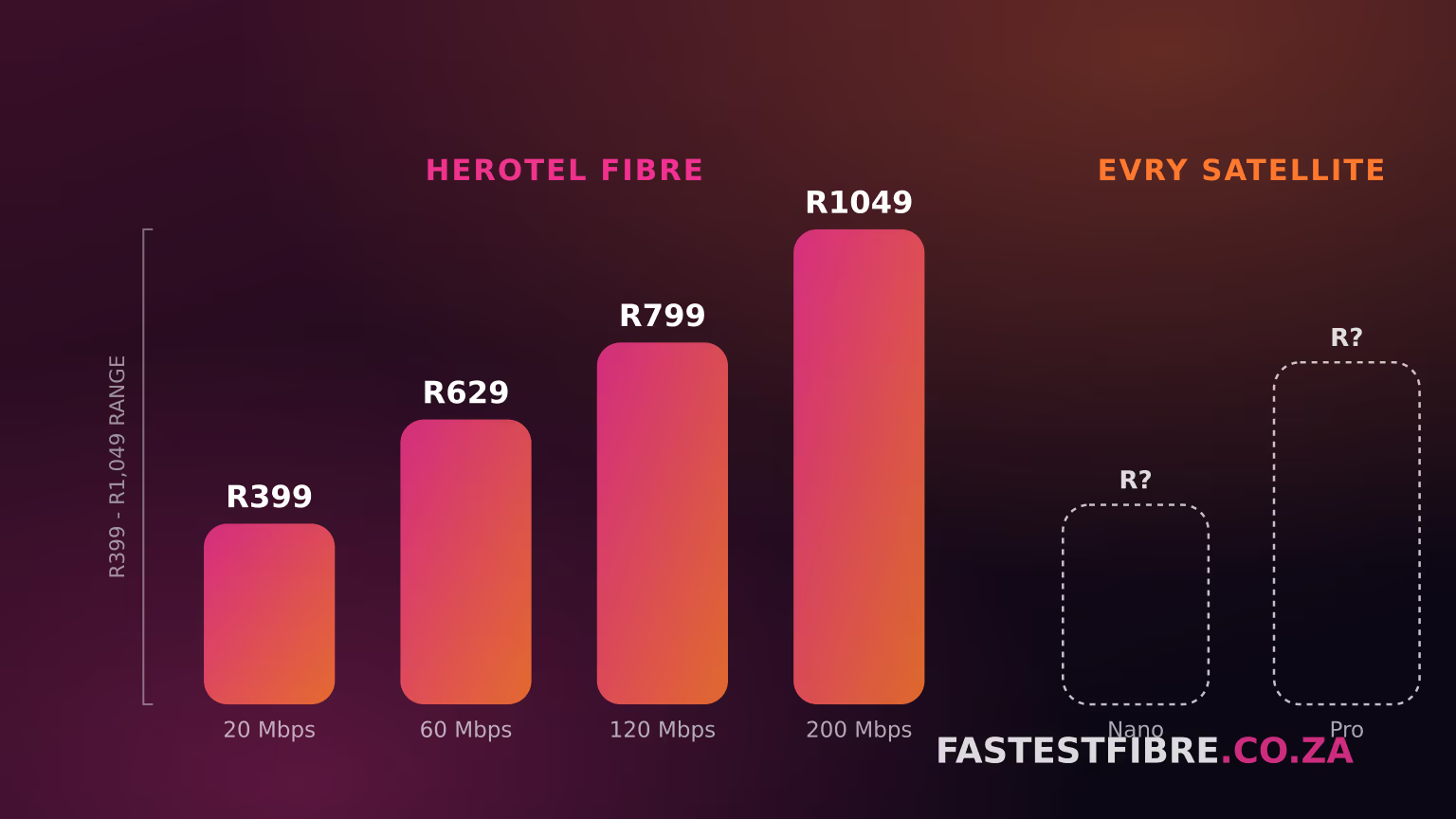
| Herotel fibre range | R399 - R1 049 | 20-200 Mbps, the benchmark evry is being priced against |
| evry Nano top speed | 100 Mbit/s | Smaller antenna, entry tier |
| evry Pro top speed | 300 Mbit/s | Larger antenna, higher tier |
| Price stability pledge | 3 years | Herotel importing terminals directly to absorb currency risk |
The benchmark: what Herotel fibre costs today
"Match almost entirely our current fibre prices" only means something if you know what those prices are. Herotel is both an ISP and its own fibre network operator, selling HeroFibre directly with a free-to-use router and no upfront install cost. Its four current residential tiers, re-verified today against Herotel's own site and cross-checked against the same speed figures Botha used in the TechCentral interview, are the table below - this is the actual range evry is being pitched against.
| Speed | Monthly price | Price per Mbps |
|---|---|---|
| 20/10 Mbps | R399 | R19.95 |
| 60/60 Mbps | R629 | R10.48 |
| 120/120 Mbps | R799 | R6.66 |
| 200/200 Mbps | R1 049 | R5.25 |
Read that range and Botha's quote together, and the honest translation is: evry's eventual price for Nano and Pro should land somewhere between R399 and R1 049 a month - not below it, and probably not far above it either, since undercutting or wildly overshooting Herotel's own fibre range would contradict "match almost entirely." That's a genuinely useful signal for budgeting purposes. It is not, however, a confirmed price for either specific tier, and we're not going to present it as one.
One pattern worth noticing in Herotel's own fibre table: price per Mbps falls sharply as speed rises, from R19.95 per Mbps on the cheapest tier down to R5.25 per Mbps on the fastest - a roughly 74% drop in unit cost from bottom tier to top. That's a normal shape for a fixed-line network, where a large share of the monthly price covers infrastructure and overheads that don't scale linearly with speed. Whether evry's own price-per-Mbps curve follows the same shape - or whether Nano and Pro end up priced closer together, given that both share the same satellite constellation and ground infrastructure rather than genuinely different physical lines - is exactly the kind of detail that won't be knowable until Herotel names actual figures.
Nano vs Pro: what's confirmed, and the gap that isn't
Two antenna tiers are confirmed by name and top speed. Nothing else about them - price, exact latency, hardware cost, data allowances if any - has been published anywhere we could find, first- party or otherwise, as of today.
| Tier | Top speed | Monthly price |
|---|---|---|
| Nano | Up to 100Mbit/s | Not yet announced |
| Pro | Up to 300Mbit/s | Not yet announced |
We're showing that gap deliberately rather than guessing at a Nano-costs-this, Pro-costs-that split. It's tempting to assume Nano maps to Herotel's cheaper fibre tiers and Pro to the pricier ones, but Botha's quote describes matching the range, not a tier-for-tier mapping, and nothing in the interview or on evry.co.za assigns a specific figure to either antenna. Any article confidently stating "Nano costs R629" or similar today would be inventing a data point - we'd rather tell you plainly what's known and what isn't.
How we got here: from a licensing workaround to a pricing strategy
This is the second evry story we've covered, and it's worth being clear about what each one added. The first, from July, was about why evry could launch at all - a structural workaround to the Icasa ownership rule that has kept Starlink locked out of South Africa for more than six years. This one is about what it will cost. Here's the sequence:
- 15 July 2026Herotel and Amazon Leo announce the evry distribution deal
Herotel - the Maziv-owned fixed-wireless and fibre ISP - signs a distribution agreement to bring Amazon's Leo satellite constellation to South Africa under the evry brand, using Herotel's existing network licences to route around Icasa's ownership rule that has kept Starlink out. Registration opens at evry.co.za; commercial launch is pencilled in for 2027, with no pricing announced.
- 11 August 2026Herotel CEO reveals the pricing strategy on the TechCentral Show
Van Zyl Botha tells TechCentral evry will be priced to “match almost entirely” Herotel's current fibre prices, held stable for roughly three years because Herotel - not a currency-exposed importer - will be “the importer of record” landing the antennas locally. He names the two antenna tiers, Nano (up to 100Mbit/s) and Pro (up to 300Mbit/s), but gives no exact Rand figure for either and no firmer date than “sometime next year,” dependent on Amazon's satellite launch schedule.
| Date | Milestone | What happened |
|---|---|---|
| 15 July 2026 | Herotel and Amazon Leo announce the evry distribution deal | Herotel - the Maziv-owned fixed-wireless and fibre ISP - signs a distribution agreement to bring Amazon's Leo satellite constellation to South Africa under the evry brand, using Herotel's existing network licences to route around Icasa's ownership rule that has kept Starlink out. Registration opens at evry.co.za; commercial launch is pencilled in for 2027, with no pricing announced. |
| 11 August 2026 | Herotel CEO reveals the pricing strategy on the TechCentral Show | Van Zyl Botha tells TechCentral evry will be priced to “match almost entirely” Herotel's current fibre prices, held stable for roughly three years because Herotel - not a currency-exposed importer - will be “the importer of record” landing the antennas locally. He names the two antenna tiers, Nano (up to 100Mbit/s) and Pro (up to 300Mbit/s), but gives no exact Rand figure for either and no firmer date than “sometime next year,” dependent on Amazon's satellite launch schedule. |
We covered the licensing mechanics in full in our July report on the evry deal - the short version is that Herotel, not Amazon, holds the South African network licences, which is why evry has a dated (if vague) 2027 launch plan while Starlink, six years into the same fight, still doesn't. We won't re-litigate that here; this article picks up specifically where that one left off, on the question its own FAQ admitted it couldn't yet answer: "pricing hasn't been announced yet."
Why would a fibre operator price satellite at fibre parity?
It's a genuinely unusual strategic choice worth sitting with. Satellite broadband has historically priced itself as a premium product - the "no other option" tax for customers fibre and fixed- wireless can't reach. Herotel, a company that also sells fibre, choosing to price its satellite product at fibre parity rather than at a premium looks at first glance like leaving money on the table.
Read against who evry is actually targeting, it makes more sense. Herotel and Amazon have both framed evry as a product for farms, small towns, townships and rural communities - the exact customers HeroFibre's own trenching economics will never reach. Pricing evry as a premium product would price out the very segment it exists to serve, and would also invite an obvious customer objection: "why does the satellite option cost more than the fibre option I can't get?" Matching Herotel's own fibre range sidesteps that entirely, and reinforces the message Botha and Herotel have been consistent about since July - evry isn't meant to compete with fibre where fibre already works, it's meant to be the answer where fibre never will be.
The three-year price-stability pledge does similar strategic work. Import-dependent hardware businesses in South Africa are usually exposed to Rand volatility in a way that shows up as unpredictable price increases for the customer - exactly the kind of experience that's eroded trust in satellite broadband pricing generally. By explicitly taking on that currency risk itself as "the importer of record," Herotel is selling price predictability as much as it's selling a Mbit/s figure - a reasonable bet if the real competition for evry's target market isn't Starlink, but the uncertainty of not having a reliable connectivity option at a knowable price at all.
It's worth being explicit about why that currency exposure exists in the first place. Low-Earth- orbit satellite broadband, unlike fibre, requires the customer to own a piece of imported hardware - the antenna/terminal - manufactured overseas and priced in US Dollars or another hard currency at the factory gate. Every LEO satellite provider anywhere in the world faces the same structural problem: a weakening local currency makes replacement terminals and new-customer hardware more expensive to source, which is normally solved by either raising the local subscription price, charging a large once-off hardware fee that shifts the risk to the customer up front, or absorbing the swing on the provider's own balance sheet. Herotel's public framing puts it in that third category - a deliberate choice, not a default one, and one that only works if Herotel's own margins can absorb a bad currency year without needing to break the three-year pledge.
Who evry is actually competing with - and it isn't Starlink
It's easy to frame every satellite broadband story in South Africa as "Starlink vs everyone else," but for evry's actual target market - farms, small towns, townships and rural communities beyond fibre and fixed-wireless economics - Starlink isn't a live competitor at all. It still has no licensed commercial service in South Africa, for the same regulatory reason evry needed Herotel's workaround in the first place. The realistic competition for evry in its own target geography is mobile data and fixed-wireless LTE/5G, the connectivity options people in those areas are actually using today, imperfect as they often are on price-per-GB, peak-time congestion and indoor signal strength.
That reframes what "match our fibre prices" is really competing against. Herotel isn't trying to make evry cheaper than Openserve or Vumatel fibre in Johannesburg's northern suburbs - it's trying to make evry cost-competitive with the mobile data bundles and LTE routers that are the realistic alternative for a household in a farming district or a small town with no fixed-line infrastructure at all. Judged against that comparison rather than against urban fibre, a price in Herotel's existing R399-R1 049 fibre range for uncapped, low-latency, up-to-300Mbit/s satellite broadband is a genuinely different value proposition than what most rural and small-town South African households can access today.
Should you wait for evry, or get fibre now?
Does evry's pricing news change what you should do today?
For almost every reader, the honest answer is: no, not yet - work through it below.
- Q1
Does fibre already pass your street, or is a network operator's rollout realistically reaching you within a year or two?
- Yes → Get fibre. At every Herotel tier we track (R19.95-R5.25 per Mbps), fibre already beats what evry is likely to cost per Mbit/s once priced, isn't affected by rain fade or line-of-sight obstructions, and is available now rather than "sometime next year" at the earliest.
- Q2
Are you in a farm, small town, township or rural area with no realistic fibre or fixed-wireless timeline?
- Q3
Do you need connectivity this month, not “sometime next year”?
What we verified today, and what we couldn't
This article's central claims trace to a single interview - Van Zyl Botha's appearance on the TechCentral Show, reported by TechCentral's Fanie van Rooyen on 11 August 2026. We read the full article directly today rather than relying on a secondary summary, and we independently re-verified Herotel's own current fibre pricing against herotel.com/fibre today rather than trusting our own catalogue's last check (26 July 2026) - which turned out to matter: the R799 tier had moved from 100 Mbps to 120 Mbps since our last check, a change neither TechCentral's article nor any other source we found had flagged, but one that Herotel's own on-page FAQ and Botha's interview (which cites "60 Mbps, 120 Mbps, 200 Mbps" as tier examples) independently corroborate. We've corrected our own Herotel catalogue accordingly as part of publishing this piece.
What we could not verify: an exact Rand price for either the Nano or Pro evry tier (not published by Herotel, Amazon Leo or evry.co.za as of today), a confirmed 2027 launch date more specific than Botha's own "sometime next year," and any detail on hardware cost, contract terms or data policy for evry. We checked evry.co.za directly today and it remains a registration/waitlist page with no pricing or launch-date detail beyond what's already covered here. Where the record is silent, we've said so rather than filled the gap with an estimate presented as fact.
What to watch next
Three things would move this story forward: an exact Rand price for Nano and Pro, which Herotel has not committed to a timeline for; a firmer 2027 launch window once Amazon's Leo satellite deployment schedule solidifies; and confirmation of which of Herotel's existing four fibre tiers, if any, each evry tier is meant to price-match most closely. We'll update this piece, or publish a follow-up, as any of that firms up.
Bottom line
Herotel has confirmed the pricing philosophy behind evry - match its own current fibre prices (R399 to R1 049 a month across its four tiers), hold that pricing stable for roughly three years by absorbing currency risk itself, and launch two antenna tiers, Nano and Pro, at some point in 2027. What it hasn't confirmed is an exact price for either tier, or a firmer date than "sometime next year."
If you're reading this because fibre hasn't reached you yet, the practical takeaway hasn't changed since July: evry isn't your fastest path to better internet today, and won't be for at least another year. If you're reading it because you already have fibre, this pricing news doesn't change your calculus at all - fibre remains the cheaper, more reliable option everywhere it's already available, and nothing about evry's price target changes that math.
Frequently asked questions
Help someone else pick the right fibre
Now go and compare the deals
Prices below come from our own deal tracking, checked on 6 October 2026.
Ranked by price across every ISP and network we track.
See the dealsWhat each package actually costs per megabit, not just per month.
See the dealsEvery package at 1 Gbps and above, with the cheapest route to that speed.
See the dealsRelated insights
Amazon Just Solved the Problem That Kept Starlink Out of South Africa
Read article
Prepaid & Township Fibre Explained
Read article
Vuma Key vs Fibertime: SA's Prepaid Fibre Showdown
Read articleHerotel Fibre: Coverage, Pricing and Deals
Read article
Why Vodacom Just Cut Its Dividend to Fund Its Fibre Push
Read articleSA Fibre Benchmarks: Price, Speed and Network Data
Read article
Capitec's Annual Report Just Revealed a Home Connectivity Ambition - Here's What's Actually Confirmed
Read article