Municipalities Are Fibre's Biggest Bottleneck
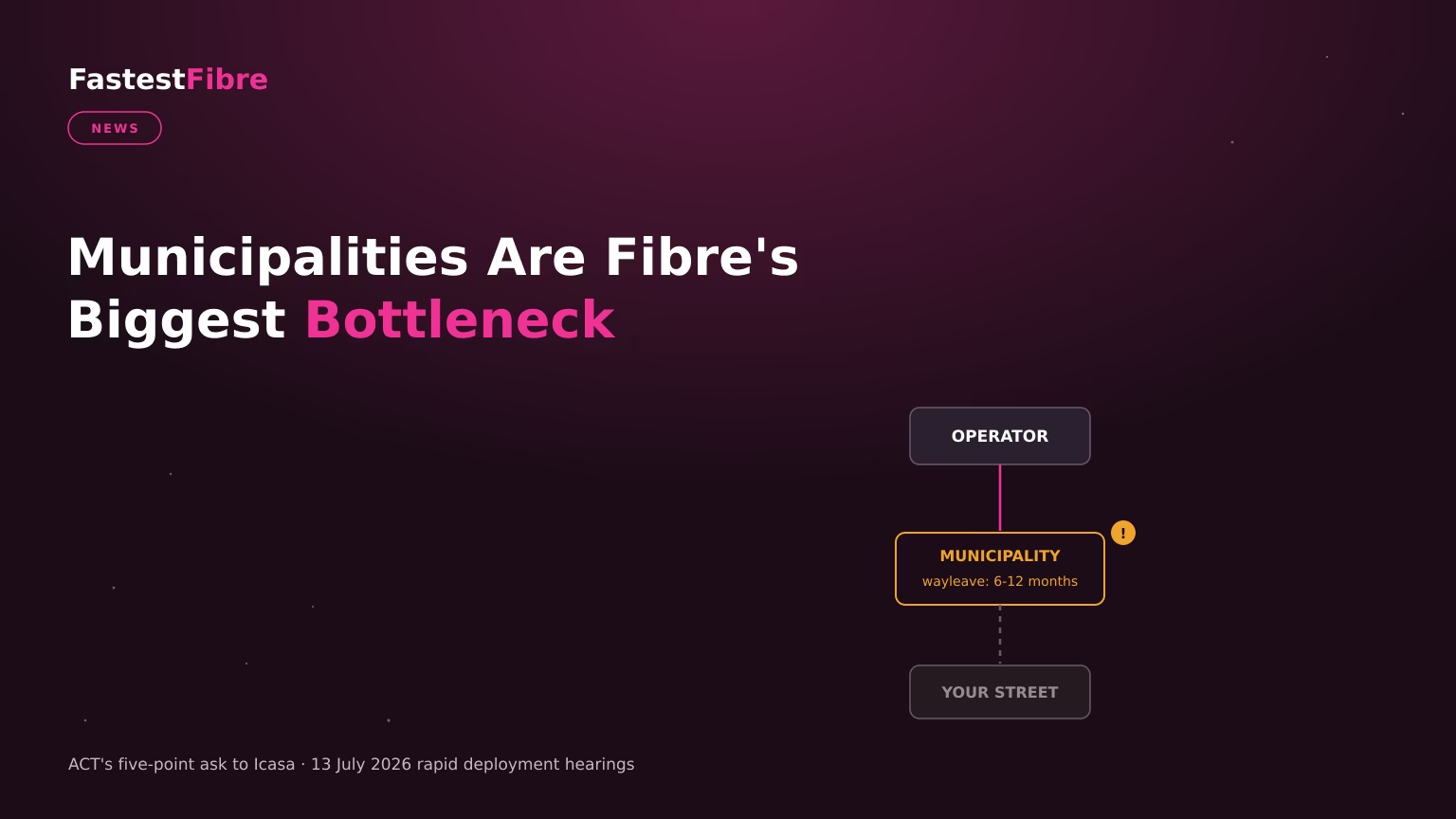
The Association of Comms & Technology has asked Icasa to force municipalities to approve fibre wayleaves within 30 working days or pay for the delay - here's why 257 town halls have become the single biggest obstacle to getting fibre to your street, and what a fix could look like.
In this article(11)
- 01The bottleneck isn't the network. It's the town hall.
- 02What a wayleave actually is, and why every metre of cable needs one
- 03Six to 12 months, and up to hundreds of thousands of rand
- 04Why municipalities are doing this: it isn't only bureaucratic inertia
- 05ACT's five-point fix, in plain terms
- 06South Africa has tried to fix this before - it just hasn't worked yet
- 07How this stacks up against what Europe actually legislated
- 08Who ACT actually is, and why a submission from them carries weight
- 09What happens next
- 10What this means if you're still waiting for fibre
- 11Frequently asked questions
The bottleneck isn't the network. It's the town hall.
Two stories about South African fibre broke in the space of a week. One was about Openserve launching its own retail ISP and unsettling the 200-plus resellers built on top of its network. The other was about Ispa's annual survey showing smaller network operators out-rating the giants on service quality. Both are genuinely important - but both are arguments about who controls the fibre that already exists. A third story, aired at Icasa's rapid deployment public hearings on 13 July 2026, is about something more basic: getting fibre built in the first place.
The Association of Comms & Technology (ACT) - the industry body representing South Africa's six largest network operators - used that hearing to make a blunt case to the regulator: the country's fibre rollout isn't primarily being slowed down by funding, equipment, or even competition between operators. It's being slowed down by municipalities. Specifically, by how long it takes to get a wayleave - the municipal permission needed to dig up a road reserve or servitude and lay cable - and by what municipalities charge for the privilege.
ACT's ask was equally blunt: give Icasa the power to enforce binding deadlines on municipalities, and make delay cost the municipality something. If you've ever wondered why fibre reached the suburb two kilometres away years before it reached yours, this is very often the real answer - and it's a story about municipal administration and municipal finances as much as it is about telecoms.
What a wayleave actually is, and why every metre of cable needs one
A wayleave is formal permission from whoever controls a piece of land - most often a municipality, for public road reserves and servitudes - to install and maintain infrastructure on or under that land. For fibre, that means trenching along pavements and road reserves, boring under intersections, and attaching cable to existing poles and ducting. No wayleave, no legal right to break ground, no matter how much capital or how many staff a network operator has ready to deploy.
In principle, this is a reasonable check: municipalities are responsible for their roads, their other buried services (water, sewage, electricity), and public safety, and a wayleave process exists to make sure a fibre operator doesn't cut through a water main or dig up a road without warning. In practice, ACT's submission argues the process has become something closer to a toll gate than a safety check - one with wildly inconsistent rules, pricing and turnaround times depending entirely on which of South Africa's 257 municipalities happens to sit under the street you live on.
Six to 12 months, and up to hundreds of thousands of rand
The figures ACT put in front of Icasa are the kind that reframe an entire industry debate. Operators say they routinely wait six to 12 months for a wayleave to be approved in some metros - a delay measured against typical fibre construction timelines where the actual trenching and splicing for a suburb can be completed in weeks once permission exists. The application itself can cost anywhere from R8,000 to hundreds of thousands of rand, and on top of the once-off fee, some municipalities levy an ongoing annual "maintenance" charge for infrastructure the municipality does not actually maintain - the fibre network operator does that itself, at its own cost, as a condition of the same wayleave.
This isn't a hypothetical or a single disgruntled operator's complaint. The Wireless Access Providers' Association (Wapa), representing smaller wireless and fixed operators with even less capital buffer for prolonged delays than the majors ACT represents, has separately and publicly described the situation in blunter terms - accusing some municipalities of treating wayleaves as a revenue line rather than an administrative process, and warning that the practice is actively undermining affordable connectivity in the communities that need it most. When an industry body representing six of the country's largest, best-capitalised operators and a separate body representing dozens of smaller ISPs and wireless providers are making functionally the same complaint, it's a reasonable sign the problem is systemic rather than isolated.
The dispute isn't only rhetorical, either. In 2017, Dark Fibre Africa took the City of Cape Town to the Western Cape High Court over wayleave conditions - specifically the size of refundable and non-refundable deposits and tariffs the city wanted to charge for using road reserves to lay cable. It's the kind of case that rarely makes consumer news, but it shows this friction between fibre operators and municipal wayleave terms has been simmering in South African courts for the better part of a decade, well before ACT's 2026 submission put a number on how widespread it's become.
Why municipalities are doing this: it isn't only bureaucratic inertia
It's tempting to read six-to-12-month wayleave queues purely as incompetence or red tape for its own sake, but the more complete explanation is financial. South African municipalities have historically depended heavily on electricity sales for revenue - and that revenue base has been under sustained pressure from two directions at once: load-shedding has pushed households and businesses toward solar and battery backup, permanently reducing grid consumption from paying customers, and years of load-shedding itself have eroded municipal billing and collection efficiency generally. Faced with a shrinking traditional revenue base, some municipalities have turned to wayleave fees - effectively, the right to dig up a road - as an alternative income stream.
That reframes the "hundreds of thousands of rand" application fees and the recurring "maintenance" charges ACT flagged: they aren't simply administrative costs recovered at cost, in many cases they function as a fundraising mechanism, priced at whatever the market of well-funded network operators will bear rather than at what it actually costs a municipal planning department to review an application. It's also, on ACT's telling, why municipalities have little built-in incentive to move faster - a slow, expensive wayleave process that operators have no real alternative to using generates more, not less, revenue than a fast, cheap one would.
ACT's five-point fix, in plain terms
ACT didn't only bring Icasa a list of grievances - it brought a specific reform package, presented as five concrete regulatory changes:
- A deemed-approval mechanism. If a municipality doesn't process a wayleave application within 30 working days, the application is automatically treated as approved. This is the single biggest structural change on the list: it flips the default from "nothing happens until the municipality acts" to "the operator can proceed unless the municipality actively objects in time."
- Financial penalties for delay. Where a municipality's delay causes demonstrable losses - a missed construction window, contractor stand-down costs, a lost commercial opportunity - operators would be able to claim damages directly from the municipality responsible.
- Fee caps tied to actual cost. Wayleave fees would be limited to the municipality's reasonable direct administrative cost of processing the application - not an open-ended charge set by whatever the municipality decides the market will tolerate.
- Binding acknowledgement and processing timelines. A hard five-working-day requirement to acknowledge that an application has even been received, on top of the 30-working-day processing deadline - closing off the possibility of an application simply sitting unopened and unacknowledged for months.
- One national, digitised wayleave platform. A single system for submitting and tracking wayleave applications across all 257 municipalities, replacing the current patchwork where some metros (Tshwane and Cape Town among them) run their own online systems, others still process applications on paper, and an operator building a national network has to learn a different process in every jurisdiction it touches.
Read together, the package is less about relaxing municipal oversight of road reserves and more about converting an open-ended, unpredictable process into a bounded one - even a municipality that still takes the full 30 working days to review every application becomes, from an operator's planning perspective, an entirely different proposition than one that might take six to 12 months with no fixed ceiling at all.
South Africa has tried to fix this before - it just hasn't worked yet
What makes ACT's submission notable isn't that it's the first time government has tried to address municipal wayleave delays - it's that an existing attempt has largely stalled, and ACT is explicitly asking Icasa to force the issue rather than continue relying on voluntary adoption. On 31 March 2023, the Minister of Communications and Digital Technologies issued a National Policy on the Rapid Deployment of Electronic Communications Networks and Facilities under the Electronic Communications Act, alongside a policy direction instructing Icasa to turn parts of that policy into binding regulations. A few weeks earlier, on 24 February 2023, the Minister had also published Standard Draft By-Laws - a template municipalities could adopt wholesale to bring their own wayleave rules in line with the national policy, in theory giving every operator a single, predictable set of rules regardless of which municipality they were dealing with.
Three years on, adoption has been minimal. By some counts, only three municipalities nationwide had actually incorporated the Standard Draft By-Laws into their own local wayleave rules by mid-2026 - out of 257. The rest have either kept their pre-existing local by-laws, drafted their own variations, or in some cases have no clearly codified wayleave process at all. That gap between national policy intent and municipal-level implementation is precisely the gap ACT's submission is asking Icasa to close - not with another voluntary template, but with binding regulation municipalities can't simply decline to adopt.
Icasa itself has been moving on a parallel track this year. A Draft Policy Direction followed in March 2026, and Icasa published its own Draft Rapid Deployment Regulations on 10 April 2026 - the clearest sign yet that the regulator intends to legislate rather than merely encourage. Icasa has also been pushing a related but separate initiative in 2026: a mandatory national infrastructure database requiring every licensed operator to submit detailed data on fibre routes, towers, ducts and poles twice a year, which has drawn its own pushback from operators worried about exposing sensitive infrastructure maps. ACT's wayleave submission landed inside that broader, already-active regulatory process, rather than as a standalone request out of nowhere.
How this stacks up against what Europe actually legislated
ACT's submission leaned on international precedent to make its case, pointing specifically to the European Union's Gigabit Infrastructure Act (GIA) as evidence that binding permit deadlines are a proven, adopted approach rather than a regulatory experiment. That comparison is accurate, but the actual numbers are worth putting side by side, because South Africa's industry is asking for something considerably more aggressive than what the EU settled on.
The GIA, in force across the EU since November 2025, gives national authorities up to four months to decide on a permit application for high-capacity network infrastructure, with a 20-working-day window just to check that an application is complete before that clock properly starts. Only once that four-month deadline passes does a form of tacit approval kick in as the default fallback - and even then, individual EU member states are allowed to swap tacit approval for a compensation mechanism or a right to escalate to a court instead.
ACT's ask - a 30-working-day deemed-approval deadline, with acknowledgement required within five working days - is more than four times faster than the EU's four-month benchmark. That's a genuinely striking gap: South Africa's fibre industry isn't asking Icasa to catch up to what Europe has already legislated, it's asking for something meaningfully tighter. Whether that reflects how much more severe the current South African delays are (six to 12 months, against a backdrop where even four months would already be an improvement), or simply an opening negotiating position ahead of Icasa finalising its own Draft Rapid Deployment Regulations, isn't something ACT's submission itself settles - but it's a useful yardstick for judging what actually ends up in South African regulation once the hearings conclude.
Who ACT actually is, and why a submission from them carries weight
It's worth being precise about who's making this ask, because it shapes how much regulatory weight it is likely to carry. The Association of Comms & Technology was registered as a non-profit company in October 2021 and publicly launched the following year, founded by - and still representing - South Africa's six largest network operators: MTN, Vodacom, Cell C, Telkom, Rain and Liquid Intelligent Technologies. It's chaired by Vodacom Group CEO Shameel Joosub and led day-to-day by Nomvuyiso Batyi, a former Icasa councillor and special adviser to a former communications minister - a leadership pairing that gives ACT both boardroom-level industry authority and direct, practical familiarity with how Icasa itself operates.
That matters for reading this story correctly. This isn't a fringe complaint or a single aggrieved fibre network operator lobbying for itself - it's the country's largest network operators, several of whom (Telkom via Openserve, Vodacom via its Maziv/Vumatel stake, MTN through its own infrastructure investments) have enormous capital committed to exactly the kind of rollout that wayleave delays slow down, collectively telling the regulator that municipal administration has become the binding constraint on how fast that capital can actually turn into cable in the ground. Combined with Wapa's independent, separately voiced concerns representing smaller operators, it's a rare case of near industry-wide alignment across company size and network type.
What happens next
Icasa's rapid deployment hearings are a public consultation process, not a final decision - ACT's submission is one input into regulations Icasa is still actively drafting, following its own 10 April 2026 Draft Rapid Deployment Regulations. The realistic path from here runs through further public comment, likely revision of Icasa's draft regulations to account for industry submissions like ACT's, and eventual publication of final regulations with legal force - a process that, based on how long the parallel infrastructure-database regulations have taken to develop this year, is unlikely to conclude quickly.
The more important open question is enforcement, not drafting. South Africa has had a National Policy on Rapid Deployment and Standard Draft By-Laws for municipalities to adopt since 2023, and adoption has been close to negligible three years later. Binding Icasa regulations carry more legal force than a voluntary by-law template municipalities can simply ignore, but municipalities facing genuine fiscal pressure - the same pressure that plausibly explains their reliance on wayleave fees as revenue in the first place - have shown limited appetite to move quickly even under national policy pressure. Whether a deemed-approval mechanism and the threat of damages claims actually change that calculus, or simply produce a new round of legal disputes over what counts as a "demonstrable loss" from delay, is the real test this submission sets up. Update, 30 July 2026: ACT's CEO says Icasa's actual draft regulations still don't include this ask, and estimates final rules could be up to two years away.
What this means if you're still waiting for fibre
If fibre hasn't reached your street yet, this story is a big part of why - and it's worth recalibrating expectations accordingly. Network operators publish rollout plans and expansion maps in good faith, but those plans are downstream of wayleave approvals they don't fully control the timing of. A suburb sitting "next in line" on a network's public roadmap can slip by months, sometimes a year or more, purely because of how long its specific municipality takes to sign off - independent of anything the network operator itself is doing.
Practically, that means two things worth doing if you're in an area without full fibre yet. First, check what's actually already available at your address rather than assuming full fibre is the only option - many areas without fixed fibre now have viable interim options through prepaid and township fibre models, or 5G and LTE fixed wireless, that don't depend on the same municipal wayleave process. Second, keep checking back rather than treating a single "not yet available" result as permanent - if Icasa's regulations do land with real teeth, the areas that have been stuck in municipal queues the longest are exactly the ones most likely to see rollout timelines compress once approvals stop being the binding constraint.
Frequently asked questions
Help someone else pick the right fibre
Now go and compare the deals
Prices below come from our own deal tracking, checked on 19 October 2026.
Ranked by price across every ISP and network we track.
See the dealsThe full catalogue in one sortable table - filter by speed, price or network.
See the dealsHow the major ISPs rank on price, support and real measured performance.
See the dealsRelated insights

Icasa's New Rollout Rules Skip the Wayleave Fix Industry Asked For
Read article
Openserve Just Became Its Own Competitor
Read article
SA's Fibre Underdogs Are Beating the Giants
Read article
Prepaid & Township Fibre Explained
Read article
The State of Fibre Internet in South Africa (2026)
Read article
The Maziv Merger Explained
Read article
Octotel Says the Fibre Rollout Race Is Over. Does Its Own Data Back That Up?
Read article
Openserve Fires Back in the Fibre ISP Row
Read article