Openserve Just Became Its Own Competitor
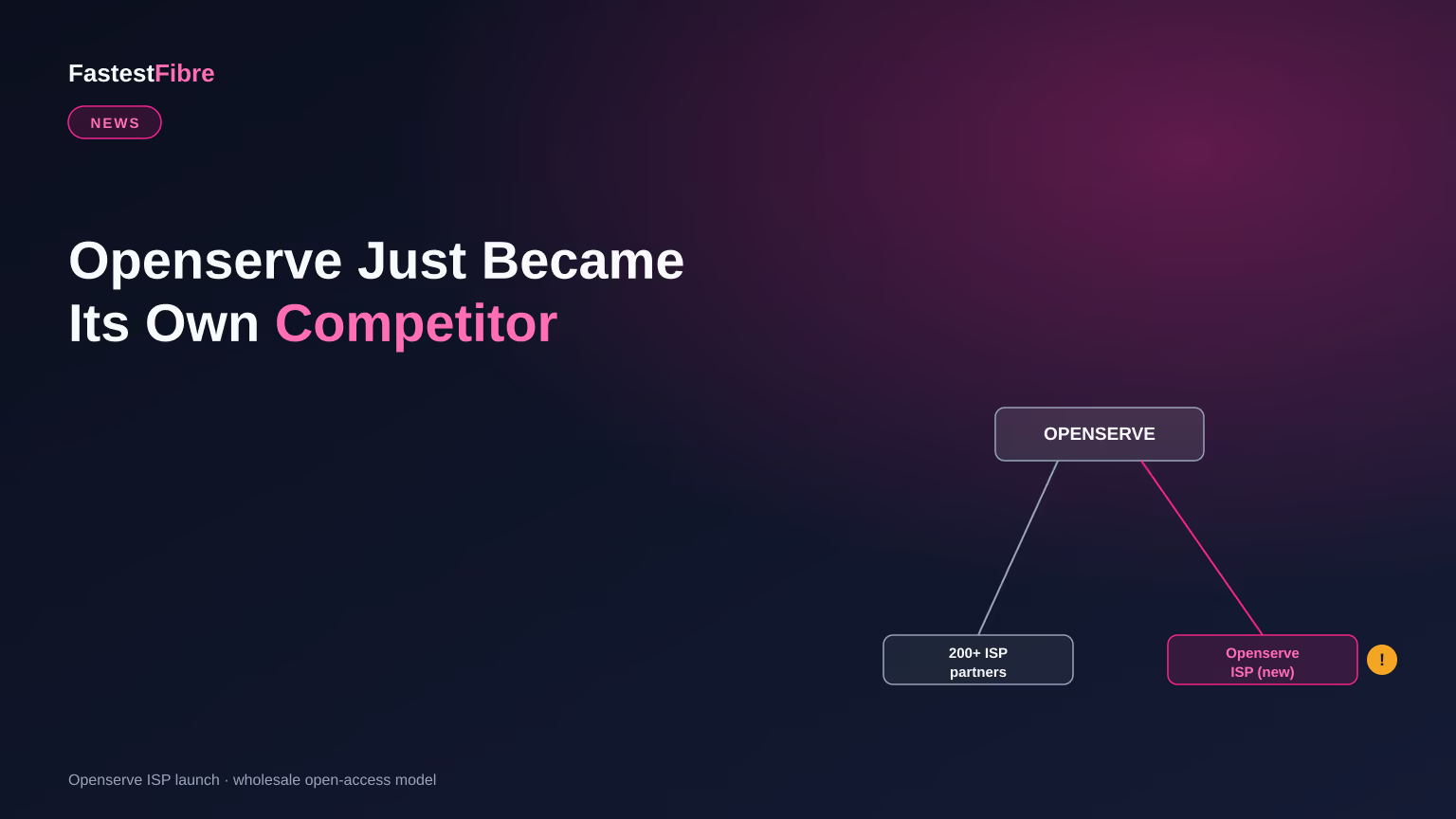
Openserve has launched a direct-to-consumer ISP selling its own fibre - reversing two decades of wholesale/retail separation and drawing anti-competitive concerns from the 200+ ISPs that resell its network. Here's what changed, why it matters, and what it could mean for your bill.
In this article(9)
- 01The network everyone resells just started reselling to itself
- 02What Openserve ISP is actually selling
- 03Why this is a bigger deal than one more ISP entering the market
- 04South Africa has been here before - and it cost Telkom R200 million
- 05The three specific concerns Ispa's members have raised
- 06Every other major network has stayed on the wholesale side of the line
- 07What happens next: the stakes for Openserve's own reputation
- 08What this means if you're shopping for fibre right now
- 09Frequently asked questions
The network everyone resells just started reselling to itself
For as long as fibre has existed as a mass-market product in South Africa, Openserve - Telkom's fibre network arm - has operated on a simple premise: it builds and maintains the physical infrastructure, and it sells access to that infrastructure wholesale to any ISP willing to buy it. More than 200 ISPs currently resell Openserve fibre under their own brands - Afrihost, Webafrica, RSAweb, Axxess, Cool Ideas and dozens more - each competing on price, support and extras, all riding the same underlying cable. Openserve itself was not meant to be one of the competitors in that race. It was the track, not a runner on it.
That premise just changed. Openserve has launched Openserve ISP, a direct-to-consumer retail service sold through its own web store, offering uncapped fibre packages from R345 to R1,449 a month on month-to-month terms, with a free Wi-Fi modem and no installation fee. For the first time, the company that owns the wholesale network is also selling directly to the households that network passes - in direct competition with every ISP that has spent years building a retail business on the assumption that Openserve wouldn't do exactly this.
The Internet Service Providers' Association (Ispa) says its members are worried, and the concerns aren't cosmetic. They go to the heart of what "open access" is supposed to mean, and they echo a fight South African telecoms regulators already had with Telkom once before - one that ended in a R200 million fine.
What Openserve ISP is actually selling
The headline numbers are straightforward. Openserve ISP's uncapped fibre packages range from R345 to R1,449 a month, sold on month-to-month terms with no long-term contract, a free Wi-Fi modem included, and no installation fee. On paper, that's a genuinely competitive entry-level offer - cheaper than several established resellers' comparable Openserve-network packages, and without the usual trade-off of a 24-month lock-in to get the free hardware.
That competitiveness is exactly the problem, according to Ispa's members. A free modem and free installation are real costs that any ISP has to absorb somewhere - typically recovered over a 12-to-24-month contract term. Offering the same freebies on a month-to-month plan, where a customer can leave at any time, is a materially harder economics problem to make profitable. ISPs reselling the same underlying Openserve fibre, buying it at the same wholesale rates Openserve charges everyone else, say they cannot match that combination of price, month-to-month flexibility and free hardware without losing money on every signup - because unlike Openserve ISP, they're paying a wholesale margin on top of their own retail costs before they even start competing on price.
Why this is a bigger deal than one more ISP entering the market
South Africa didn't arrive at its current fibre market - more than 75 active ISPs competing on shared infrastructure, prices falling steadily, real product differentiation on service and support - by accident. It's the direct result of an open-access model that both Openserve and Vumatel built their early growth on: the network operator builds and maintains the cable, sells wholesale access to any ISP on equal terms, and deliberately does not compete with its own customers at the retail level. That structural promise is what let dozens of small, independent ISPs build real businesses on top of infrastructure none of them could have afforded to build themselves.
Openserve entering retail directly doesn't just add a 201st competitor to that market. It changes who the other 200 are competing against. An independent ISP competing against another independent ISP is a fair fight - both are buying the same wholesale product at the same price and competing on execution. An independent ISP competing against the network operator itself, inside a bundle the network operator controls the wholesale cost structure for, is a fundamentally different contest - and it's the exact scenario open-access separation was designed to prevent.
Ispa's members have flagged a second layer to this beyond pricing: structural access. Openserve ISP's retail operation sits inside the same corporate entity as the wholesale network - which means, at least in principle, it shares a roof with the systems that hold every reseller's customer and coverage data, the provisioning queues that determine how fast a new line gets activated, and the fault-repair dispatch that determines how fast an outage gets fixed. None of that requires bad faith to be a problem; it only requires the retail arm to get treated as "just another internal customer" with slightly better visibility or slightly faster turnaround than the reseller down the street, and the open-access premise starts to erode from the inside.
South Africa has been here before - and it cost Telkom R200 million
This is not the first time a Telkom entity's retail ambitions have collided with its role as the network everyone else depends on. In 2013, the Competition Commission settled a long-running abuse-of-dominance case against Telkom, stemming from complaints lodged by rival ISPs between 2005 and 2007. The Commission's finding was that Telkom had engaged in a margin squeeze - pricing its wholesale ADSL and Diginet leased-line access to competing ISPs so tightly against its own retail prices that those ISPs couldn't compete profitably, regardless of how efficiently they ran their businesses.
Telkom agreed to pay an administrative penalty of R200 million over three years and, critically, to implement a functional separation of its wholesale and retail businesses - the regulatory ancestor of the standalone Openserve that exists today. That separation was formalised further in September 2023, when Openserve was legally spun out as its own standalone company rather than remaining a division of Telkom. Two decades of regulatory history, a nine-figure fine and a full legal restructuring all point the same direction: keep the network operator out of the retail fight it referees.
Openserve ISP does not necessarily repeat the specific 2013 conduct - that case turned on wholesale pricing set deliberately too close to retail pricing for margin-squeeze purposes, and no regulator has yet made an equivalent finding here. But the structural pattern - the network operator selling directly to the same customers its wholesale partners are trying to win - is precisely the pattern the 2013 remedy and the 2023 legal separation were built to prevent from recurring. That history is why Ispa's members reacted the way they did rather than shrugging off one more retail entrant.
The three specific concerns Ispa's members have raised
Stripped of framing, the objections from Ispa's membership come down to three distinct claims, each of which would need to be true for this to cross from "aggressive but fair competition" into genuinely anti-competitive conduct:
- Unfair bundling: that the free modem plus free installation, offered on a month-to-month basis, cannot be matched by a reseller buying the same product at the same wholesale rate while remaining profitable - meaning the bundle is only viable because Openserve ISP doesn't pay itself a wholesale margin the way every other ISP has to.
- Structural conflict of interest: that housing a retail ISP inside the wholesale network operator gives that retail arm privileged access to competitor data, provisioning systems and repair-priority queues that arm's-length resellers don't have, independent of any specific pricing decision.
- Below-cost wholesale pricing: a claim from at least one industry player that Openserve's entry-level direct retail offer actually undersells what that ISP currently pays Openserve wholesale for an equivalent product - which, if accurate, would mean Openserve ISP's cheapest package is priced below what its own wholesale price list charges everyone else for the same access.
None of these claims has been independently verified or tested through a formal competition complaint as of writing, and Telkom had not responded to TechCentral's detailed questions on pricing equivalence, margin sustainability for competing ISPs, or any audit undertakings around the separation of the retail and wholesale businesses. Until Telkom responds publicly, or a regulator opens a formal inquiry, the below-cost pricing claim in particular remains an allegation from a single unnamed industry player rather than an established fact - worth flagging clearly rather than treating as proven.
Every other major network has stayed on the wholesale side of the line
What makes Openserve's move stand out is that none of South Africa's other major fibre network operators have made the equivalent leap. Vumatel, the country's biggest FNO by homes passed, sells exclusively through its ISP partners and has built its entire growth story - including the open-access model that helped create the country's 75-plus-ISP market in the first place - on staying out of direct retail. MetroFibre, Frogfoot, Octotel, Link Africa, Liquid Intelligent Technologies and Dark Fibre Africa all operate the same way: they sell wholesale capacity, and the ISPs on top of that capacity are the ones who compete for the household.
That consistency matters for reading Openserve's decision correctly. This isn't an industry-wide shift where every network is quietly moving toward vertical integration and Openserve is simply first - it's a unilateral move by one network, and one with a specific regulatory history that makes the move harder to read as coincidental. Herotel is arguably the closest precedent, since it operates both a retail ISP brand and, since its 2025 acquisition, sits inside the same Maziv group as wholesale network operator Vumatel - but Herotel and Vumatel remain organisationally and operationally distinct businesses within that group, rather than one entity selling both wholesale and retail versions of the identical product under a single brand the way Openserve ISP now does under the Openserve name itself.
If Openserve's bet pays off commercially without triggering a competition complaint, it's a fair question whether Vumatel, MetroFibre or others eventually follow with their own direct-retail arms. For now, though, Openserve is running this experiment alone, which is exactly why its 200-plus wholesale partners are watching so closely - there's no competing network's identical playbook to compare outcomes against, only Telkom's own history with this specific manoeuvre.
What happens next: the stakes for Openserve's own reputation
There's a direct line from this story to one we covered here last week. Ispa's most recent survey of ISP satisfaction with fibre network operators, run in February 2026, found that open-access adherence - whether a network treats every reseller equally - was one of the four metrics ISPs said mattered most to them, alongside reliability, staff friendliness and technical proficiency. Openserve scored 6.5 out of 10 in that survey, rated by 38 ISPs - by far the widest pool of any network measured, reflecting just how central Openserve is to the wholesale market every other operator's reputation gets measured against.
That wide reach cuts both ways. It means Openserve has more to lose than any other network if its 200- plus reseller relationships conclude that open-access adherence is no longer something they can take for granted. A single below-cost pricing allegation or one ISP's account of losing margin to an unmatchable bundle can travel fast through a reseller community that already spends its time comparing notes on exactly these kinds of scores. If Openserve ISP's launch genuinely does squeeze wholesale partners' margins the way critics allege, expect that to show up concretely in the next Ispa survey wave - and potentially, if the below-cost pricing claim holds up, in a formal Competition Commission complaint given the direct parallel to the 2013 case.
Whether that happens depends on facts nobody outside Telkom currently has: the actual wholesale cost Openserve ISP pays for its own network access, and whether that figure is genuinely identical to what independent resellers pay. Until Telkom answers those questions publicly, this story sits in the gap between "an aggressive new competitor" and "a margin squeeze" - and which one it turns out to be will shape how the rest of the fibre industry treats Openserve going forward.
What this means if you're shopping for fibre right now
If you're on Openserve's network or comparing providers on it, three practical things follow from all this. First, Openserve ISP's own package is worth putting on your comparison shortlist purely on the numbers - R345 entry pricing, no contract, free modem and free install is a genuinely strong offer regardless of the politics around it, provided the coverage and support match what's promised.
Second, don't assume every existing Openserve reseller will simply match the new pricing - if the margin-squeeze concerns are accurate, some may not be able to without cutting service quality elsewhere, so it's worth checking current promotions from your shortlist of ISPs rather than assuming Openserve ISP's launch has automatically repriced the whole market downward.
Third, if service quality or support responsiveness matters to you more than headline price, this is exactly the kind of structural conflict worth watching over the next few months - a reseller that feels it's losing provisioning priority or fault-repair speed to Openserve's own retail arm has both the motive and, per Ispa's members, plausible grounds to say so publicly. Keep an eye on this section for how the story develops as Telkom responds, or doesn't.
Frequently asked questions
Help someone else pick the right fibre
Now go and compare the deals
Prices below come from our own deal tracking, checked on 19 October 2026.
Ranked by price across every ISP and network we track.
See the dealsThe full catalogue in one sortable table - filter by speed, price or network.
See the dealsHow the major ISPs rank on price, support and real measured performance.
See the dealsRelated insights

Openserve Launched Its Own ISP - Should You Switch, or Stick With a Reseller?
Read article
SA's Fibre Underdogs Are Beating the Giants
Read article
How Vumatel's Open-Access Model Created 75+ ISPs
Read article
Openserve vs Vumatel in 2026
Read article
Webafrica vs Afrihost vs MWeb 2026
Read articleOpenserve Fibre Deals
Read article
Openserve Passed 1.57 Million Homes and Connected 843,563 of Them - What Its Q1 FY2027 Results Show
Read article
1Gbps Fibre Price Comparison 2026: Openserve vs Vumatel vs Frogfoot vs Octotel
Read article