Icasa Just Told Starlink Exactly How to Get a Licence
Icasa says it can't issue Starlink a new satellite licence - but it can approve a licence transfer from an existing holder. Here's the workaround Icasa confirmed on 29 June 2026, why the 30% ownership deadlock still isn't solved, and what it means if you're weighing satellite against fibre.
In this article(8)
- 01Icasa finally spells out what Starlink would actually have to do
- 02Quick recap: why Starlink is still locked out in the first place
- 03The workaround Icasa actually confirmed: buy a licence, don't wait for one
- 04Why this doesn't actually solve Starlink's problem
- 05The workaround that's already working - just not for Starlink
- 06How we got here: the timeline
- 07What this means if you're comparing fibre against satellite right now
- 08Frequently asked questions
Icasa finally spells out what Starlink would actually have to do
For more than a year, South Africa's Starlink story has followed the same shape: a policy proposal announced with fanfare, followed by a regulator saying, in effect, "we can't do that without Parliament." On 29 June 2026, the Independent Communications Authority of South Africa (Icasa) broke that pattern slightly - not by resolving the deadlock, but by finally spelling out, in concrete terms, what a satellite operator such as Starlink would actually have to do to operate legally in South Africa right now, today, without waiting for any law to change.
The short version: Icasa cannot open a new licensing window for satellite constellation operators, because the legal precondition for doing so - a ministerial policy direction plus a published invitation to apply - doesn't exist yet. But it can approve the transfer of an existing licence from a company that already holds one, to a new entrant that acquires it commercially. That's not a loophole Icasa invented on the spot; it's a standard mechanism, section 13 of the Electronic Communications Act (ECA), that already governs how spectrum and network licences change hands in South Africa. What's new is Icasa naming it, in writing, as the answer to "how does Starlink actually get in."
Quick recap: why Starlink is still locked out in the first place
We've covered the full history of Starlink's South African licensing saga in detail in our dedicated explainer, so here's the short version needed to understand why this latest development matters. Any company that wants to run a network and sell connectivity in South Africa needs two individual licences under the ECA - an Individual Electronic Communications Network Service (I-ECNS) licence and an Individual Electronic Communications Service (I-ECS) licence - plus the relevant radio-frequency spectrum authorisation. Icasa's rules require licence holders to be at least 30% owned by historically disadvantaged groups under South Africa's Broad-Based Black Economic Empowerment framework. SpaceX's global policy is not to sell equity in its local operating entities anywhere in the world, so that single condition has kept Starlink unlicensed here since it launched across more than 20 other African countries.
Communications Minister Solly Malatsi tried to break the impasse with a 12 December 2025 policy direction instructing Icasa to recognise Equity Equivalent Investment Programmes (EEIPs) - letting a multinational invest in skills development, local procurement and infrastructure instead of selling equity - as a lawful alternative to the 30% ownership rule. Public consultation on the proposal ran hot: roughly 90% of submissions supported it, and SpaceX signalled it was prepared to back the idea with real money - reportedly around R2 billion in commitments, including R500 million earmarked to connect 5,000 rural schools.
Then, on 13 May 2026, Icasa told the minister it could not give the EEIP direction full legal effect. Its position: the Electronic Communications Act, as currently written, doesn't recognise EEIPs as an equivalent to direct ownership - so implementing the minister's instruction would require Parliament to actually amend the Act. That left the EEIP route stuck behind the slow-moving Electronic Communications Amendment Bill, with no firm timeline for when, or whether, it passes.
The workaround Icasa actually confirmed: buy a licence, don't wait for one
The 29 June statement is where the story moves forward. Icasa laid out, more precisely than it had before, the mechanics of what a satellite operator needs and the paths available to get it:
- Three licences are required to run a satellite broadband service: an I-ECS licence, an I-ECNS licence, and the relevant radio-frequency spectrum licence(s) for the frequency bands the service uses.
- New I-ECNS applications are frozen until the Minister issues a policy direction and Icasa publishes a formal invitation to apply - neither of which currently exists for satellite constellation operators specifically.
- An inquiry is already underway: the Department of Communications & Digital Technologies directed Icasa, back on 22 August 2025, to investigate whether new I-ECNS licences are even needed for this category of operator. That inquiry is still open, more than 11 months later.
- Section 13 licence transfers are the exception - and, in Icasa's own words, "the quickest legal path for a new entrant." Rather than applying for a brand-new licence, an operator can negotiate directly with a company that already holds an I-ECNS/I-ECS licence and acquire it, or a controlling stake in the entity that holds it, subject to Icasa's approval of the transfer.
- Lawful interception still applies: Icasa flagged that any applicant operating earth stations or gateway infrastructure outside South Africa must show how the service will still comply with local lawful-interception requirements - a technical and legal detail that matters for a constellation whose ground infrastructure isn't necessarily on South African soil.
Put plainly: Icasa isn't creating a new front door for Starlink. It's pointing at a side door that was always there - buy your way in by acquiring an existing licence holder - and confirming that door is currently open while the main entrance stays locked pending an Act of Parliament.
Why this doesn't actually solve Starlink's problem
It's tempting to read "quickest legal path for a new entrant" as Icasa handing Starlink a shortcut. It isn't, for two reasons that matter more than the mechanics.
First, the ownership rule doesn't disappear - it just moves. Section 13 transfers still require Icasa's approval, and Icasa still has to be satisfied the resulting licence holder meets the same B-BBEE ownership conditions every other licensee does. Buying an existing I-ECNS/I-ECS licence doesn't exempt the buyer from the 30% Black-ownership requirement; it just changes which specific legal entity needs to satisfy it. If SpaceX bought a South African licence holder outright and kept its no-local-equity policy, it would run into exactly the same wall it hit trying to apply from scratch. The section 13 route only actually helps if the acquiring structure is built to satisfy the ownership rule some other way - which is precisely what the stalled EEIP proposal was trying to make possible in the first place.
Second, there has to be a willing seller with a usable licence. An I-ECNS/I-ECS licence transfer only works if an existing South African licence holder - one whose licence scope actually covers satellite network services - is willing to sell or partner. That's a commercial negotiation Icasa doesn't control and can't force. It also isn't automatic security: Icasa still has to review and approve the transfer, which means the regulator retains exactly the same gatekeeping power over a section 13 deal that it has over a fresh application. The "quickest legal path" is quicker only in the sense that it skips the currently-closed new-application window - not in the sense that it skips scrutiny.
So the practical upshot for Starlink specifically: the 29 June statement confirms a mechanism exists, but SpaceX still needs either a change to the ownership rule (the stalled EEIP/ECA Amendment Bill route) or a genuinely empowerment-compliant acquisition structure to use it. Neither of those has moved forward since May. The deadlock is exactly where it was - Icasa has simply been more precise about what "unblocked" would actually require.
The workaround that's already working - just not for Starlink
There is a live example of a satellite operator using almost exactly this kind of structure to get into the South African market without a new licence application - and it happened before Icasa's 29 June statement, which is part of why the statement reads less like a new policy and more like Icasa catching up to what was already happening. In our coverage of the Amazon Leo deal, we explained how Herotel - the internet service provider owned by Maziv, the same group behind Vumatel - signed a distribution agreement to launch Amazon's satellite broadband service under the brand evry. Amazon holds none of the South African licences itself; Herotel does, as an already-licensed, already B-BBEE-compliant South African operator. Amazon supplies the satellites and the technology; Herotel supplies the legal standing to actually sell the service here.
That's not a section 13 licence transfer in the strict legal sense - Herotel isn't acquiring anyone else's licence, it's using its own - but it's the same underlying idea Icasa is now pointing satellite operators toward: don't wait for a new licensing window to open, work with an entity that already clears the ownership bar. Amazon's approach sidestepped the entire ownership fight by partnering rather than applying. Starlink, by contrast, has spent years trying to get licensed directly, in its own name, without giving up equity - which is precisely the structural choice the 29 June guidance doesn't change.
How we got here: the timeline
- 22 August 2025 - The Department of Communications & Digital Technologies directs Icasa to open an inquiry into whether new I-ECNS licences are needed for satellite constellation operators. The inquiry remains open today.
- 12 December 2025 - Minister Solly Malatsi issues a formal policy direction instructing Icasa to recognise Equity Equivalent Investment Programmes as an alternative to the 30% ownership rule. SpaceX signals a roughly R2 billion commitment, including R500 million for rural school connectivity.
- 13 May 2026 - Icasa tells the minister it cannot give the EEIP direction full legal effect without Parliament first amending the Electronic Communications Act, throwing the matter to the slow-moving Electronic Communications Amendment Bill.
- 29 June 2026 - Icasa issues its clearest public guidance yet: no new I-ECNS licences can be issued to satellite operators without a policy direction and invitation to apply, but existing-licence transfers under section 13 of the ECA remain "the quickest legal path for a new entrant" available today.
- Ongoing - The Electronic Communications Amendment Bill's progress through Parliament is the mechanism that would actually resolve the ownership question for good; no passage date has been confirmed. Herotel's evry, launched via an existing South African licence, continues rolling out registrations at evry.co.za ahead of a targeted 2027 commercial launch.
What this means if you're comparing fibre against satellite right now
None of this changes what you can actually buy today. If you're reading this because you're deciding between fibre, 5G and satellite for your home, here's how the practical picture actually looks in late July 2026:
- Starlink still isn't a legal option in South Africa. Nothing in the 29 June guidance changes that - it clarifies a path that exists on paper without Starlink having used it. Kits registered through neighbouring-country "Roam" plans remain a grey-market workaround, not a supported home-internet product; see our full Starlink legality guide for the detail on cost, throttling and the risks of that route.
- If fibre covers your address, it remains the better choice on every measurable factor - price per Mbps, latency, upload speed and reliability all favour a wired connection over any satellite constellation, licensed or not. Check your address on our fibre coverage map before weighing anything else.
- If you're in a genuine fibre dead zone - a farm, a small town, a rural property well outside metro coverage - the realistic near-term satellite option is Herotel's evry via Amazon Leo, not Starlink, precisely because evry already has the legal standing this article has just explained Starlink still lacks. Registration is open at evry.co.za ahead of a 2027 commercial launch; it won't help anyone today, but it's a genuinely licensed product moving toward launch rather than one still negotiating access.
- Don't wait on Starlink specifically before signing up for something else. Even in the most optimistic reading of this story - a clean, empowerment-compliant section 13 acquisition, negotiated quickly - Starlink would still need to close that deal, get Icasa's transfer approval, and stand up local operations before selling a single legal connection. There is no scenario in which that happens faster than simply checking what fixed-wireless, prepaid fibre or township fibre is already live at your address. Our guide to prepaid and township fibre and our comparison of 5G home internet options cover the realistic alternatives available right now if fibre genuinely isn't an option at your address.
The honest takeaway is that this story is a regulatory clarification, not a breakthrough. It's worth tracking because it tells you exactly what would have to happen for Starlink to arrive - a section 13 deal built around real empowerment compliance, or the Electronic Communications Amendment Bill actually passing - and neither of those has happened yet. We'll update this piece and our main Starlink guide the moment either one does.
Frequently asked questions
Help someone else pick the right fibre
Now go and compare the deals
Prices below come from our own deal tracking, checked on 12 October 2026.
Ranked by price across every ISP and network we track.
See the dealsThe full catalogue in one sortable table - filter by speed, price or network.
See the dealsHow the major ISPs rank on price, support and real measured performance.
See the dealsRelated insights
Is Starlink Legal in South Africa? The 2026 Status, Explained
Read article
Amazon Just Solved the Problem That Kept Starlink Out of South Africa
Read article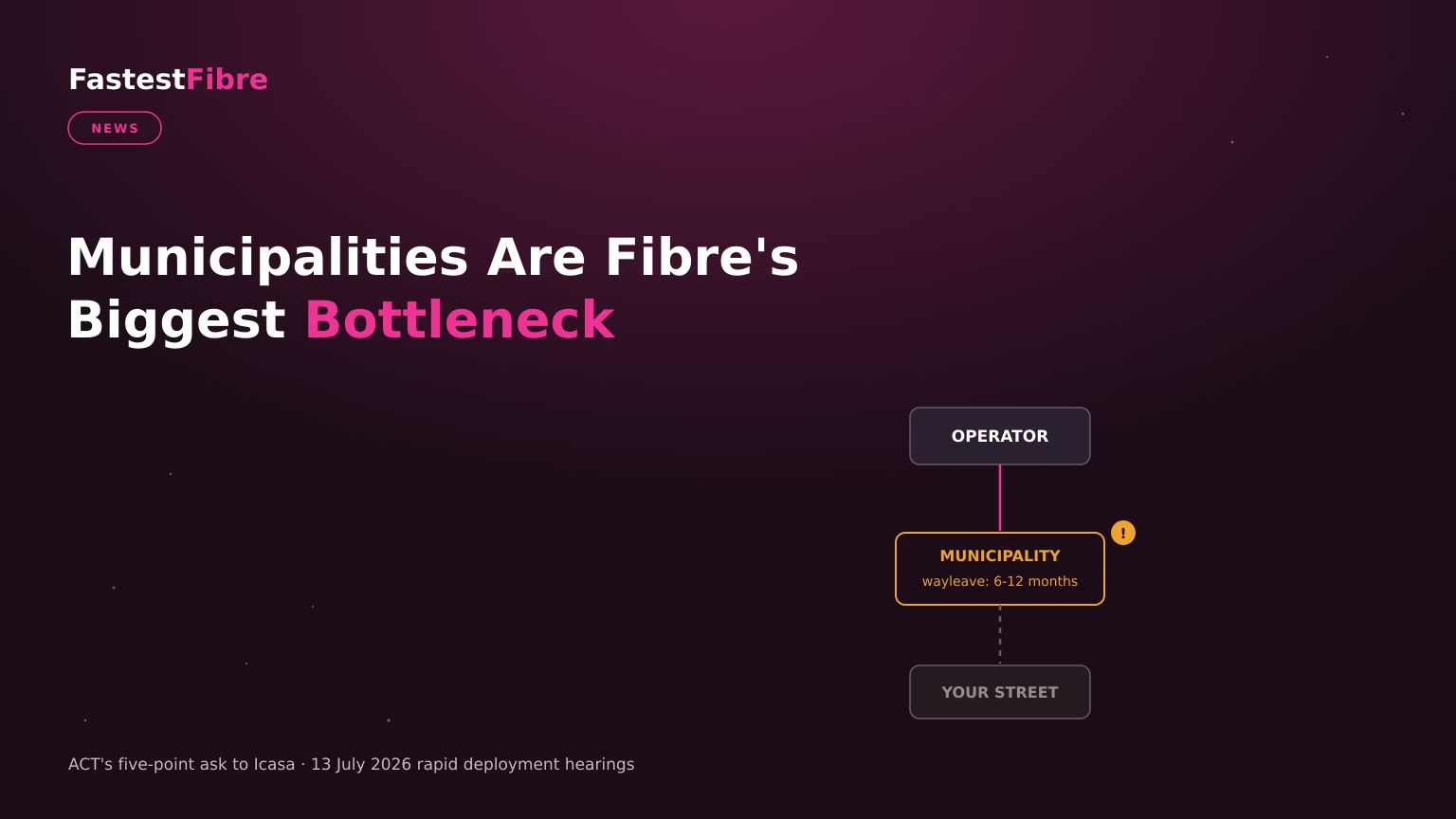
Why Municipalities Are Fibre's Biggest Bottleneck
Read article
Prepaid & Township Fibre Explained
Read article
Best 5G Home Internet in South Africa: Rain vs Vodacom vs MTN
Read article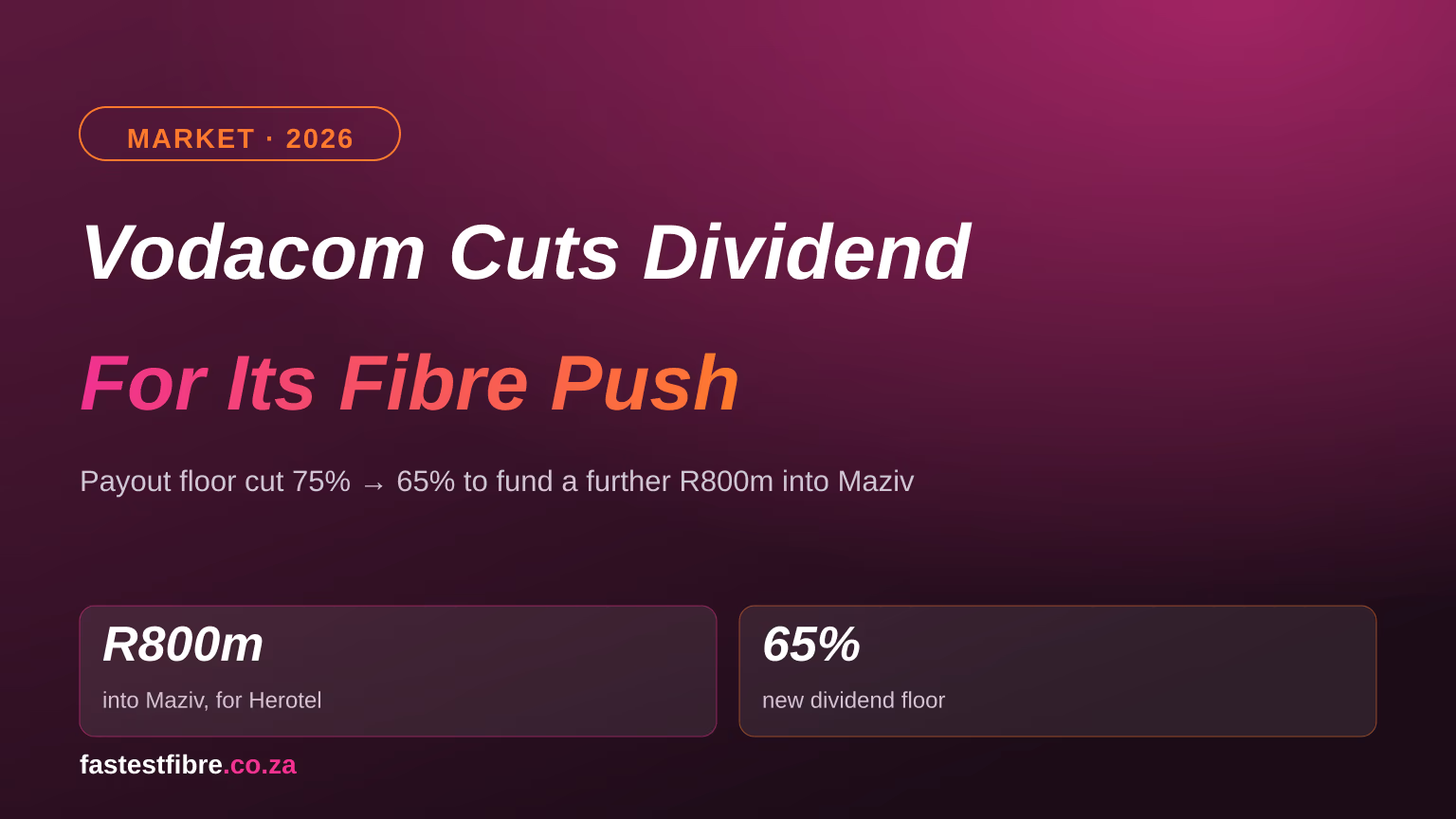
Why Vodacom Just Cut Its Dividend to Fund Its Fibre Push
Read article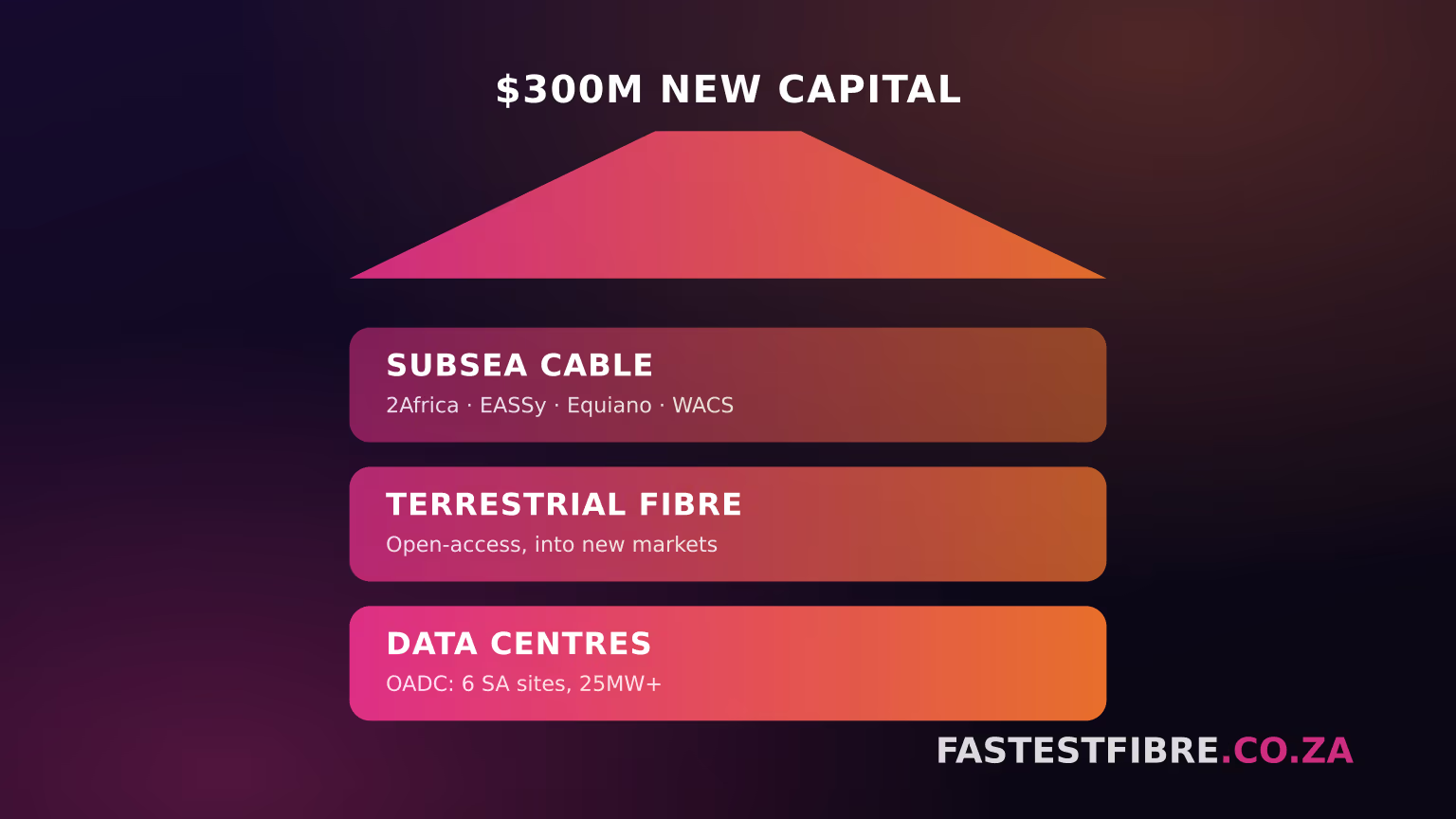
WIOCC's $300 Million Raise: What a Bigger Backbone Wholesaler Means for SA Fibre
Read article