MTN Wants to 'Own the Household': Inside the Plan to Grab 30% of SA's Home Internet Market by 2030
MTN CEO Ferdi Moolman says the company wants 30% of South Africa's home fixed-internet market by 2030 - up from roughly 6% today - using a four-brand mix of fibre, 5G and dedicated fixed wireless. Here's the strategy, the numbers, and what it means if you're comparing fibre against MTN's wireless options.

In this article(9)
- 01MTN isn't choosing between fibre and 5G - it's selling both
- 02The number: from roughly 6% to 30% of the market in four years
- 03Four brands, one strategy: what MTN Fibre, MTN Home, AirFibre and Supersonic actually are
- 04Why fixed wireless is doing most of the heavy lifting
- 05How MTN's base compares to the fibre incumbents
- 06Fibre vs MTN's fixed wireless: how to actually decide
- 07What could slow MTN down
- 08Looking ahead
- 09Frequently asked questions
MTN isn't choosing between fibre and 5G - it's selling both
Most of the competitive noise in South African home internet over the past year has come from fibre network operators - Openserve launching its own retail ISP, smaller networks out-scoring the giants in customer satisfaction surveys, and a fresh round of price increases working through the market. MTN's move is a different kind of story. Speaking to Business Day in mid-June 2026, group CEO Ferdi Moolman laid out a target that has nothing to do with any single network or price point: MTN wants 30% of South Africa's home fixed-internet market by 2030, using whichever technology - fibre, licensed mobile spectrum, or dedicated fixed wireless - gets a connection into a given household fastest.
"The big drive is to own the household," Moolman said. "We want to get to a 30% market share by 2030." It's a deliberately technology-agnostic way to frame the goal, and that's the point: MTN isn't trying to out-build Vumatel's fibre network or out-price Openserve's wholesale rate card. It's betting that most households don't actually care whether their connection arrives through a glass fibre in the ground or a radio signal from a nearby tower - they care whether it works, and who they pay for it. That's a meaningfully different competitive threat to established fibre ISPs than another price war, and it's worth understanding on its own terms.
The number: from roughly 6% to 30% of the market in four years
South Africa has around 19 million households, and fibre networks combined have passed roughly 6 million of them - meaning even before you get to who's actually connected, a large share of the country still has no fibre option at their address at all. MTN's current home broadband base - fibre and fixed wireless combined - sits at around 401,000 connections as of its most recent disclosure in June 2026, up from 344,000 in Q3 2025 and continuing several straight quarters of double-digit growth. Against a total addressable market of 19 million households, that's a small base today - by MTN's own reckoning, somewhere around 6% penetration - which is exactly why the 30%-by-2030 target represents such an aggressive multiple of where the business actually sits right now.
Getting there requires MTN to add roughly five to six million home connections within about four years - a scale of growth no single fibre network operator has managed even over a full decade. That context matters for judging whether the target is realistic: it isn't a modest tweak to an existing plan, it's a bet that MTN's mobile network footprint - built over two decades for phones, not fixed lines - gives it a shortcut into homes that fibre still can't reach on the same timeline.
Four brands, one strategy: what MTN Fibre, MTN Home, AirFibre and Supersonic actually are
Unlike a fibre ISP selling one product on one type of line, MTN's home connectivity push runs through four differently-branded services, each built on different underlying technology. If you've seen adverts for more than one of these and assumed they were unrelated companies, you're not alone - here's what each one actually is:
| Brand | Technology | What it actually is | Typical price |
|---|---|---|---|
| MTN Fibre | FTTH (wholesale, open-access) | MTN reselling fibre from partner network operators (e.g. Frogfoot) - the same open-access model every other fibre ISP uses. | From ~R399-R599/month, uncapped |
| MTN Home | LTE / 5G (MTN's own licensed mobile spectrum) | A router that connects over MTN's mobile network. No installation - it works the moment you plug it in, if you have signal. | From ~R299-R499/month, capped or uncapped tiers |
| AirFibre (via Supersonic) | Fixed wireless (unlicensed spectrum, external antenna) | A dedicated point-to-point wireless link to a nearby tower, not the general mobile network - closer to fibre-like performance without trenching. | Uncapped tiers roughly 80-300 Mbps, from ~R500-R900/month |
| Supersonic | Fibre + 5G, multi-network | MTN's own-brand ISP, reselling both fibre (from any network at your address) and MTN's 5G - positioned as the budget/entry option. | From ~R199-R399/month |
Pricing above is indicative - actual packages depend heavily on what's available at your specific address, and both MTN's own site and Supersonic surface final pricing only once you've entered your location. The more useful takeaway is structural: MTN Fibre is a wholesale reseller exactly like Afrihost or Webafrica on someone else's fibre network, MTN Home rides MTN's existing mobile towers, and AirFibre is a dedicated wireless link - a meaningfully different technology from ordinary mobile data, closer in spirit to a wireless ISP than to a phone contract.
Why fixed wireless is doing most of the heavy lifting
The practical reason MTN can even entertain a target this size on this timeline comes down to infrastructure it already owns. Reporting on the strategy indicates the 30% target is expected to be reached mostly through fixed-wireless access rather than fibre-to-the-home - broadly split around 60% FWA to 40% FTTH, according to analysis of the plan. That split makes sense once you consider what each technology actually requires: fibre needs new cable in the ground at every address, a capital-intensive, wayleave-dependent process that takes months per suburb even when municipal approvals move quickly. Fixed wireless needs a tower MTN has already built for mobile coverage, plus a router - and MTN's mobile network already reaches the overwhelming majority of the country.
That's the real disruption in MTN's strategy: it doesn't need to dig a single trench to compete for a household that fibre hasn't reached yet, and in many cases can be activated same-day. For homes in areas where fibre is years away - or where an existing FNO has already decided the economics don't justify a build - a wireless link from MTN is often the first genuinely fibre-comparable option to show up at all, which is precisely the segment MTN is targeting hardest.
How MTN's base compares to the fibre incumbents
To put MTN's 401,000 connections in perspective: Vumatel, now under the Maziv group after its merger with Vodacom's fibre assets, passed one million active fibre subscribers in early 2026. Openserve's most recent results show roughly 1.54 million homes passed and 817,540 connected homes - a 53% connectivity rate on its own network, at the end of its March 2026 financial year. Against those numbers, MTN's home base is still a fraction of either incumbent's - but the growth rate is the number worth watching, not the base. Sustained double-digit quarter-on-quarter growth compounds quickly, and MTN is starting that growth from a network footprint measured in tens of thousands of existing towers rather than kilometres of cable still to be dug.
It's also worth noting MTN isn't alone in this convergence play. Vodacom already sells fibre and 5G home internet under one roof, and Telkom's Openserve has its own retail ISP now competing alongside its wholesale fibre business, a move covered in our recent look at the Openserve ISP dispute. What makes MTN's version distinct is the scale of its existing mobile footprint relative to its current home-broadband base - no other operator making this pitch has quite the same gap between "how much infrastructure we already have" and "how few home customers we currently serve."
Fibre vs MTN's fixed wireless: how to actually decide
None of this changes the calculus for a household that already has good fibre coverage - fibre remains the more consistent, lower-latency option where it's available, and nothing about MTN's target changes that today. But if you're comparing a fibre quote against MTN Home, AirFibre or Supersonic's wireless tiers, here's what actually matters:
- Check fibre availability first, properly. Confirm whether fibre is actually live at your address - not just "in the area" - using a fibre coverage map before treating wireless as your only option. A surprising number of "no fibre yet" addresses do have live infrastructure a household simply never checked for.
- Understand which MTN product you're actually being sold. "MTN Home" over the general mobile network behaves differently under load than AirFibre's dedicated point-to-point link - ask explicitly which technology underlies the quote, since the two have very different reliability profiles even though both carry an MTN-adjacent brand.
- Weigh weather and congestion sensitivity. Fixed wireless, even on a dedicated link, is more exposed to heavy rain, physical obstructions and network congestion at peak times than fibre. If your household depends on video calls or gaming at consistent latency, this matters more than the headline speed number.
- Compare contract flexibility. AirFibre and MTN Home are typically pitched as month-to-month with free or low-cost activation - a genuine advantage if fibre eventually reaches your address and you want to switch without a penalty. Confirm the actual terms rather than assuming "no contract" applies to every tier.
- Price the total cost, not the entry tier. The R199-R399 headline pricing on Supersonic and MTN Home applies to entry speeds and capped or lower-uncapped tiers - compare the speed and data terms you'd actually need against equivalent fibre pricing before assuming wireless is automatically cheaper.
See our fuller technology breakdown in fibre vs LTE vs 5G in South Africa and our best 5G home internet comparison if fixed wireless is genuinely your best option right now.
What could slow MTN down
A 30%-by-2030 target is a statement of intent, not a guarantee. MTN's own 5G population coverage sat at roughly 57% as of mid-2025 reporting - meaning the fastest, most fibre-comparable version of its fixed-wireless offering still doesn't reach every household it's targeting, and expanding that coverage requires the same kind of capital spend and site-acquisition process that slows every network operator down, mobile or fixed. Load-shedding resilience, tower backhaul capacity in dense suburbs, and spectrum availability in unlicensed bands for AirFibre are all practical constraints that don't show up in a boardroom target but do show up in whether a given household actually gets a reliable connection.
There's also a simple demand-side risk: households that already have fibre generally don't switch to a lower-latency-sensitive wireless alternative without a strong reason, which means most of MTN's growth has to come from the roughly 13 million South African households fibre hasn't reached at all - a genuinely large opportunity, but one where MTN will increasingly compete not just against fibre operators but against Rain's own fixed-wireless expansion and, eventually, satellite services like Amazon's evry, which we covered when it launched via Herotel in July 2026.
Looking ahead
Watch two numbers over the next few quarters rather than the 2030 target itself: MTN's home-connection growth rate (whether double-digit quarterly growth holds as the base gets larger), and the FWA-to-FTTH mix within that growth (whether wireless keeps carrying most of the load, or fibre's share increases as MTN partners with more open-access networks). Both will tell you far more about whether "owning the household" is on track than the 2030 date itself.
For now, the practical takeaway for anyone shopping today is unchanged from any other week: compare what's actually available and priced at your specific address, not the brand doing the loudest marketing. If fibre is live where you live, it remains the safer default. If it isn't - or your current fibre line has been unreliable - MTN's wireless options are worth a genuine look, provided you confirm which underlying technology and contract terms you're actually being quoted.
Frequently asked questions
Help someone else pick the right fibre
Now go and compare the deals
Prices below come from our own deal tracking, checked on 12 October 2026.
Ranked by price across every ISP and network we track.
See the dealsThe full catalogue in one sortable table - filter by speed, price or network.
See the dealsHow the major ISPs rank on price, support and real measured performance.
See the dealsRelated insights
MTN's H1 Results Say Fibre Is Overtaking Wireless - But Not Necessarily in South Africa
Read article
Fibre vs LTE vs 5G in South Africa
Read article
Best 5G Home Internet in South Africa
Read article
SA's Fibre Underdogs Are Beating the Giants
Read article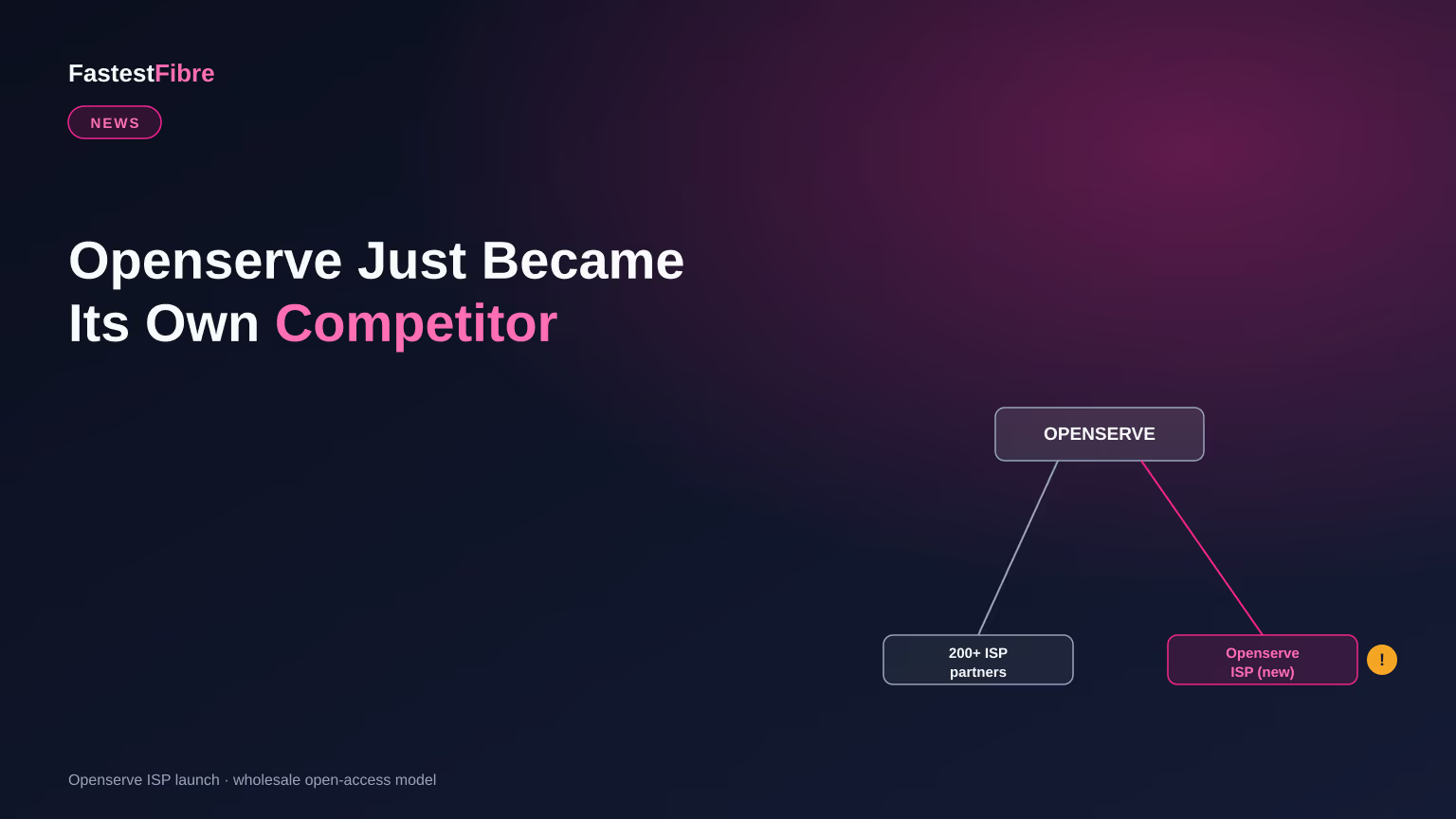
Openserve Just Became Its Own Competitor
Read articleBest Fibre ISP in South Africa 2026
Read article
Six to 12 Months, Thousands of Rand: Why Municipalities Are Fibre's Biggest Bottleneck
Read article
Octotel Says the Fibre Rollout Race Is Over. Does Its Own Data Back That Up?
Read article