MetroFibre Just Hit the Brakes on New Rollout - the Numbers Explain Why
MetroFibre's CEO told MyBroadband the network's 2026 build strategy has been 'deliberately selective', concentrating on saturating its existing footprint rather than chasing new rollout. Our own tracked homes-passed data shows why: at roughly 34% take-up, MetroFibre converts fewer of the homes it already passes than any of South Africa's other four biggest wholesale fibre networks.

In this article(6)
What MetroFibre actually said
MetroFibre Networx - South Africa's fourth-largest wholesale fibre network by homes passed, behind Vumatel, Openserve and Herotel - has told MyBroadband that its approach to new fibre construction has changed in 2026. In comments reported on 2 July 2026, CEO Jan-Jan Bezuidenhout described the network's build strategy this year as "deliberately selective," saying that instead of aggressive new rollout, MetroFibre has "concentrated on saturating and strengthening areas in and around our existing network." He characterised uptake across 2026 as "moderate to positive," with particularly encouraging take-up in areas where the network has focused on maturity rather than large-scale expansion, and said the approach lets MetroFibre deploy capital more efficiently and shorten access build times where density already supports it.
That's a meaningfully different posture from the growth-at-almost-any-cost expansion phase most of South Africa's wholesale fibre networks have run through since 2020. It's also a useful moment to check the claim against MetroFibre's own numbers, rather than taking "moderate to positive uptake" at face value - which is exactly what our tracked footprint data lets us do.
| Metric | Value | Detail |
|---|---|---|
| MetroFibre homes passed | 510 000 | As of Jun 2025 |
| MetroFibre homes connected | 172 000 | As of Jun 2025 |
| Take-up rate | 33.7% | Lowest of SA's 5 biggest wholesale networks |
| Ispa reliability score | 6.4/10 | -0.3 year-on-year, rated by 31 ISPs |
The math behind the pivot
Every wholesale fibre network reports two very different numbers: homes passed (fibre built past a property, ready to connect) and homes connected (an actual paying customer on that fibre). The gap between them is capital sitting unmonetised in the ground - and it's the single best public signal of whether a network's next rand is better spent building somewhere new, or selling harder into what it's already built.
Below is that gap for South Africa's five biggest wholesale fibre networks by homes passed, using the same tracked figures that power our benchmarks page. Take-up is computed directly from each network's own homes-passed and homes-connected figures, not estimated.
| Network | Homes passed | Homes connected | Uptake | As of | Source |
|---|---|---|---|---|---|
| Vumatel | 2 339 932 | 1 032 226 | 44% | Mar 2026 | Remgro FY2026 results presentation |
| Openserve | 1 565 750 | 843 563 | 54% | Jun 2026 | Telkom Q1 FY2027 trading update, 3 Aug 2026 |
| Herotel | 620 000 | 350 000 | 56% | Jun 2026 | Remgro FY2026 results presentation (stated as floors) |
| MetroFibre | 510 000 | 172 000 | 34% | Jun 2025 | TeleGeography |
| Frogfoot | 406 000 | 169 000 | 42% | Jun 2025 | TeleGeography |
At 33.7% take-up, MetroFibre converts a smaller share of the homes it has already passed than Vumatel, Openserve, Herotel or Frogfoot - the other four networks in this table. Read alongside Bezuidenhout's comments, that's not a coincidence: a network sitting on hundreds of thousands of already-built, unconnected homes has an obvious, lower-risk place to spend its next rand of capital before it spends on a new street that isn't built at all yet.
Individually, the gap between networks is wide. Openserve converts 53.9% of its 1 565 750 homes passed - the strongest of the five - followed by Herotel at 56.5%. Vumatel and Frogfoot sit in the middle, at 44.1% and 41.6% respectively, both still comfortably ahead of MetroFibre's 33.7%. None of this means MetroFibre has built badly - a newer or more recently-expanded footprint will always show a lower take-up rate than a mature one, simply because more of its homes passed haven't had time to convert yet. What it does mean is that, by MetroFibre's own numbers, the fastest available growth right now isn't in new streets - it's in the roughly 338 000 homes MetroFibre has already built past but hasn't yet connected.
MetroFibre's pivot vs the market's most aggressive expansion story
MetroFibre's shift toward its existing footprint lands in sharp contrast with the other big fibre story of the past week: on 25 August 2026, this site reported on a R14.4bn DNI Consortium-led recapitalisation of Frogfoot, Vox and Hypa aimed at roughly quadrupling new fibre connections a year, targeted squarely at townships and lower-income areas most networks - MetroFibre included - haven't prioritised. Side by side, the two strategies aren't really competing for the same capital or the same customer.
| Dimension | MetroFibre | Frogfoot / Vox / Hypa |
|---|---|---|
| Stated 2026 build priority | “Deliberately selective” - saturating and strengthening the existing footprint over new-area rollout | Explicitly aggressive - a stated goal to roughly quadruple annual new connections |
| Primary target segment | Existing coverage areas with unconnected homes already passed | Townships and lower-income areas with little or no fibre today |
| Confirmed 2026 capital event | No recapitalisation announced in this reporting window | R14.4bn DNI Consortium-led recapitalisation of Frogfoot, Vox and Hypa (25 Aug 2026) |
| Take-up on existing footprint | 33.7% of homes passed are connected (Jun 2025) | Not separately disclosed at the same footprint-wide level |
| Ispa reliability score (Feb 2026) | 6.4/10, rated by 31 ISPs (-0.3 y/y) | 6.1/10, rated-by count not published (+0.5 y/y) |
Neither approach is objectively "better" - they're answers to different questions. MetroFibre's bet is that the fastest, lowest-risk revenue sits inside fibre it has already built; Frogfoot, Vox and Hypa's bet, backed by fresh capital, is that the biggest untapped market sits in areas with no fibre option at all yet. If you live inside MetroFibre's existing footprint, the first strategy is the one that affects you. If you're in an underserved area waiting for any fibre to arrive, the second one is more likely to move the needle.
Should you wait for MetroFibre, or look elsewhere right now?
A quick way to read this if you're deciding what to do next
These aren't universal rules - check your own address on the coverage map before acting on any of them.
- Q1
Does MetroFibre already pass your home?
- Yes → you're inside the segment MetroFibre says it's now prioritising for stronger uptake and support - compare live packages
- Not sure → check your exact address before assuming either way
- No, and I'm not near existing MetroFibre infrastructure → this strategy shift makes a near-term MetroFibre build to your street somewhat less likely, not more
- Q2
Are you specifically waiting for any fibre to reach an underserved or township area?
- Q3
Want the full reliability picture before deciding on a network?
What this means depending on where you sit today
If you're already a MetroFibre customer or live inside its footprint, this is, on balance, good news. A network explicitly prioritising "saturating and strengthening" the area you're already in tends to mean more retail ISP competition selling into your street, more support and billing investment (Bezuidenhout specifically cited both), and less of the coverage-first, quality- second pattern that can show up when a network is spread thin chasing new ground. It's also worth noting alongside the reliability data: MetroFibre's Ispa score still fell -0.3 year-on-year in the same window this strategy describes, so "prioritising existing customers" hasn't yet shown up as an improving satisfaction trend - something worth watching in the next survey round rather than assuming has already been fixed.
If you're waiting for fibre to reach a street MetroFibre doesn't yet pass, this strategy shift is a real, if modest, signal that a near-term MetroFibre build to your specific address is less likely than it might have been under a more aggressive 2025-style expansion push. That doesn't mean fibre generally is slowing down where you are - Frogfoot, Vox and Hypa's just-funded expansion is aimed at exactly the underserved and township areas most likely to be in that position, and it's worth checking whether your address falls inside their stated target areas rather than assuming no network is coming.
It's also worth being clear about why a network's take-up rate matters to you personally, not just to its balance sheet. A low take-up rate isn't itself a sign of poor line quality - fibre passed past a home works the same whether the neighbour next door has signed up or not. But it does affect the commercial incentives around you: a network converting a smaller share of its own footprint has more obvious headroom to compete on price, bundle deals or support responsiveness to win the customers it hasn't converted yet, which can work in your favour if you're an unconnected home inside MetroFibre's existing coverage right now.
Either way, a short list of things worth checking before you decide anything:
- Confirm coverage at your exact address, not your suburb generally - fibre footprints can end mid-street. Use our fibre coverage map.
- Check MetroFibre's actual live pricing - MetroFibre has since confirmed a 2026 wholesale increase (average 5.29%, effective 1 June 2026) plus a separate MetroConnect prepaid increase (18-25%, effective 1 May 2026), joining Frogfoot, Openserve, Vumatel and Octotel as networks that moved on price this year. See the MetroFibre price change breakdown or the full 2026 price-change timeline.
- Weigh the Ispa score alongside the take-up data, not instead of it - a network can have real headroom to improve uptake and still be mid-decline on customer satisfaction, which appears to be exactly where MetroFibre sits right now.
Frequently asked questions
Help someone else pick the right fibre
Now go and compare the deals
Prices below come from our own deal tracking, checked on 6 October 2026.
What each package actually costs per megabit, not just per month.
See the dealsThe full catalogue in one sortable table - filter by speed, price or network.
See the dealsRanked by price across every ISP and network we track.
See the dealsRelated insights
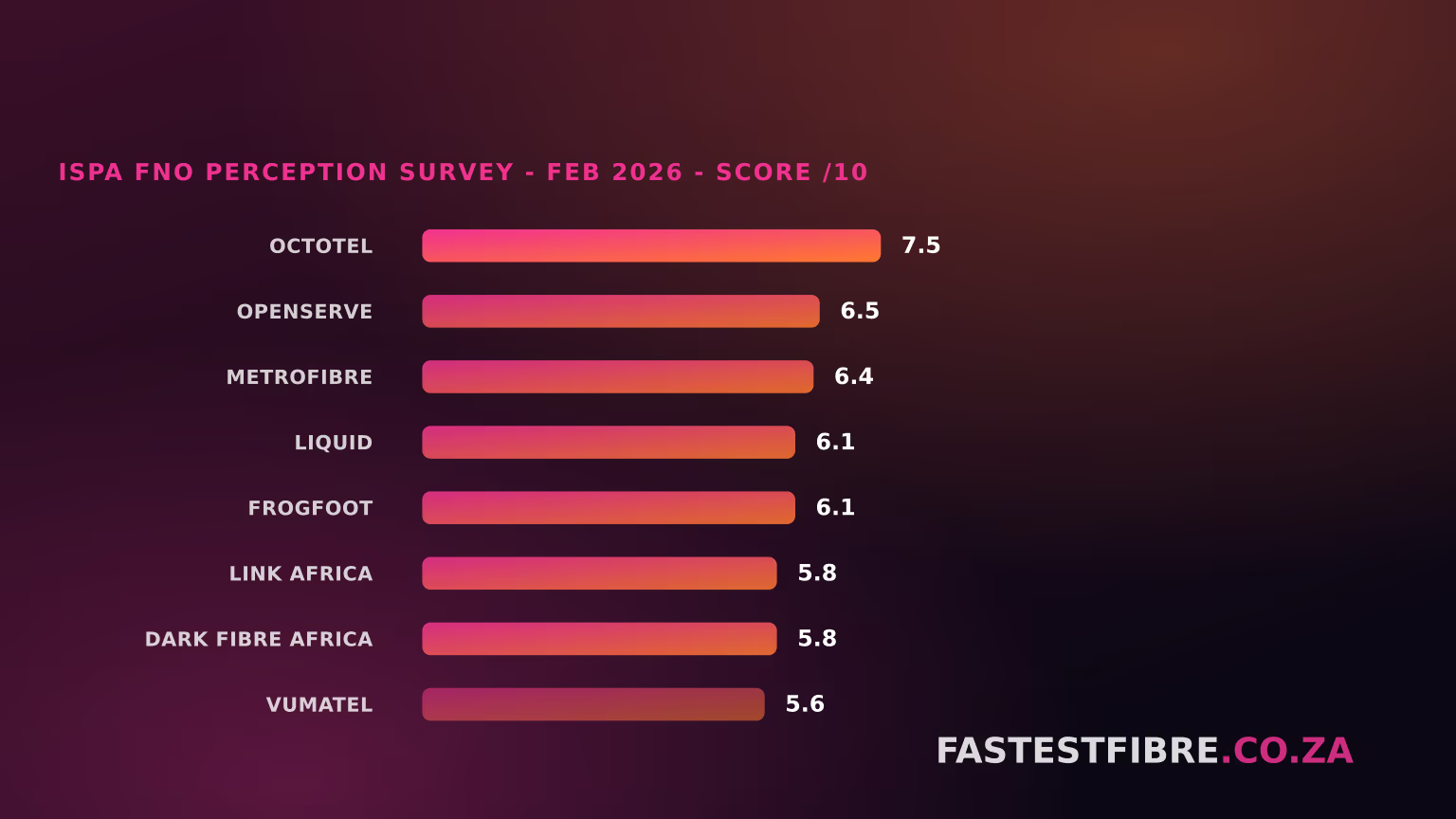
South Africa's ISPs Just Ranked Every Fibre Network - Octotel's On Top, Vumatel's Last
Read article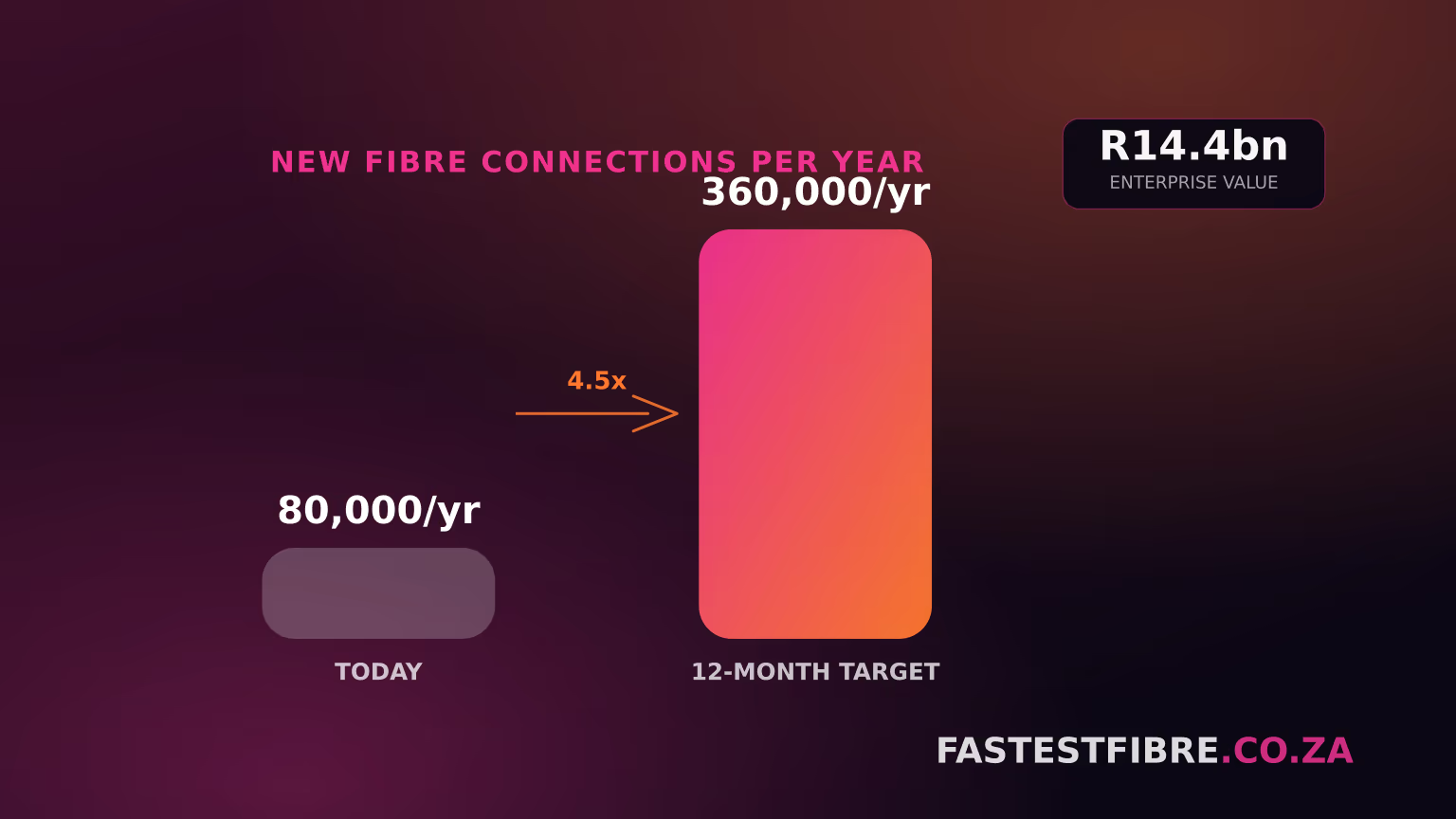
Frogfoot, Vox and Hypa Raise R14.4bn to Quadruple Township Fibre Rollout
Read article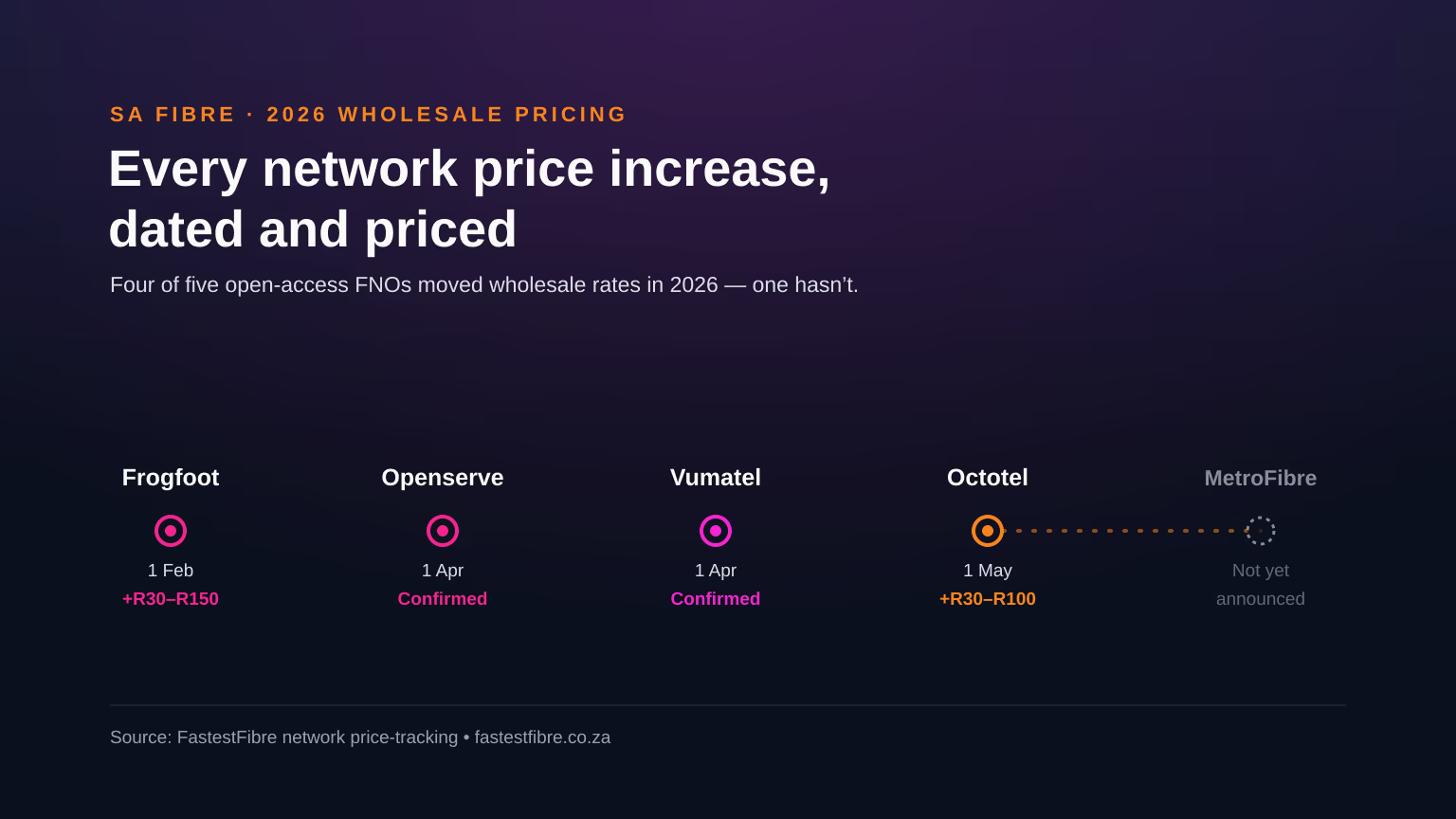
Every SA Fibre Price Increase in 2026, Network by Network
Read articleMetroFibre Coverage, Deals and ISPs
Read articleSA Fibre Benchmarks: Speeds, Ratings & Prices
Read article
MTN's H1 Results Say Fibre Is Overtaking Wireless - But Not Necessarily in South Africa
Read article
MTN Wants to 'Own the Household': Inside Its Plan for 30% of SA's Home Internet Market
Read article