Icasa just settled the 6GHz spectrum fight - here's what it means for your fibre Wi-Fi
Icasa gazetted South Africa's updated National Radio Frequency Plan on 24 July 2026, giving mobile operators the upper 6GHz band while permanently protecting the lower band for Wi-Fi 6E and Wi-Fi 7. Here's why that matters even though almost nobody in SA is using 6GHz yet.
In this article(8)
- 01What just happened
- 02The spectrum fight, explained without the jargon
- 03Why a mobile-spectrum decision matters if you have fibre, not a SIM card
- 04The adoption gap: SA households aren't using the spectrum they already have
- 05Should you actually upgrade your router for this?
- 06What happens next with the upper band
- 07Bottom line
- 08Frequently asked questions
What just happened
On 24 July 2026, the Independent Communications Authority of South Africa (Icasa) gazetted an updated National Radio Frequency Plan (NRFP) 2026, following ministerial sign-off on 2 July. Buried in the technical detail of a document mostly concerned with mobile spectrum is a decision that touches almost every fibre customer in the country: how the 6GHz radio band gets split between mobile networks and Wi-Fi.
The short version: mobile operators get the top two-thirds of the band for future 5G and 6G services. Wi-Fi keeps the bottom third, permanently and licence-free. If you've never heard of the 6GHz band, that's fair - almost nobody in South Africa is using it yet. But the decision matters anyway, because it removes a real risk that had been hanging over the home Wi-Fi upgrade path for the last three years, and it puts a spotlight on a gap most fibre customers don't know they have: the difference between what your fibre line can deliver and what your router can actually pass on to your laptop or phone.
The spectrum fight, explained without the jargon
Radio spectrum is just a range of frequencies, and every wireless technology - mobile 5G, Wi-Fi, satellite links, TV broadcast - needs a slice of it to operate. The more spectrum a technology gets, the wider the "lanes" it has to move data through, which usually means higher speeds and less congestion.
The 6GHz band (5.925GHz to 7.125GHz) is valuable because it's one of the last wide, contiguous chunks of usable spectrum left in the mid-band range that both mobile networks and Wi-Fi equipment want. Icasa opened the lower slice (5.925-6.425GHz) for licence-exempt Wi-Fi use back in 2023 - that decision is what made Wi-Fi 6E and Wi-Fi 7 hardware legal to use in South Africa in the first place, since both standards depend on 6GHz spectrum to deliver their headline speed and congestion improvements over older Wi-Fi.
What was never settled was the upper slice (6.425-7.125GHz). Mobile operators wanted it for 5G today and 6G down the line, arguing that consumer demand for mobile data would keep outstripping available spectrum. The Wi-Fi and wireless ISP industry wanted it kept unlicensed, arguing that home and office Wi-Fi - and the fixed-wireless links that some smaller ISPs rely on - needed the extra headroom just as much. The updated NRFP resolves that three-way tug of war: mobile gets the upper 700MHz slice, Wi-Fi's existing lower allocation is confirmed and left untouched.
South Africa's approach lands closest to the model already used across the European Union, and is a deliberate middle path between the two extremes taken by the world's two largest markets.
| Market | 6GHz band split |
|---|---|
| United States | Whole 6GHz band to Wi-Fi / unlicensed use |
| China | Whole 6GHz band reserved for cellular (IMT) |
| European Union | Lower 6GHz to Wi-Fi, most of the upper band to mobile |
| South Africa (2026) | Lower 6GHz to Wi-Fi (permanent), upper 6GHz to mobile 5G/6G |
Why a mobile-spectrum decision matters if you have fibre, not a SIM card
It's tempting to file this under "mobile network news" and move on. That would be a mistake, because the lower 6GHz band Icasa just re-confirmed for Wi-Fi is the same band your home router would use to run Wi-Fi 6E or Wi-Fi 7 - and Wi-Fi, not the fibre line itself, is the most common reason a fast fibre package doesn't feel fast once you're a few metres from the router.
We've covered this gap in detail before: in Why Is My Fibre Slow?, the honest answer nine times out of ten is "your Wi-Fi, not your line." A 1Gbps fibre package run through an ageing dual-band router, competing with a dozen smart-home devices on a congested 2.4GHz channel, will feel nothing like the number on your invoice. Confirming that the 6GHz band stays available to Wi-Fi for the long term is the regulatory precondition for South Africans actually closing that gap - it guarantees the spectrum newer routers use will still be legally available in five or ten years, rather than being clawed back for mobile use just as adoption picks up.
In other words: this decision doesn't upgrade anyone's Wi-Fi overnight. What it does is remove the one regulatory question mark that could have made buying a 6GHz-capable router today a bad long-term bet.
The adoption gap: SA households aren't using the spectrum they already have
Here's the part of this story that should actually change how you think about your next router purchase. South Africa - and Africa as a whole - has had legal access to the lower 6GHz band for Wi-Fi since 2023. Take-up has been almost nonexistent. Industry Wi-Fi analytics from the first quarter of 2026 put South African 6GHz usage at just 0.2% of Wi-Fi connections, against 13.8% in North America. Across the wider African continent, the figure rounds down to effectively zero - the lowest of any region tracked.
The reason isn't the regulation. It's the hardware sitting in people's lounges. Wi-Fi 6E and Wi-Fi 7 are the only two Wi-Fi generations that can use 6GHz at all - older Wi-Fi 6, Wi-Fi 5 and Wi-Fi 4 devices simply can't see that spectrum, no matter how good your fibre line is. And most South African homes are still running exactly that older hardware:
| Wi-Fi generation | Share of connections (Africa, Q1 2026) | Trend |
|---|---|---|
| Wi-Fi 4 (802.11n) | 48.8% | Still the single biggest slice of the installed base |
| Wi-Fi 5 (802.11ac) | 34.4% | Up from 19.9% in 2022 |
| Wi-Fi 6 (802.11ax) | 16.8% | Up from 1.6% in 2022 - the fastest-growing tier |
| Wi-Fi 7 (802.11be) | 0.1% | Barely present outside flagship phones and premium routers |
Two structural reasons keep that mix skewed toward older hardware. First, ISPs' free-to-use routers - the ones that ship with most fibre signups - are built to a price, and typically sit at Wi-Fi 5 or entry Wi-Fi 6, well behind the 6GHz-capable tier. Second, households simply keep routers and phones for years rather than upgrading on every new standard, so even a favourable regulatory environment turns into real-world usage only gradually. Rising global component costs - partly driven by AI infrastructure demand pushing up semiconductor prices - are an additional headwind on how fast that hardware refresh happens.
Should you actually upgrade your router for this?
Not automatically, and not for everyone. Whether a 6GHz-capable router is worth buying now depends on what you're actually trying to fix:
- You're on a gigabit or near-gigabit fibre line and still see nowhere near that speed on Wi-Fi - this is the clearest case for upgrading. A Wi-Fi 6E or Wi-Fi 7 router, paired with a 6GHz-capable laptop or phone, gives you a clean, largely interference-free channel that older 2.4GHz and 5GHz bands - crowded with neighbours' networks, Bluetooth devices and smart-home gear - simply can't match. We cover router shopping in more depth in Best Wi-Fi Router for Fibre in South Africa.
- Your phone or laptop doesn't support 6GHz - and most in South Africa still don't - a new router alone won't change anything for that device. 6GHz is a two-sided upgrade: router and client device both need it before you see any benefit on that connection.
- You're on a 20-50Mbps entry-level fibre package - your bottleneck almost certainly isn't Wi-Fi generation at all. A cheap line can't benefit from a wider, faster Wi-Fi band if there isn't more actual bandwidth coming in from the street to begin with. See Should You Pay for Gigabit Fibre? for that trade-off in full.
- You're renting, or don't own your router - check with your ISP before buying your own hardware. Some free-to-use router agreements restrict swapping in third-party equipment, or charge a fee if you do.
The practical middle ground for most households: there's no urgency created by this specific gazette. What it does is confirm that money spent on a 6GHz-capable router today is not money spent on a standard that could be regulated away. If a router refresh was already on your list, that decision just got a little easier to justify.
What happens next with the upper band
Mobile operators don't get to switch on 6GHz 5G tomorrow. Icasa has committed to running feasibility studies and drawing up radio frequency spectrum assignment plans before any licensing or auction process for the upper band can begin - the same multi-step process that has stretched South Africa's last few major spectrum auctions out over years rather than months. The upper 6GHz band also currently carries licensed point-to-point microwave links and satellite uplinks that will need to be accommodated or migrated before mobile use can start in earnest.
For context on how slow that pipeline typically runs: Icasa's next big high-demand spectrum auction - covering bands like 750MHz, 800MHz, 1.5GHz, 2.3GHz, 3.3GHz and 3.5GHz - has already been pushed into Icasa's 2027 financial year, which only starts in April 2026 and runs to March 2027. The regulator told Parliament's portfolio committee on communications & digital technologies that it had received R51 million from National Treasury to run that process and was still appointing service providers as of early 2026. The 6GHz upper band, being newer to the official spectrum plan, sits behind that queue rather than ahead of it.
What that means practically: don't expect the mobile side of this decision to affect network congestion or 5G speeds in the next year or two. The part of the decision that matters to fibre customers right now - permanent protection of the lower band for Wi-Fi - is already in force.
Bottom line
Icasa's updated National Radio Frequency Plan is, on its face, a mobile-industry story about 5G and 6G spectrum. But the part worth remembering as a fibre customer is smaller and more durable: the regulator has now locked in, rather than merely allowed, Wi-Fi's claim to the lower 6GHz band. That removes the last real uncertainty hanging over Wi-Fi 6E and Wi-Fi 7 adoption in South Africa.
It doesn't change anything about your connection today. Almost nobody here is using 6GHz Wi-Fi yet, and that won't shift until routers and phones catch up. But if your fibre line already outpaces what your Wi-Fi can deliver - the single most common complaint behind a "slow fibre" experience - this is one less reason to hold off on fixing the actual bottleneck: the router, not the line.
Frequently asked questions
Help someone else pick the right fibre
Now go and compare the deals
Prices below come from our own deal tracking, checked on 12 October 2026.
Ranked by price across every ISP and network we track.
See the dealsThe full catalogue in one sortable table - filter by speed, price or network.
See the dealsHow the major ISPs rank on price, support and real measured performance.
See the dealsRelated insights

Icasa Strike 2026: What It Means for Fibre Wayleave and Spectrum Rules
Read article
Best Wi-Fi Router for Fibre in South Africa (2026)
Read article
Why Is My Fibre Slow? How to Fix Slow Wi-Fi at Home
Read article
Should You Pay for Gigabit Fibre in 2026?
Read article
Icasa Wants a Map of Every Fibre Cable in SA
Read article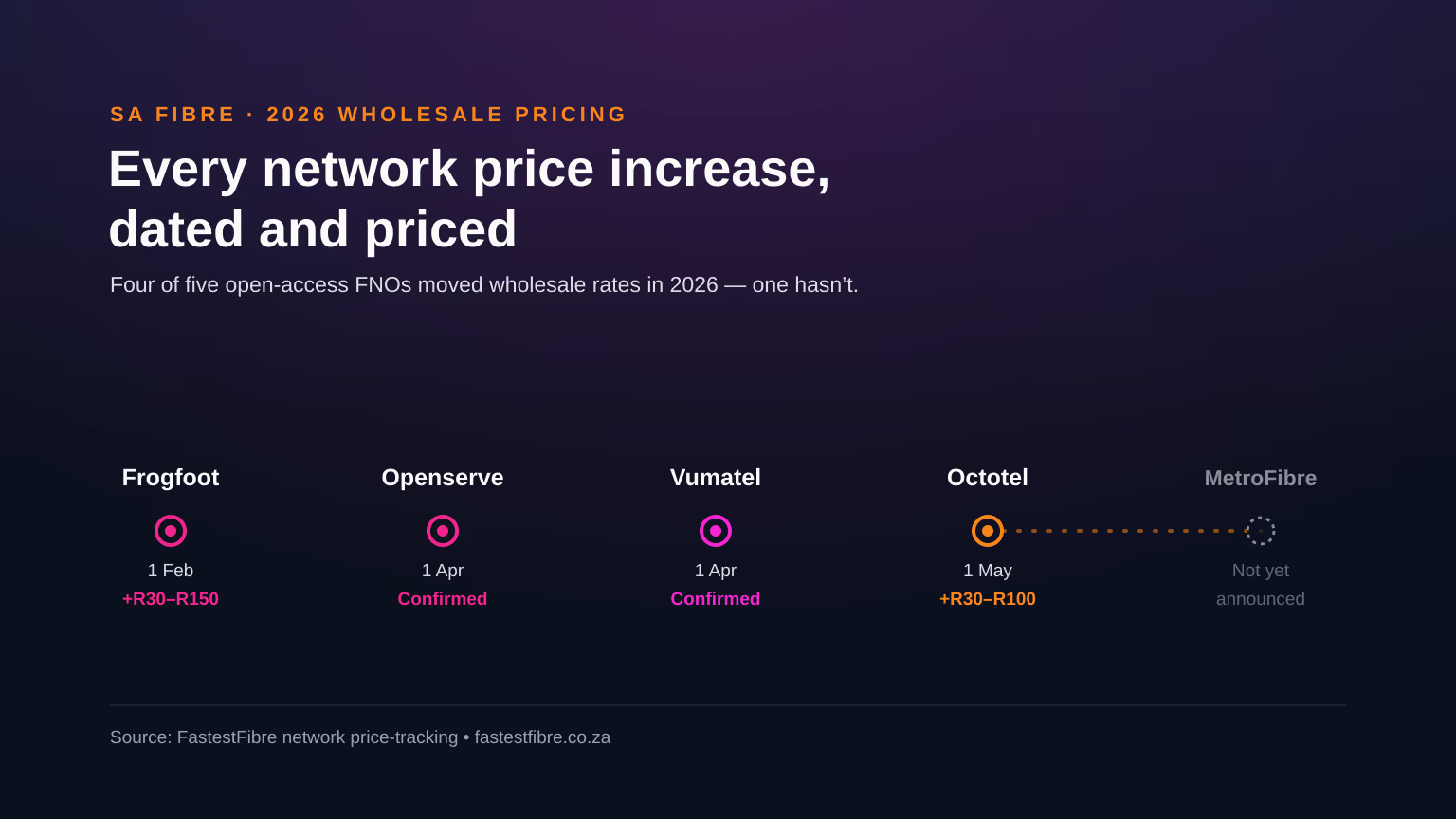
Every SA Fibre Price Increase in 2026, Network by Network
Read article
The Fastest Fibre Countries in the World 2026
Read article
Icasa Withdrew Its Telecoms Affordability Inquiry Before It Began
Read article