We Tracked Every Fibre Outage for 5 Straight Days
We logged every outage Afrihost's public status board posted over 5 days in late July/early August 2026 - 14 incidents across 8 networks, all rated Medium Impact. Here's the full list, what it can't tell you, and how to check your own area.

In this article(7)
- 01What a status board actually captures - and what it doesn't
- 02The full 5-day log, in order
- 03Tallied by network - and why the raw count is the wrong number to compare
- 04Does this match what ISPs themselves say about these networks?
- 05How to check this yourself, and what "Medium Impact" actually means
- 06What this means if you're comparing networks right now
- 07Frequently asked questions
What a status board actually captures - and what it doesn't
Afrihost, like most large fibre resellers, runs a public network status page that lists outage notices as its field teams and upstream network operators report them. Because Afrihost resells capacity from more than 40 different fibre networks - not just the household names like Openserve, Vumatel, Frogfoot and MetroFibre, but smaller regional operators like Clear Access, FMAS Networks, Gaia Fibonacci and Netstream too - its status board ends up functioning as a rough, real-time window onto outages across a wide slice of the whole SA fibre market, not just Afrihost's own customers.
We watched that board for five days, from 29 July to 2 August 2026, and logged every outage notice it posted. The result: 14 separate incidents across 8 different networks and 14 different suburbs. Below is the complete list, unedited and in the order it was reported - followed by what it can responsibly tell you, and, just as importantly, what it can't.
| Metric | Value | Detail |
|---|---|---|
| Outages logged | 14 | 29 Jul - 2 Aug 2026 (5 days) |
| Networks affected | 8 | Of 40+ networks Afrihost resells |
| Highest severity seen | Medium | No High or Critical-rated incident in this window |
| Suburbs affected | 14 | No two incidents in the same area |
The full 5-day log, in order
Fourteen incidents, oldest first. Each one is exactly as Afrihost's status board described it at the time we checked - we haven't paraphrased the affected-area wording or guessed at a cause beyond what the board itself stated.
- 29 July 202609:35 - Blue Hills Country & Equestrian Estate (Clear Access)
Medium-impact outage logged for the Blue Hills Country and Equestrian Estate area on the Clear Access network.
- 29 July 202617:45 - Somerset West (Netstream)
Medium-impact outage logged for Somerset West on the Netstream network.
- 30 July 202608:39 - Roodepoort (Gaia Fibonacci)
Medium-impact outage logged across New Haven, Rainbow, Rothchild, Khayalala and Greenshank on the Gaia Fibonacci network.
- 30 July 202614:32 - Meredale (Clear Access)
Medium-impact outage logged for Meredale, Johannesburg South, on the Clear Access network.
- 30 July 202622:12 - Delft, Bonteheuwel & Belhar (Vuma Reach)
Medium-impact outage logged across Delft, Bonteheuwel and Belhar on Vumatel's Vuma Reach aerial network.
- 30 July 202622:21 - Centurion (Openserve)
Medium-impact outage logged for Centurion on the Openserve network.
- 31 July 202607:37 - Pinetown (Vumatel)
Medium-impact outage logged for Pinetown, KwaZulu-Natal, on the Vumatel network.
- 31 July 202612:52 - Blue Hills (FMAS Networks)
Medium-impact outage logged for Blue Hills, Gauteng, on the FMAS Networks network.
- 1 August 202619:47 - Sky City, Vereeniging (Frogfoot)
Medium-impact outage logged for the Sky City area of Vereeniging on the Frogfoot network.
- 1 August 202622:08 - Port Shepstone / Marburg (Frogfoot)
Medium-impact outage logged for Marburg, Port Shepstone, on the Frogfoot network.
- 2 August 202608:15 - Emalahleni / Witbank (MetroFibre)
Medium-impact outage logged for the Emalahleni (Witbank) area, listed alongside Pretoria, on the MetroFibre network.
- 2 August 202608:53 - Silverfields (FMAS Networks)
Medium-impact outage logged for Silverfields, listed with Donegia, on the FMAS Networks network.
- 2 August 202610:13 - Die Hoewes (MetroFibre)
Medium-impact outage logged for Die Hoewes, Centurion, on the MetroFibre network.
- 2 August 202613:44 - Klerksdorp (MetroFibre)
Medium-impact outage logged for Klerksdorp, North West, on the MetroFibre network.
| Date | Milestone | What happened |
|---|---|---|
| 29 July 2026 | 09:35 - Blue Hills Country & Equestrian Estate (Clear Access) | Medium-impact outage logged for the Blue Hills Country and Equestrian Estate area on the Clear Access network. |
| 29 July 2026 | 17:45 - Somerset West (Netstream) | Medium-impact outage logged for Somerset West on the Netstream network. |
| 30 July 2026 | 08:39 - Roodepoort (Gaia Fibonacci) | Medium-impact outage logged across New Haven, Rainbow, Rothchild, Khayalala and Greenshank on the Gaia Fibonacci network. |
| 30 July 2026 | 14:32 - Meredale (Clear Access) | Medium-impact outage logged for Meredale, Johannesburg South, on the Clear Access network. |
| 30 July 2026 | 22:12 - Delft, Bonteheuwel & Belhar (Vuma Reach) | Medium-impact outage logged across Delft, Bonteheuwel and Belhar on Vumatel's Vuma Reach aerial network. |
| 30 July 2026 | 22:21 - Centurion (Openserve) | Medium-impact outage logged for Centurion on the Openserve network. |
| 31 July 2026 | 07:37 - Pinetown (Vumatel) | Medium-impact outage logged for Pinetown, KwaZulu-Natal, on the Vumatel network. |
| 31 July 2026 | 12:52 - Blue Hills (FMAS Networks) | Medium-impact outage logged for Blue Hills, Gauteng, on the FMAS Networks network. |
| 1 August 2026 | 19:47 - Sky City, Vereeniging (Frogfoot) | Medium-impact outage logged for the Sky City area of Vereeniging on the Frogfoot network. |
| 1 August 2026 | 22:08 - Port Shepstone / Marburg (Frogfoot) | Medium-impact outage logged for Marburg, Port Shepstone, on the Frogfoot network. |
| 2 August 2026 | 08:15 - Emalahleni / Witbank (MetroFibre) | Medium-impact outage logged for the Emalahleni (Witbank) area, listed alongside Pretoria, on the MetroFibre network. |
| 2 August 2026 | 08:53 - Silverfields (FMAS Networks) | Medium-impact outage logged for Silverfields, listed with Donegia, on the FMAS Networks network. |
| 2 August 2026 | 10:13 - Die Hoewes (MetroFibre) | Medium-impact outage logged for Die Hoewes, Centurion, on the MetroFibre network. |
| 2 August 2026 | 13:44 - Klerksdorp (MetroFibre) | Medium-impact outage logged for Klerksdorp, North West, on the MetroFibre network. |
Tallied by network - and why the raw count is the wrong number to compare
Grouped by network, MetroFibre shows up most (3 incidents), followed by Frogfoot, Clear Access and FMAS Networks (2 each), with Openserve, Vumatel, Vuma Reach, Gaia Fibonacci and Netstream logging one apiece. Read on their own, raw counts like that invite exactly the wrong conclusion, because they ignore network size entirely - a network passing 500,000 homes and a network passing 2 million homes logging the same number of incidents are not equally reliable, they're wildly different.
Where a network's homes-passed figure is independently published (see our benchmarks page for sourcing), we've normalised the incident count against it below. Where it isn't - four of the eight networks in this log have no independently published homes-passed figure we could verify - we're showing that gap rather than inventing a number to fill it.
| Network | Outages logged | Areas | Homes passed | Outages per 100k homes passed |
|---|---|---|---|---|
| MetroFibre | 3 | Klerksdorp, Die Hoewes, Emalahleni/Witbank | 510,000 (Jun 2025) | ~0.59 |
| Frogfoot | 2 | Vereeniging, Port Shepstone | 406,000 (Jun 2025) | ~0.49 |
| Clear Access | 2 | Meredale, Blue Hills Equestrian Estate | Not separately published | N/A |
| FMAS Networks | 2 | Blue Hills, Silverfields | Not separately published | N/A |
| Openserve | 1 | Centurion | 1,539,209 (Mar 2026) | ~0.06 |
| Vumatel | 1 | Pinetown | 2,040,231 (Mar 2025) | ~0.05 |
| Vuma Reach | 1 | Delft/Bonteheuwel/Belhar | Not published separately from Vumatel | N/A |
| Gaia Fibonacci | 1 | Roodepoort | Not separately published | N/A |
| Netstream | 1 | Somerset West | Not separately published | N/A |
Normalised this way, MetroFibre's rate in this window (about 0.59 per 100,000 homes passed) comes out roughly 12 times Vumatel's (about 0.05) and about 9 times Openserve's (about 0.06). That's a real difference in this specific 5-day sample - but it would be a mistake to read three incidents at one network and one at another as proof of a genuine reliability gap. A single cable break, a single contractor's digger, or a single ageing joint failing can double or triple a small network's count in a five-day window without reflecting anything structural about how that network is run. Meaningful reliability comparisons need months of consistent data, not five days - which is exactly why we're publishing the raw log rather than a ranking.
Does this match what ISPs themselves say about these networks?
For a second, independent reference point, our benchmarks page already tracks Ispa's February 2026 member survey - 406 ratings from 45 ISPs, scoring each major network out of 10 on reliability, support and related metrics. It's a completely different data source, gathered a different way, over a much longer period. Here's how the four majors that appear in our outage log scored in that survey:
| Network | Ispa score (/10) | Rated by | Year-on-year | This outage snapshot |
|---|---|---|---|---|
| Openserve | 6.5 / 10 | 38 | -0.2 | 1 outage in this snapshot |
| MetroFibre | 6.4 / 10 | 31 | -0.3 | 3 outages in this snapshot |
| Frogfoot | 6.1 / 10 | Not published | +0.5 | 2 outages in this snapshot |
| Vumatel | 5.6 / 10 | Not published | +1.0 | 1 outage in this snapshot |
There's no clean story here, and we're not going to manufacture one. Openserve and MetroFibre - the two networks with published, ISP-count-backed scores - sit closest together (6.5 and 6.4) despite a 12x gap in our outage tally, and both saw their score fall year-on-year. Frogfoot and Vumatel's rated-by counts weren't published in Ispa's report, which limits how much weight their scores alone can carry here. The honest read: a 5-day outage count and a 6-month-old satisfaction survey are measuring different things, and neither one should be read as a substitute for the other. Use the full Ispa breakdown for network reputation over time, and a live status board for what's happening in your suburb right now.
How to check this yourself, and what "Medium Impact" actually means
Every incident logged in our window carried the same severity label: Medium Impact. Afrihost's board didn't define exactly what separates a Medium-impact outage from a High or Critical one in the copy we could see, but by elimination, this window contained nothing the board's own system considered severe enough to escalate above that middle tier - no network-wide event, no multi-day outage, no incident affecting more than one suburb at a time.
If you suspect an outage in your own area, the fastest way to confirm it is a status board rather than a support call: check your own ISP's status page first, since most resellers run one, and cross-reference against Afrihost's public fibre status page if your ISP doesn't. If your suburb and network combination shows up as a known, already-being-worked incident, you can skip the support queue entirely and just wait it out. If it doesn't show up anywhere, the fault is more likely local to your own line or in-house equipment - our guide to fibre cable breaks covers the fault-indicator lights that tell you which case you're in within seconds, and our backup power guide covers the separate scenario where the issue is a power cut at your ONT rather than the fibre line itself.
What this means if you're comparing networks right now
Nothing here should move you off a network purely on the strength of a 5-day snapshot - that's the central, repeated caveat of this piece, and it's worth restating plainly. What it should change is how you weigh a single bad outage story, whether from a friend, a review site or your own recent experience: one incident, or even three, tells you very little about a network serving hundreds of thousands or millions of homes.
A short checklist for reading outage claims about any SA fibre network sensibly:
- Normalise for size before comparing. A network with 2 million homes passed will rack up more absolute incidents than one with 400,000 simply by having more infrastructure exposed to damage - raw counts without that context are close to meaningless.
- Look for patterns over months, not days. Our own five-day sample here isn't enough to draw a reliability conclusion from, and neither is anyone else's short-window anecdote.
- Check the actual status board for your address before signing up. Confirm coverage on our fibre coverage map, then ask any ISP you're considering which upstream network they resell and whether that network runs a public status page.
- Weigh survey data and live status data together, not one instead of the other. A network can score well on a satisfaction survey and still have a bad week - and vice versa - which is exactly what this snapshot and the Ispa numbers above show side by side.
Frequently asked questions
Help someone else pick the right fibre
Now go and compare the deals
Prices below come from our own deal tracking, checked on 19 October 2026.
What each package actually costs per megabit, not just per month.
See the dealsEvery package at 1 Gbps and above, with the cheapest route to that speed.
See the dealsRanked by price across every ISP and network we track.
See the dealsRelated insights

What Really Happens When Your Fibre Line Breaks?
Read article
Does Your Fibre Need a UPS in 2026?
Read articleSA Fibre Benchmarks: Speeds, Ratings & Prices
Read article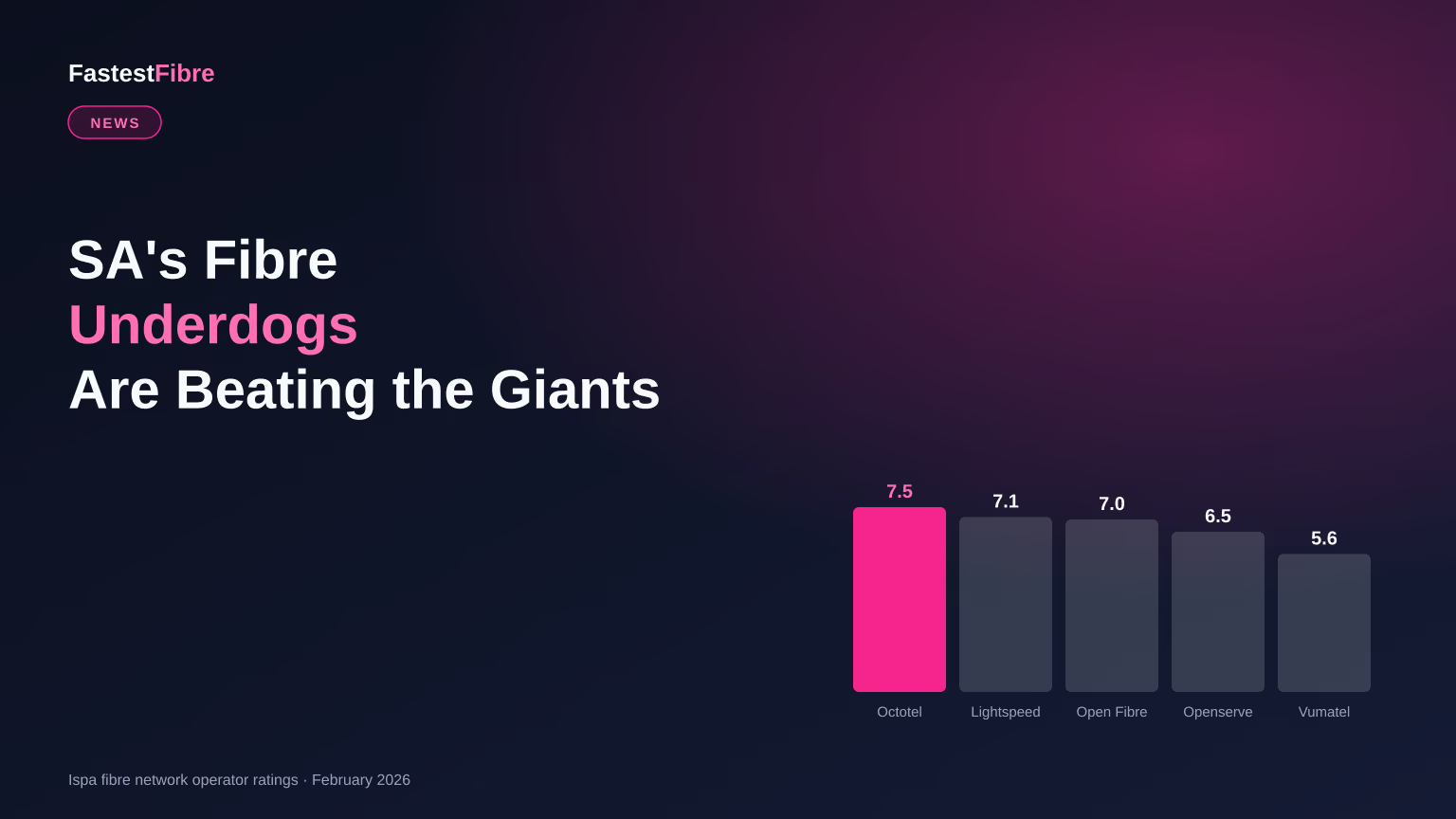
SA's Fibre Underdogs Are Beating the Giants
Read articleBest Fibre ISP in South Africa
Read article
Every SA Fibre Price Increase in 2026, Network by Network
Read article
Icasa Just Told Starlink Exactly How to Get a Licence
Read article