Why Your Fibre Feels Slow: The Wi-Fi Bottleneck Behind SA's Speed Complaints
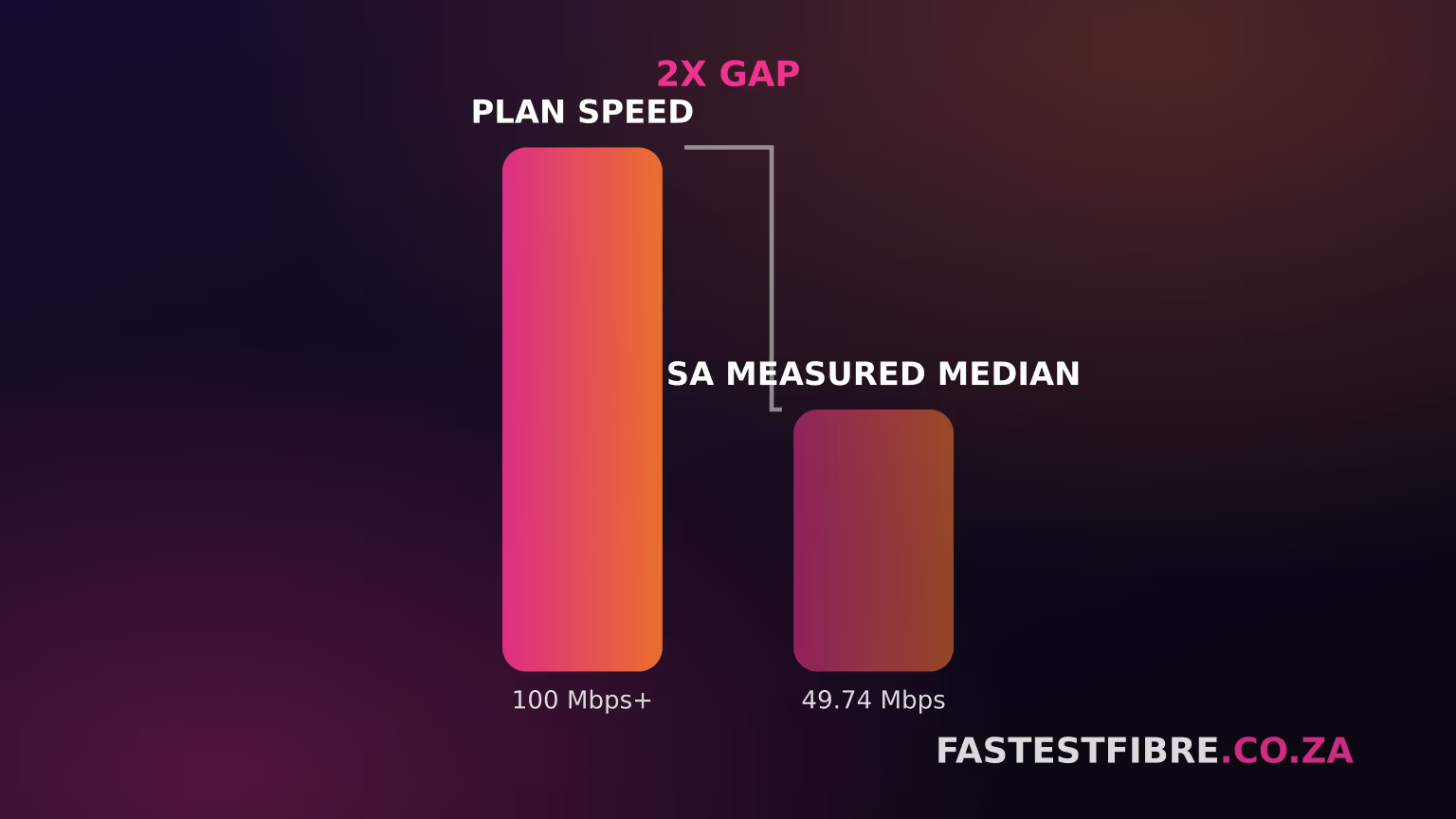
Vox argued on 8 September 2026 that SA households need better in-home Wi-Fi, not faster fibre lines - vendor commentary we're treating cautiously since it names no independent source. But FastestFibre's own tracked catalogue shows something genuinely worth checking: 45.5% of the 627 live monthly fibre deals we track are provisioned at 100 Mbps or faster, more than double South Africa's actual measured national median fixed-line speed of 49.74 Mbps (Ookla, May 2026). Here's what that gap can and can't tell you, and a practical checklist before you pay for a faster tier.
In this article(9)
- 01The claim, and why we're not taking it at face value
- 02The gap, in FastestFibre's own numbers
- 03What South Africans are actually buying, tier by tier
- 04Why people buy the faster tier: it's a genuinely better deal per Mbps
- 05Faster line vs better Wi-Fi: what each one actually fixes
- 06Should you upgrade your tier, or fix your Wi-Fi first?
- 07What we verified today, and how
- 08Bottom line
- 09Frequently asked questions
The claim, and why we're not taking it at face value
On 8 September 2026, Vox Telecom published an article on TechCentral arguing that South African households facing connectivity frustration usually have a Wi-Fi distribution problem, not an underpowered fibre line - pointing to router age, band steering between 2.4GHz and 5GHz, and neighbourhood Wi-Fi congestion as the real culprits. It's a plausible argument technically, but by this site's own sourcing bar it doesn't clear the verification threshold on its own: the piece names no independent expert, cites no survey or measurement data, and reads as promotional content published by an ISP rather than a neutral report. We checked - there's no named source or quote in it.
So rather than repeat Vox's argument as news, we went to FastestFibre's own tracked deal catalogue and to the one independently measured, dated, sourced figure this site already publishes on /benchmarks/: Ookla's Speedtest Global Index median for South African fixed broadband. Putting those two numbers next to each other produces a genuinely interesting, first-party-adjacent data point that doesn't depend on taking any vendor's word for it.
The gap, in FastestFibre's own numbers
Nearly half of the live fibre packages sold in South Africa today are provisioned well above what the country actually measures on average. Both figures below are independently sourced and dated - the left three come from this site's own live deal catalogue, computed at build time; the national median comes from Ookla, not from us.
| Metric | Value | Detail |
|---|---|---|
| Live deals tracked | 690 | Standard monthly fibre packages, re-verified 7 September 2026 |
| Provisioned at 100 Mbps+ | 47.7% | 329 of 690 live deals on this site's own catalogue |
| SA's actual measured median | 49.74 Mbps | Ookla Speedtest Global Index, fixed broadband, May 2026 |
| 100 Mbps vs that median | 2.01x | How far a common entry-to-mid fibre tier sits above what SA actually measures |
To be precise about what this gap does and doesn't show: Ookla's median measures actual achieved speed across every fixed-line technology and every household that ran a speed test, not specifically the subset of households on a 100 Mbps+ fibre plan. It isn't a like-for-like comparison of "what fibre customers paid for" against "what fibre customers got" - some of that national median is dragged down by ADSL and slower legacy lines still in the mix, and speed-test-takers skew toward people who suspect a problem in the first place. We're not presenting this as proof that half the country's fibre customers are being short-changed. We're presenting it as a real, sourced gap worth understanding - and the rest of this article is about the most common, well-documented reason that gap exists for people who do have a fast plan.
What South Africans are actually buying, tier by tier
Here's the full breakdown behind that 47.7% figure - every tier this site tracks, live deal counts, and the cheapest price and price-per-Mbps in each one.
| Tier | Live deals | Share of market | Cheapest from | Median R/Mbps |
|---|---|---|---|---|
| Up to 25 Mbps | 70 | 10.1% | R279 | R26.72 |
| 26-50 Mbps | 138 | 20% | R299 | R14.90 |
| 51-100 Mbps | 153 | 22.2% | R299 | R9.79 |
| 101-500 Mbps | 248 | 35.9% | R379 | R4.49 |
| Gigabit (501+) | 81 | 11.7% | R699 | R1.55 |
South Africa's 49.74 Mbps measured median sits inside the "26-50 Mbps" band above - meaning the typical achieved speed nationally is roughly what the second-cheapest tier promises, even though the single largest tier by live deal count is "101-500 Mbps" at 248 packages. For comparison, the global median fixed download speed is 125.47 Mbps - South Africa's measured median is well behind that too, which is a separate, larger story about national infrastructure and adoption rather than about any individual household's Wi-Fi setup.
Why people buy the faster tier: it's a genuinely better deal per Mbps
One reason so much of the market sits above 100 Mbps isn't hype - it's that South African fibre pricing rewards buying more speed. Rand-per-Mbps drops sharply as you move up the tiers, from R26.72/Mbps at the entry tier down to R1.55/Mbps at gigabit. On paper, a faster plan is close to always the more efficient purchase.
| Package | Monthly price | Download | Price per Mbps |
|---|---|---|---|
| Up to 25 Mbps | R279 | 13 Mbps | R26.72 |
| 26-50 MbpsBest value | R299 | 38 Mbps | R14.90 |
| 51-100 Mbps | R299 | 76 Mbps | R9.79 |
| 101-500 Mbps | R379 | 301 Mbps | R4.49 |
| Gigabit (501+) | R699 | 501 Mbps | R1.55 |
Source: FastestFibre deal database, median R/Mbps per tier, computed from 690 live monthly packages. As of 7 September 2026.
Here's the same efficiency worked through as an actual cash example, using the single cheapest live deal at each of three common tiers today:
| Tier | Cheapest deal | Price | R/Mbps | Cost of the upgrade |
|---|---|---|---|---|
| 50/25 Mbps | RSAweb on Vumatel | R499 | R9.98 | - |
| 100/100 Mbps | RSAweb on Octotel | R379 | R3.79 | +R-120/mo for 2x the download speed |
| 200/200 Mbps | RSAweb on Vumatel | R549 | R2.75 | +R170/mo for another 2x |
Going from 50 to 100 Mbps roughly doubles the download speed for well under double the price - a genuinely better R/Mbps deal. But that better deal only pays off if the extra capacity actually reaches the device you're using. If your home Wi-Fi is the bottleneck, you can buy an efficient 100 Mbps or 200 Mbps plan and still see the same 15-20 Mbps on your phone in the back bedroom that you saw on the 50 Mbps plan - because the ceiling you're hitting was never the line's ceiling to begin with.
Faster line vs better Wi-Fi: what each one actually fixes
These solve different, specific problems. Match your actual symptom to the right column before spending money on either.
| Dimension | Upgrading your fibre tier | Fixing your home Wi-Fi |
|---|---|---|
| What it actually fixes | The maximum speed available at your router/ONT - the ceiling on what your line can deliver at all | How much of that ceiling actually reaches your laptop, TV or phone in another room |
| Typical monthly cost to upgrade | R-120-R170 more per month, indefinitely, per tier jump | Once-off: a modern router or a 2-3 pack mesh system, no recurring cost |
| Fixes a wired, one-metre-from-router speed test that already falls short of your plan | Yes - this is the one symptom a faster line tier can actually fix | No - if the fault is this close to the router, the problem is upstream of Wi-Fi entirely |
| Fixes 'fast near the router, slow in the bedroom' | No - a faster plan does not change what a wall, floor or thick door does to a 5GHz signal | Yes - this is the textbook Wi-Fi-bottleneck symptom |
| Fixes speed that drops every evening at the same time | Sometimes - can be genuine ISP/network contention at peak hours | Sometimes - can also be neighbouring Wi-Fi networks congesting the same channels at peak hours |
| Install effort | None from you - ISP or network technician handles a tier change remotely or with a short visit | Router placement, and mesh add-on setup if you go that route - 20-60 minutes, no technician needed for most homes |
For a full walkthrough of router placement, band steering, mesh systems and channel congestion - the practical side of the right-hand column - see our existing guide, Why Is My Fibre Slow? How to Fix Slow Wi-Fi at Home. We're not duplicating that checklist here; this article is about which side of the table you should even be looking at.
Should you upgrade your tier, or fix your Wi-Fi first?
Five minutes to find out which problem you actually have
Run a speed test with a laptop or phone connected by an Ethernet cable, sitting right next to the router. Then compare it to a speed test over Wi-Fi in the room where the problem actually bothers you.
- Q1
Does the wired, next-to-the-router test come in close to your plan's advertised speed?
- No - it falls well short even wired and next to the router → The bottleneck is upstream of your home network entirely - the line, the router itself, or your ISP's provisioning. Contact your ISP with this specific wired result; a faster plan won't fix an already-under-delivering one.
- Yes - wired speed matches or comes close to the plan → Your line is delivering what you're paying for. Move to the next question.
- Q2
Does a Wi-Fi test in another room fall well short of that wired result?
- Yes - big drop once you go over Wi-Fi and change rooms → This is the textbook Wi-Fi-bottleneck pattern Vox's piece describes, and it's the more common cause in our reading of the evidence. A faster line tier will not fix this. See our Wi-Fi fix checklist for router placement, band and mesh options.
- No - Wi-Fi speed in other rooms is close to the wired result → Your home network is fine. If it still feels slow, the cause is more likely contention (too many devices, or ISP peak-hour congestion) or that your current tier genuinely doesn't cover your household's simultaneous usage - see our guide on how much speed you actually need.
- Q3
Confirmed it's a Wi-Fi problem - is upgrading your plan ever still worth it?
- Only if you also fix the Wi-Fi side → A faster tier plus unresolved Wi-Fi problems just means you're paying more for a ceiling you were never hitting. Fix the Wi-Fi first, re-test, then decide whether you're actually capacity-constrained.
What we verified today, and how
The 690-deal catalogue figure and every tier breakdown, cheapest price and R/Mbps figure in this article is computed live from FastestFibre's own deal database at build time via the same computeTierBenchmarks() function that powers /benchmarks/ - not retyped or estimated separately. That database was last re-verified against Afrihost's live API, MWeb's live provider pages and RSAweb's live shop on 7 September 2026 (see that day's commit for the full per-source breakdown); Webafrica's catalogue remains sourced from a third-party listing because webafrica.co.za returns 403 to server-side requests, per the standing sourcing note on that table.
South Africa's 49.74 Mbps measured median and the 125.47 Mbps global median both come from Ookla's Speedtest Global Index, May 2026 - the same figures already published and sourced on /benchmarks/, not a new or separately fetched number. Vox's 8 September 2026 TechCentral piece is cited above only as the news trigger for this article and is explicitly flagged as unverified vendor commentary - we are not treating any specific claim inside it (router-age statistics, congestion figures, or otherwise) as confirmed, because it names no source for them and we could not independently corroborate them today. The general technical facts about 2.4GHz versus 5GHz range and channel count referenced in the comparison table above are well-established Wi-Fi/802.11 networking behaviour, not claims sourced to Vox's article.
Bottom line
47.7% of the 690 live fibre deals FastestFibre tracks today are provisioned at 100 Mbps or faster - more than double South Africa's actual measured national median fixed-line speed of 49.74 Mbps. That's a real gap in this site's own numbers, not a borrowed claim. It doesn't prove SA's fibre lines are underpowered - our own price-per-Mbps data shows a faster tier is usually a genuinely efficient buy - but it's a strong reason to run a wired, next-to-the-router speed test before assuming a faster plan is the fix for a slow-feeling connection. If that wired test already matches your plan, the fastest, cheapest fix is very often in the room you're sitting in, not on your next invoice.
Frequently asked questions
Help someone else pick the right fibre
Now go and compare the deals
Prices below come from our own deal tracking, checked on 19 October 2026.
Ranked by price across every ISP and network we track.
See the dealsThe full catalogue in one sortable table - filter by speed, price or network.
See the dealsHow the major ISPs rank on price, support and real measured performance.
See the dealsRelated insights

Why Is My Fibre Slow? How to Fix Slow Wi-Fi at Home
Read article
Best Wi-Fi Router for Fibre in South Africa
Read article
How Much Internet Speed Do You Actually Need?
Read article
Best Fibre for Working From Home in South Africa
Read articleSA Fibre Benchmarks: Price, Speed and Network Data
Read article
WIOCC's $300 Million Raise Explained
Read article
SA's Fibre Underdogs Are Beating the Giants: Inside the 2026 Ispa Network Ratings
Read article
Is Fixed Wireless Finally a Real Fibre Alternative? What SA's New Spectrum Actually Changes
Read article