South Africa Just Unlocked 900MHz of New Spectrum - Does Fixed Wireless Now Rival Fibre?
Icasa gazetted 900MHz of new licence-exempt spectrum on 22 May 2026, and on 20 August the Wireless Access Providers' Association argued it makes fixed wireless "the first choice rather than the consolation prize" against fibre. Here's what's confirmed, who's making the argument, and how the two technologies actually compare today.
In this article(8)
- 01What Icasa actually changed in May 2026
- 02WAPA's argument - and who's making it
- 03Fixed wireless vs fibre: how they actually compare
- 04How we got here: SA's wireless spectrum timeline
- 05Who actually sells fixed wireless in South Africa today
- 06Should you consider fixed wireless over fibre?
- 07Bottom line
- 08Frequently asked questions
What Icasa actually changed in May 2026
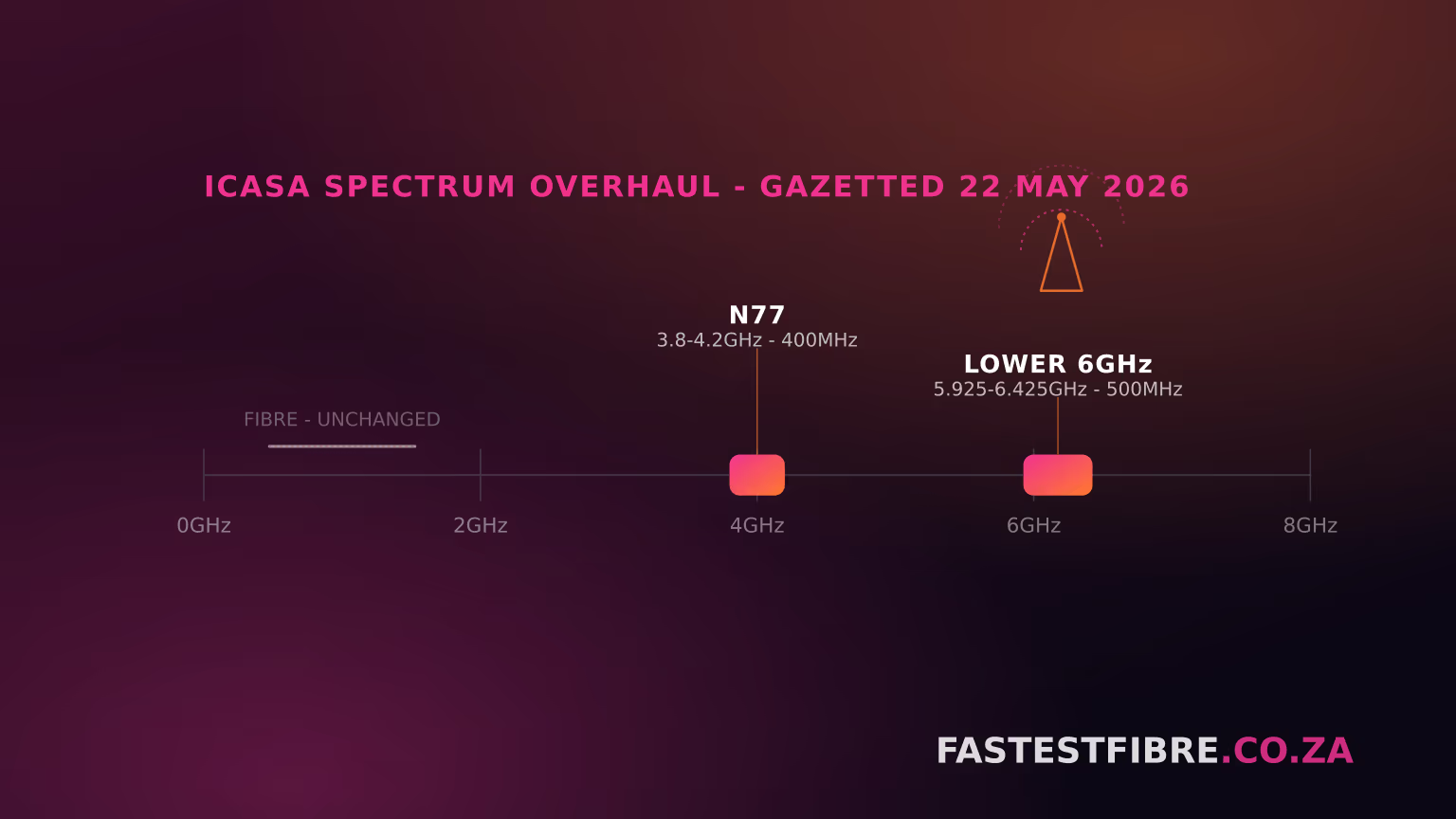
On 22 May 2026, the Independent Communications Authority of South Africa gazetted a new set of regulations - Dynamic Spectrum Access and Opportunistic Spectrum Management - that opened two bands of radio spectrum to licence-exempt, database-driven shared use. We fetched and read a detailed regulatory breakdown of exactly what changed directly today rather than relying on a summary.
| Metric | Value | Detail |
|---|---|---|
| Lower 6GHz band opened | 500MHz | 5.925-6.425GHz, licence-exempt shared access |
| N77 band opened | 400MHz | 3.8-4.2GHz, licence-exempt shared access |
| Total new capacity | 900MHz | Combined, across both bands |
| Gazetted | 22 May 2026 | Dynamic Spectrum Access and Opportunistic Spectrum Management regulations |
In practice, "licence-exempt" doesn't mean unregulated - it means operators don't need an individual Icasa licence to use the spectrum, but access is still coordinated through a database-driven sharing system (Icasa's own materials describe this as a "Unified Spectrum Switch") so multiple users don't collide on the same frequencies in the same place. That's a meaningfully lower barrier to entry than South Africa's traditional spectrum-licensing process, which is exactly why wireless ISPs - who typically can't afford to bid in a spectrum auction the way MTN or Vodacom can - are the ones most excited about it.
Icasa's own regulations name the intended beneficiaries directly: community networks, small businesses, and operators in rural or underserved areas. Nothing in the gazetted regulations names a specific home-broadband product, a coverage target, or a retail price - this is spectrum policy, not a product announcement.
WAPA's argument - and who's making it
On 20 August 2026, Paul Colmer - an executive member of the Wireless Access Providers' Association (WAPA), the industry body representing South African wireless ISPs - published an opinion piece making the case that this spectrum unlock changes fixed wireless's position relative to fibre. His central line, quoted directly: "Modern fixed wireless can now deliver the speed, capacity and reliability to be the first choice rather than the consolation prize."
His supporting argument, in brief: trenching fibre to dispersed rural populations is expensive per home reached ("no amount of enthusiasm changes the cost of trenching kilometres of road for a handful of customers," in his words), a single wireless site can serve several use cases at once (home broadband, business connectivity, CCTV backhaul, agricultural monitoring, IoT), and South Africa's relatively thin legacy copper network means the country never built the dense wired infrastructure that made wireless a consolation prize elsewhere.
It's a genuinely reasonable argument on its own terms - and it's worth being equally clear that it's an advocacy piece from an interested industry body, not independent testing or neutral reporting. WAPA's members are the operators who stand to benefit directly from more licence-exempt spectrum. That doesn't make the argument wrong; it does mean the claims deserve the same sourcing discipline this site applies to every operator announcement, price change or coverage claim it covers.
| Claim | Verification status |
|---|---|
| Lower 6GHz band (5.925-6.425GHz), 500MHz, licence-exempt | Confirmed - fetched directly from Webber Wentzel's regulatory analysis, itweb.co.za, 13 Aug 2026 |
| N77 band (3.8-4.2GHz), licence-exempt Dynamic Spectrum Access | Confirmed - same source |
| Regulations gazetted 22 May 2026, effective on publication | Confirmed - same source |
| "900MHz of new capacity" for wireless ISPs | WAPA's own framing, techfinancials.co.za, 20 Aug 2026 - arithmetically correct (500MHz + 400MHz) but WAPA's characterisation, not Icasa's own headline figure |
| "Modern fixed wireless can now deliver the speed, capacity and reliability to be the first choice rather than the consolation prize" | Direct quote, Paul Colmer, WAPA Executive Member, techfinancials.co.za, 20 Aug 2026 - an industry-association opinion piece, not independent reporting or a lab benchmark |
| No named operator, base station count, live coverage figure or retail price for either band | Not disclosed in either source - this is a regulatory and opinion story, not a product launch |
Fixed wireless vs fibre: how they actually compare
Strip away the advocacy framing and the underlying technology comparison between fibre and fixed wireless hasn't fundamentally changed - what's changed is how much spectrum wireless operators now have available to work with. Here's the practical comparison as it stands today, not as a hoped-for future state.
| Dimension | Fibre (today) | Fixed wireless (today) |
|---|---|---|
| Typical achievable speed today | 20Mbps-1Gbps+ symmetrical tiers, live on this site's catalogue | Varies widely by link and distance - WISP business links can hit several hundred Mbps; consumer 5G FWA (Rain, Vodacom) typically 100-250Mbps down |
| Latency and consistency | Consistently low, unaffected by weather or tower load | Can vary with distance, line-of-sight obstruction, weather and how many users share a sector |
| Speed to deploy at a new site | Requires trenching or duct access - can take weeks to months per street | A base station with a clear radio path can serve an area with no digging at all - WAPA's central argument |
| Cost to reach dispersed/rural homes | Trenching cost per home rises sharply the further apart homes are | One site can cover many dispersed homes - the economics favour wireless as density drops |
| Symmetrical upload speed | Common on fibre tiers, especially 100Mbps and up | Less commonly advertised on consumer FWA; varies by technology and licensed link type |
| Available to buy today at a typical home address | Yes, wherever construction has already passed your street | Consumer 5G/LTE FWA: yes, where covered. New-spectrum WISP links: mostly business-grade today, not yet a mainstream retail home product |
The honest summary: fibre keeps its edge in latency, consistency and symmetrical speed everywhere it's already built, because glass is physically unaffected by weather, interference or how many neighbours are online at once. Fixed wireless keeps its edge in how fast and cheaply it can reach a home fibre hasn't reached yet - and more available spectrum genuinely helps that case, by giving wireless operators more capacity to serve more simultaneous connections per site without everyone's speed dropping at peak time. That's a real technical benefit of the May 2026 spectrum opening. It isn't, on its own, evidence that fixed wireless now matches fibre's performance where fibre is already live.
How we got here: SA's wireless spectrum timeline
- 1 January 2022Comsol licensed C-band spectrum
Icasa licensed C-band spectrum to wireless operator Comsol in 2022 - a separate band from the two opened in May 2026, but part of the same broader shift toward giving wireless networks more usable spectrum for home and business broadband.
- 22 May 2026Innovation Spectrum regulations gazetted
Icasa's Dynamic Spectrum Access and Opportunistic Spectrum Management regulations were gazetted, opening the lower 6GHz band (500MHz) and the N77 band (400MHz) to licence-exempt, database-driven shared access - effective immediately on publication.
- 13 August 2026Regulatory detail published
Webber Wentzel published a detailed breakdown of the gazetted regulations, confirming the exact band ranges, the licence-exempt status of the lower 6GHz band, and the beneficiaries Icasa named: community networks, SMEs, and rural/underserved-area operators.
- 20 August 2026WAPA publishes its argument
Paul Colmer, an executive member of the Wireless Access Providers' Association, published an opinion piece arguing the new spectrum lets fixed wireless be "the first choice rather than the consolation prize" against fibre - an advocacy position from the industry body representing wireless ISPs, not a neutral report.
| Date | Milestone | What happened |
|---|---|---|
| 1 January 2022 | Comsol licensed C-band spectrum | Icasa licensed C-band spectrum to wireless operator Comsol in 2022 - a separate band from the two opened in May 2026, but part of the same broader shift toward giving wireless networks more usable spectrum for home and business broadband. |
| 22 May 2026 | Innovation Spectrum regulations gazetted | Icasa's Dynamic Spectrum Access and Opportunistic Spectrum Management regulations were gazetted, opening the lower 6GHz band (500MHz) and the N77 band (400MHz) to licence-exempt, database-driven shared access - effective immediately on publication. |
| 13 August 2026 | Regulatory detail published | Webber Wentzel published a detailed breakdown of the gazetted regulations, confirming the exact band ranges, the licence-exempt status of the lower 6GHz band, and the beneficiaries Icasa named: community networks, SMEs, and rural/underserved-area operators. |
| 20 August 2026 | WAPA publishes its argument | Paul Colmer, an executive member of the Wireless Access Providers' Association, published an opinion piece arguing the new spectrum lets fixed wireless be "the first choice rather than the consolation prize" against fibre - an advocacy position from the industry body representing wireless ISPs, not a neutral report. |
Who actually sells fixed wireless in South Africa today
This is the gap between the argument and the market: as of today, no operator has launched a named consumer product on either the lower 6GHz or N77 band that Icasa opened in May 2026. Consumer fixed wireless does already exist in South Africa - it's just running on different, previously licensed spectrum, and it's worth knowing what's actually buyable right now versus what's still an industry argument about future capacity.
| Operator | What it is | Typical price | Status |
|---|---|---|---|
| Rain (rainOne Home 5G) | Consumer 5G FWA | From around R649/month, uncapped | Live and buyable today - not on the new 6GHz/N77 spectrum |
| Vodacom (Fixed 5G) | Consumer 5G FWA | From around R599/month, uncapped | Live and buyable today - not on the new 6GHz/N77 spectrum |
| MTN (fixed wireless, part of its 30%-by-2030 push) | Consumer 5G/LTE FWA plus a stated fixed-wireless expansion strategy | Not fully disclosed for the fixed-wireless push | Existing 5G/LTE plans live; MTN's own stated ambition covers fibre, 5G and dedicated fixed wireless together - see our coverage of that target |
| Comsol (wholesale 5G-Advanced) | Wholesale FWA, C-band spectrum (licensed 2022, not the new bands) | No retail pricing - wholesale-only | Not yet retail anywhere; ISPs must resell on top of it first |
| Licensed WISPs using the new 6GHz/N77 bands | Point-to-point / point-to-multipoint business and community links | Not publicly listed - typically quoted per site | No named operator, live coverage map or consumer sign-up page found for either new band as of this article |
In other words: if you're weighing fixed wireless against fibre for your own home today, the products actually available to you are Rain's or Vodacom's existing 5G home plans (or MTN's, where its own fixed-wireless push has gone live) - not a new product built specifically on the May 2026 spectrum opening. That spectrum matters for the wireless industry's future capacity and cost base, which can flow through to better service or lower prices over time, but it isn't a separate sign-up option on the market this week.
Should you consider fixed wireless over fibre?
Fixed wireless or fibre - which fits your address?
The spectrum story is genuinely useful context, but the decision that actually matters is about what's buyable at your address today.
- Q1
Does fibre already reach your address?
- Yes → Fibre remains the stronger pick on latency, consistency and symmetrical speed for the vast majority of home use cases - check live deals before considering a switch.
- No, and I'm in a dense suburb where fibre construction is likely soon → Worth comparing an existing 5G plan (Rain or Vodacom) as a bridge option while you wait, rather than a long-term commitment - fibre's advantages are still real once it arrives.
- No, and I'm in a rural or dispersed area unlikely to get fibre soon → This is exactly the scenario WAPA's argument targets, and it holds up better here - a wireless link can realistically reach you sooner and cheaper than trenched fibre. Compare current 5G/LTE FWA options and ask any local WISP what's live in your area.
- Q2
Are you choosing based on the new spectrum specifically, or general fixed-wireless availability?
- Specifically the new 6GHz/N77 spectrum → Nothing to buy yet - no named operator has a live consumer product on either band. Treat this as a capacity story to watch, not a switch to make today.
- General fixed wireless, any technology → Real, live options already exist (Rain, Vodacom, MTN where covered) - compare their actual prices and coverage at your address against fibre rather than waiting on the spectrum story to produce a new product.
Bottom line
Icasa's May 2026 spectrum opening is real, confirmed against a detailed regulatory analysis, and genuinely useful to the wireless-ISP industry: 900MHz of combined new capacity across the lower 6GHz and N77 bands, available on a licence-exempt, database-coordinated basis, aimed squarely at community networks, SMEs and rural operators who can't compete for a traditional spectrum auction.
WAPA's argument that this makes fixed wireless "the first choice rather than the consolation prize" is a reasonable industry position, made by the industry body whose members benefit most directly from it being true - and it's not yet backed by a single named operator, base station count, coverage map or consumer price on either newly opened band. Until one of those things exists, the practical advice for a South African household hasn't changed: where fibre already reaches your address, it remains the stronger choice on the metrics that matter day to day. Where it doesn't, and especially in dispersed or rural areas, fixed wireless - today's live products, not a still-unlaunched one built on this specific spectrum - is a genuinely reasonable option worth comparing on price and coverage at your own address.
Frequently asked questions
Help someone else pick the right fibre
Now go and compare the deals
Prices below come from our own deal tracking, checked on 19 October 2026.
Ranked by price across every ISP and network we track.
See the dealsThe full catalogue in one sortable table - filter by speed, price or network.
See the dealsHow the major ISPs rank on price, support and real measured performance.
See the dealsRelated insights

Fibre vs LTE vs 5G in South Africa, Compared
Read article
Best 5G Home Internet in South Africa
Read article
Comsol's Wholesale 5G vs Fibre: What's Confirmed
Read article
MTN Wants to 'Own the Household': Inside Its Plan for 30% of SA's Home Internet Market
Read article
Icasa's 6GHz Wi-Fi Spectrum Decision, Explained
Read articleSA Fibre Benchmarks: Price, Speed and Network Data
Read article
Frogfoot Just Launched No-Contract Fibre From R399 - Here's What's In It
Read article
Frogfoot, Vox and Hypa Raise R14.4bn to Quadruple Township Fibre Rollout
Read article